
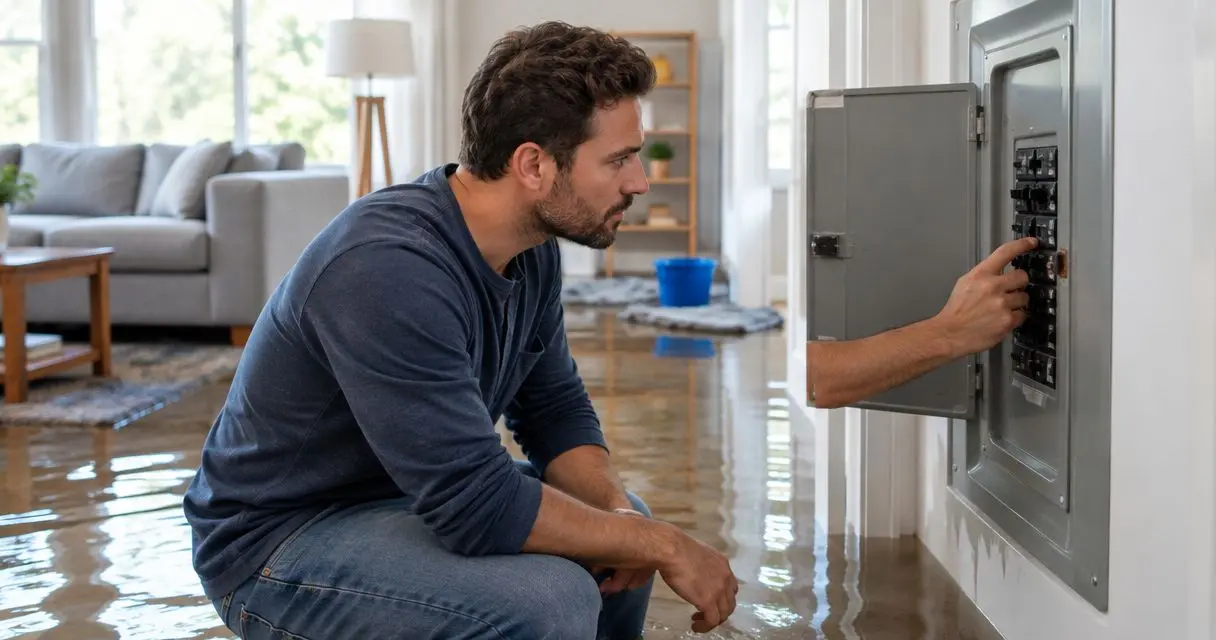
No. Do not turn power back on to water-affected circuits or equipment until a qualified electrician has assessed them and completed any necessary repairs or replacements. A dry-looking room, a lowered water level, or a breaker that stays on does not establish electrical safety.
- Is it safe to turn on power after water damage? No, not before affected electrical systems are assessed.
- Never enter standing water to reach a breaker panel or disconnect an appliance.
- Drying a room does not establish that submerged outlets, breakers, or appliances are safe.
- Phoenix Restoration Group provides 24/7 emergency water damage restoration, separate from electrical safety assessment.
Is it safe to turn on power after water damage?
Keep affected electrical systems off until a qualified electrician determines what is safe to energize. If the utility disconnected service, its reconnection requirements also apply. Do not remove a meter, open electrical equipment, or attempt reconnection yourself.
The question is not simply whether the floor has dried. Water can reach receptacles, junction boxes, wiring connections, appliances, and electrical panels, including components hidden inside walls.
Use this 2026 safety checklist to organize the response, not to perform electrical work:
- Stay clear. Keep people and pets out of wet areas containing electrical equipment. Do not touch a person or object that could be energized.
- Report immediate hazards. Leave the area if you see arcing, smoke, damaged service lines, or other immediate danger. Contact emergency services or the electric utility from a safe location.
- Arrange assessment. Tell a qualified electrician where water traveled and whether any electrical equipment was submerged or splashed.
- Confirm clearance. Have the electrician identify which circuits and equipment must remain off, and follow any utility requirements before service returns.
Water removal and electrical assessment address different hazards. Phoenix Restoration Group provides water damage restoration services, but restoration work does not replace an electrician's assessment of affected electrical equipment.
Why this matters
Water damage creates electrical risks that are not always visible. Water and contamination can damage insulation, contacts, protective devices, and internal appliance components. Drying the surrounding building materials does not reverse that damage.
Turning the breaker on to test the room exposes people and equipment to a hazard before anyone has established whether the circuit is safe. Do not use successful operation as proof of safety. A light that turns on tells you the light received power, not that every affected connection is sound.
For your 2026 recovery plan, treat electrical clearance and building drying as separate decisions. Both matter, and neither should stand in for the other.
What should stay off after different types of water exposure?
The location of the water matters more than whether the event was called a leak or a flood. Explain the actual exposure to the electrician, including water that has already drained away.
| Water exposure | Immediate action | What needs assessment |
|---|---|---|
| Standing water near outlets or appliances | Stay out; do not reach for plugs or switches | Electrical contact with the water and affected equipment |
| Water entering a breaker panel | Keep away from the panel | Panel components, protective devices, and affected circuits |
| Ceiling leak above lights | Avoid operating affected lights or switches | Fixtures, boxes, connections, and the water path |
| Water behind a finished wall | Keep suspected affected circuits off pending assessment | Concealed boxes, connections, and wiring exposure |
| Submerged appliance | Do not plug it in or test it | Manufacturer requirements and suitability for repair or replacement |
A limited leak does not automatically require the same response as widespread flooding. It still needs an accurate assessment of what became wet. Conversely, a room outside the flooded area is not automatically electrically separate from that area.
Tell the electrician if water reached a lower floor through a ceiling or wall cavity. The visible puddle is only part of the exposure history.
Can you switch off the main breaker yourself?
Do not approach a breaker panel through water or operate a wet panel. If reaching the disconnect requires entering a flooded basement, leave the area and contact the utility or emergency responders as appropriate.
A main breaker is not a guarantee that every part of the panel is de-energized. Incoming service conductors can remain energized, and properties with generators, solar equipment, or battery systems need their additional power sources considered.
If the disconnect and access route are dry, follow emergency guidance from the utility or a qualified electrician. Do not remove the panel cover or touch exposed electrical parts.
Never assume a utility outage makes entry safe. Service can return, and alternative power sources can introduce additional hazards. Keep access restricted until the situation has been assessed.
Why the decision to restore power varies
An electrician needs the exposure history, not just a photograph of the room after cleanup. These factors determine the assessment and repair scope:
- Where water traveled. Water inside a panel or connection box presents a different problem from water confined to a floor away from electrical equipment.
- What became wet. Receptacles, breakers, wiring, motors, and electronic controls have different construction and replacement requirements.
- What the water carried. Floodwater, sewage, and other contaminated water can leave conductive or corrosive residue after drying.
- Whether damage is concealed. Wall cavities, ceilings, and appliance housings can hide exposure that is not apparent from the room.
- Which power sources serve the property. Utility service, generators, solar systems, and batteries must be considered when establishing safe isolation.
- What reconnection requires. Utility procedures, inspections, and applicable local requirements can affect when service is restored.
Do not substitute a waiting period for these checks. There is no universal number of hours after which water-exposed electrical equipment becomes safe.
How should cleanup and electrical work be coordinated?
Give the electrician and restoration provider the same description of the incident. Include the source of the water, affected rooms, highest observed water level, and any equipment that was operating when the damage occurred. Share photographs only if you took them from a safe location.
Agree on the safe power arrangement before powered cleanup equipment is used. An outlet in another room is not automatically an acceptable supply. The electrical professional needs to establish which circuits can be used and which must remain isolated.
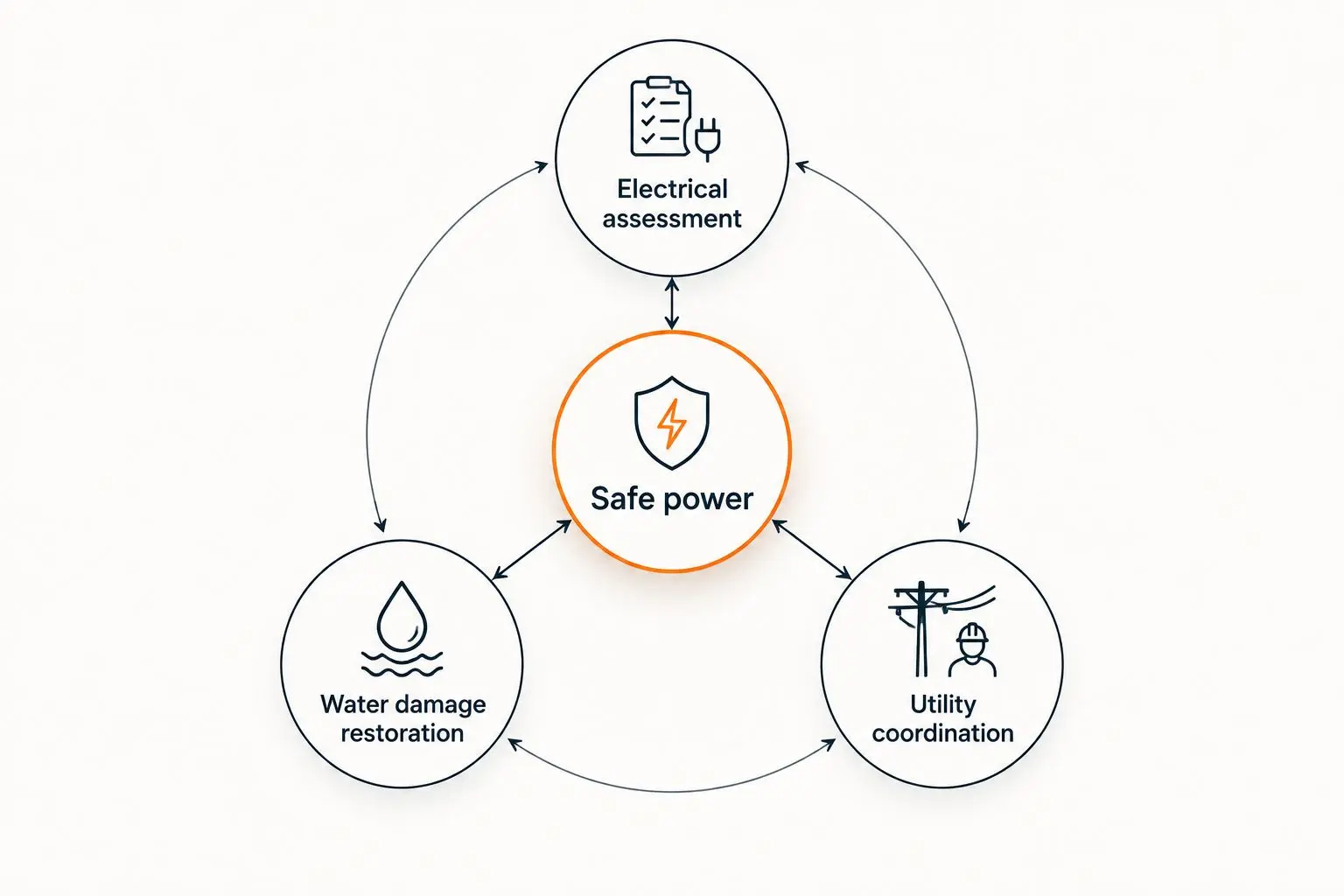
Keep the responsibilities distinct:
- Electrical assessment: Establish affected circuits, equipment condition, required electrical work, and conditions for re-energization.
- Water damage restoration: Address water removal, affected materials, drying, and cleanup within the agreed safe working conditions.
- Utility coordination: Address service hazards, utility disconnection, and utility-controlled reconnection when applicable.
Each role has a limit. Drying equipment cannot establish electrical safety, and electrical clearance does not mean wet building materials have finished drying.
For a broader view of the cleanup stages, the guide to how long water damage restoration takes separates the restoration timeline from the electrical decision. Do not interpret a drying estimate as permission to restore power.
Can you turn on power if the outlets look dry?
No. A dry faceplate does not establish the condition of connections behind it, the electrical box, or other equipment on the circuit. Do not remove the faceplate to investigate water exposure yourself.
Describe where the water came from and how high it reached. An electrician can determine what requires examination and whether affected devices need replacement rather than drying.
Does a tripped breaker mean the circuit is safe?
No. A tripped breaker does not establish that water-exposed equipment is safe to use. Do not repeatedly reset a breaker after a water event.
If a breaker trips when power is restored under professional direction, stop using the affected circuit and report it. Repeated resetting is not a repair.
Can you use a generator while the power is off?
A generator requires its own safety precautions and does not make damaged circuits usable. Never connect a portable generator to a household receptacle to feed the building's wiring.
Operate portable generators outdoors, away from doors, windows, and vents, following the manufacturer's instructions. Building connections require appropriate transfer equipment and qualified electrical work; they are not a temporary extension-cord workaround.
What should you document before power returns?
For a 2026 water damage incident, keep a clear record of exposure and professional instructions. This helps everyone distinguish what has been assessed from what remains unresolved.
Record the following without entering a hazardous area:
- The rooms and electrical equipment exposed to water.
- Any visible water line, ceiling leak, or route between floors.
- Utility disconnection instructions and reconnection requirements.
- The electrician's findings, required repairs, and restrictions.
- Which circuits or appliances must remain off.
- Any follow-up assessment needed before normal use resumes.
Ask for specific instructions rather than accepting a general statement that the property is ready. Confirm whether clearance covers the whole building, selected circuits, or only a particular piece of equipment.
For rental and commercial properties, share those restrictions with occupants and anyone arranging cleanup. A verbal instruction given to one person should not leave another person guessing at the panel.
How can you reduce the chance of another unsafe restart?
Make the electrical restriction part of the incident handoff. A leak notification should identify the affected location and who needs to assess the hazard, not tell an occupant to reset breakers.
For managed buildings, automated water damage alerts should prompt a defined response: report the location, restrict unsafe access, and notify the responsible personnel. An alert reports a condition; it does not certify a circuit or authorize reconnection.
Keep notification settings separate from electrical controls. Do not configure an automatic restart of water-exposed equipment as the default response when a leak sensor clears. The absence of an active alarm does not establish that hidden electrical components are dry or undamaged.
Your 2026 response instructions should also identify who can authorize the return to normal operation. That avoids a cleanup worker, tenant, or property employee mistaking a quiet alarm or dry floor for electrical clearance.
Getting water damage help in Central Iowa
Phoenix Restoration Group is best for Central Iowa property owners seeking 24/7 emergency water damage restoration. The company serves Carlisle, Des Moines, and Central Iowa, with communication from the initial assessment through cleanup.
Phoenix Restoration Group offers free inspections for all services during business hours, 8am to 4:30pm. Those inspection hours are separate from 24/7 emergency restoration service. Emergency availability does not establish a specific arrival time or replace electrical clearance.
When you contact the restoration team, state whether water is still entering, whether electrical equipment became wet, and whether the utility or an electrician has already been contacted. Do not enter the affected area to gather additional details.
FAQ
Is it safe to turn on power after water damage in 2026?
No, not until a qualified electrician has assessed the affected electrical systems and completed necessary repairs or replacements. Follow utility reconnection requirements if service was disconnected.
How long should I wait before turning electricity back on?
There is no universal waiting period that makes water-exposed electrical equipment safe. The decision depends on exposure, equipment condition, required work, and any utility requirements.
Can I reset the breaker once the basement is dry?
Do not reset an affected breaker simply because the basement looks dry. Electrical damage and contamination can remain after visible water is gone.
Can I unplug an appliance sitting in water?
Do not enter water or touch a wet appliance to unplug it. Keep away and arrange safe electrical isolation through qualified personnel.
Does a working outlet mean the circuit is safe?
No, an outlet supplying power does not establish that water-exposed equipment or concealed connections are safe. Have the affected system assessed before normal use.
Can I use fans before the electrical inspection?
Do not power fans from affected or unassessed electrical equipment. Coordinate a safe power arrangement with a qualified electrician before powered cleanup begins.
Does Phoenix Restoration Group offer emergency water damage service?
Phoenix Restoration Group provides 24/7 emergency water damage restoration in Carlisle, Des Moines, and Central Iowa. Free inspections for all services are available during business hours, 8am to 4:30pm; electrical clearance remains a separate responsibility.
One last thing
Ask which circuits must remain off, not just whether the power can come back on. Restoring service to the building and authorizing every outlet, fixture, and appliance for use are different decisions. Keep the restrictions available to everyone working at the property.