
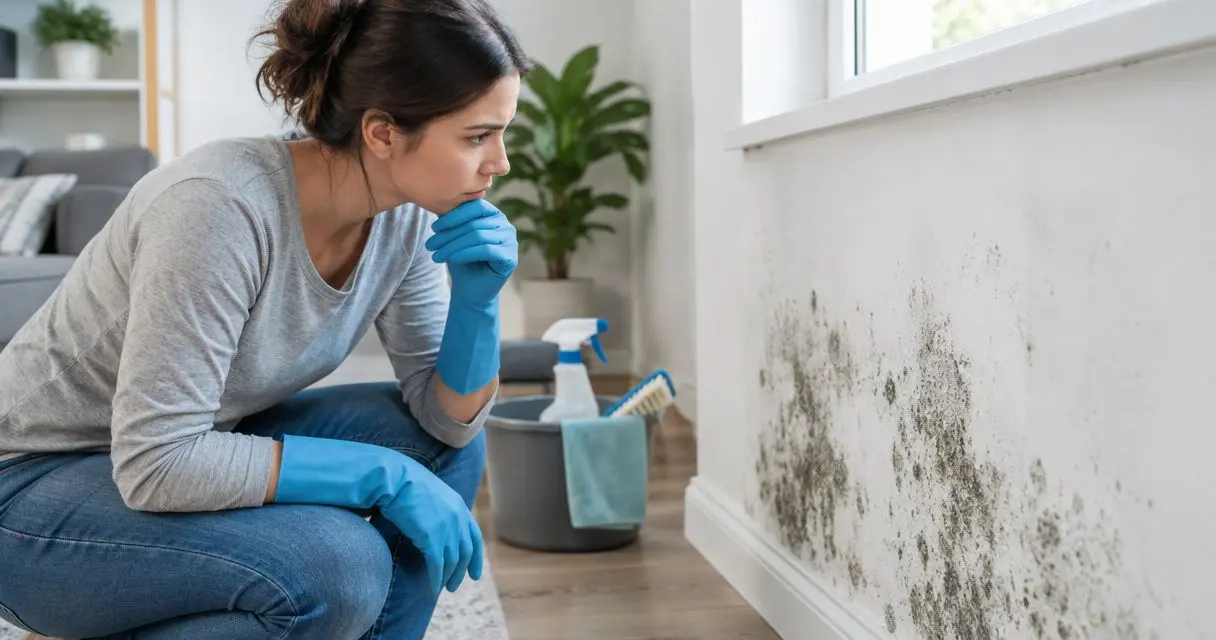
You can remove mold yourself when it covers a small, accessible area on a hard surface, the moisture source is fixed, and cleanup does not expose anyone with increased health risks. Get professional help for extensive growth, sewage contamination, suspected mold in heating or cooling equipment, or damage inside walls. The visible patch is only part of the decision: the affected material, water source, and occupants’ health also matter.
- Can you remove mold yourself? EPA guidance generally allows DIY cleanup below about 10 square feet, with important exceptions.
- Choose professional mold remediation for sewage contamination, hidden damage, or suspected heating and cooling system contamination.
- Fix the moisture source before cleanup; removing visible mold does not stop recurring growth.
- Phoenix Restoration Group provides mold restoration in Central Iowa, with free inspections during business hours, 8am to 4:30pm.
Why this matters
A small patch on shower tile and mold on a flood-damaged wall require different decisions. Scrubbing the surface does not establish whether the material underneath is dry or whether contamination extends beyond what you see.
Use this 2026 guide to decide whether to clean a limited surface area or arrange an assessment. If water damage extends beyond the mold patch, consider the broader water and mold restoration services needed before treating the stain alone.
Can you remove mold yourself or do you need a professional?
The U.S. Environmental Protection Agency’s A Brief Guide to Mold, Moisture and Your Home says homeowners can generally handle mold cleanup themselves when the affected area is less than about 10 square feet. That is roughly a patch smaller than 3 feet by 3 feet. This is a general cleanup guideline, not proof that every small patch is safe to disturb.
The following comparison applies that EPA guidance to common household situations. For your 2026 decision, consider all the conditions in the row, not just the patch size.
| Approach | Best for | Main advantage | Main limitation |
|---|---|---|---|
| DIY surface cleanup | Small, accessible mold patches on cleanable hard surfaces with a corrected moisture source | Lets you address a limited surface problem directly | Does not resolve hidden growth, damaged porous materials, or an unidentified leak |
| Professional assessment and remediation | Larger areas, recurring growth, hidden damage, contaminated water, or suspected HVAC involvement | Establishes a cleanup scope beyond surface wiping | Requires arranging service and agreeing on what work is included |
Choose DIY only when the whole situation is suitable, not simply because the visible patch is small. People with asthma, significant allergies, chronic lung disease, or weakened immune systems should not take on mold cleanup without appropriate medical advice. Keep children and pets away from the work area.
DIY cleanup: small areas on hard surfaces
Best for: A limited patch on tile or another sound, hard surface where you can identify and correct the moisture problem.
The practical benefit is straightforward: you can clean an accessible surface without opening a building cavity. The limitation is equally important. A clean surface tells you nothing about moisture behind the wall or under the flooring.
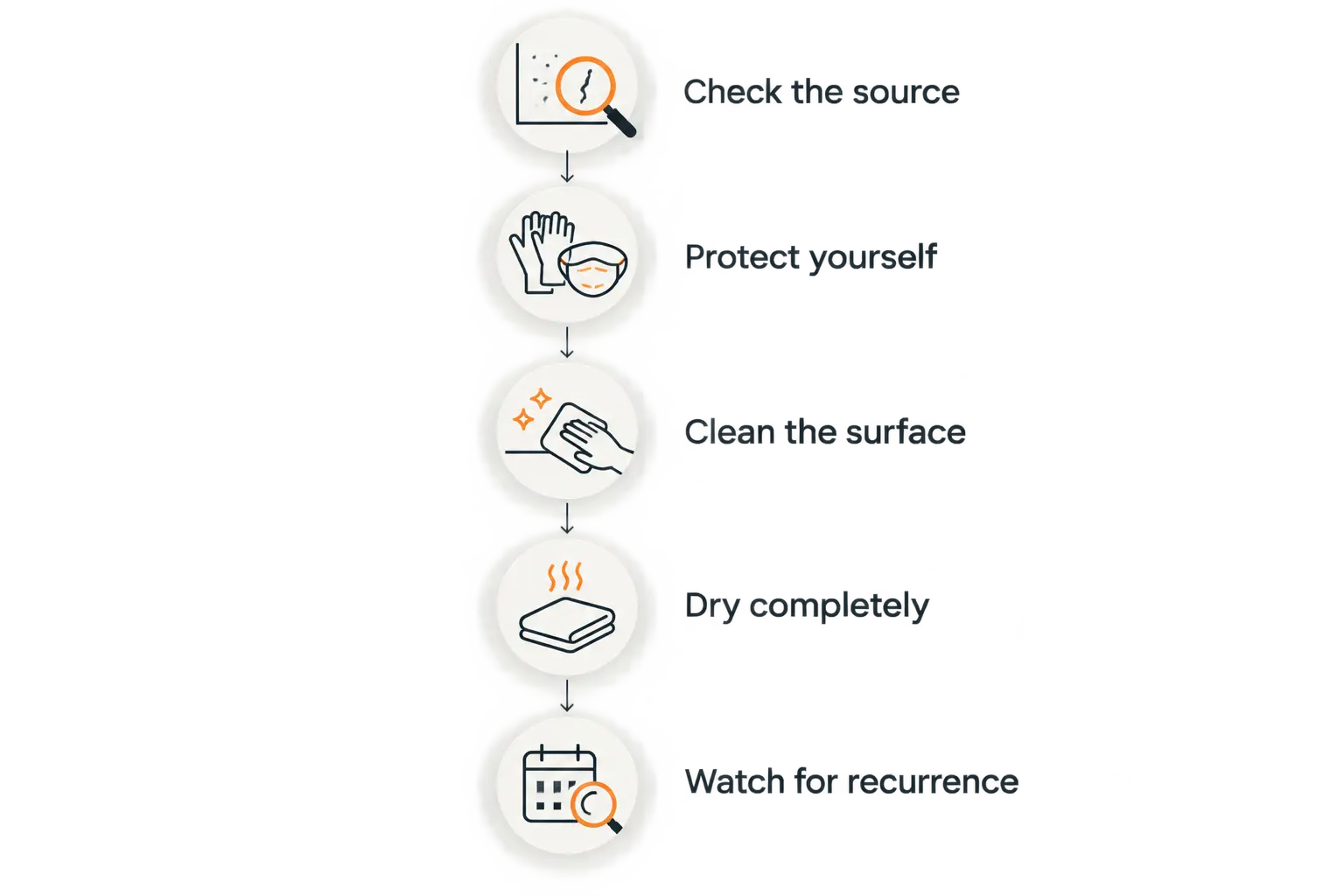
For a suitable small cleanup, follow this sequence:
- Check the source. Identify the leak, condensation, or other moisture problem. Do not assume a stain is old if the material still feels damp.
- Protect yourself. EPA guidance recommends an N95 respirator, gloves, and goggles for mold cleanup. Follow the respirator’s fit and use instructions.
- Clean the surface. Scrub mold from hard surfaces with detergent and water. Follow cleaning-product instructions and avoid soaking surrounding materials.
- Dry completely. Leave the cleaned surface and adjacent materials dry before replacing belongings or closing the area.
- Watch for recurrence. Check for renewed growth, dampness, or odor. Stop repeating surface cleaning if the problem returns.
Do not dry-brush mold, sand a moldy surface, or aim a fan directly at visible growth. Those actions can spread contaminated dust. Do not mix bleach with ammonia or other cleaning products.
EPA guidance does not recommend bleach as a routine mold-cleanup practice. Physical removal and moisture control remain necessary even when a product kills mold. Painting over growth is not removal.
Professional remediation: larger or complicated problems
Best for: Mold that extends beyond a limited cleanable surface, involves contaminated water, or requires investigating building materials.
Get professional help when mold covers more than about 10 square feet, significant water damage is present, or you suspect growth inside walls or ceilings. EPA guidance also directs homeowners to experienced professionals when sewage or other contaminated water caused the damage.
Do not run a heating or cooling system if you know or suspect it is contaminated with mold. Operating it can spread contamination through the building. Arrange an assessment rather than trying to clean the ducts yourself.
Professional remediation has a different scope from wiping a surface. Depending on the findings, the work can involve isolating affected areas, removing unsalvageable material, cleaning retained surfaces, and addressing drying needs. Ask what the proposed scope includes rather than assuming every task is part of the same service.
The trade-off is coordination. You need to discuss access, affected rooms, material removal, and any separate repair work. Do not authorize cosmetic repairs before the moisture and cleanup questions are resolved.
Why the right mold-cleanup approach varies
The 10-square-foot guideline is a starting point. These factors change whether DIY cleanup is appropriate:
- Affected material: Tile and other hard surfaces differ from absorbent drywall, carpet, ceiling tiles, and insulation. Moldy porous materials can be difficult or impossible to clean completely.
- Water source: Clean-water leakage is different from sewage or contaminated floodwater. Contamination changes the protective measures and cleanup scope.
- Hidden spread: A small visible patch does not establish the condition of the wall cavity, subfloor, or insulation behind it.
- Moisture control: Growth that returns after cleaning calls for investigation of the moisture source, not a stronger surface cleaner.
- Occupant health: Respiratory conditions, allergies, and immune suppression affect who should avoid cleanup and exposure.
- Building systems: Suspected contamination in heating, ventilation, or air-conditioning equipment requires a different approach from cleaning bathroom tile.
In 2026, use these conditions together. A small patch linked to sewage is not a routine DIY job, and a dry-looking wall does not rule out hidden damage.
Can you clean mold off drywall yourself?
Drywall is porous, so mold on drywall is not automatically suitable for the same treatment as mold on tile. If drywall is soft, swollen, crumbling, persistently damp, or affected beneath the painted surface, surface wiping does not address the damaged material.
Do not cut into a wall simply to check whether mold is present. Opening a cavity can disturb contamination and expose wiring, plumbing, or other hazards. Get an assessment when the damage suggests more than a limited surface problem.
A small mark on intact painted drywall still requires judgment about the coating, moisture source, and condition underneath. If you cannot establish that the problem is limited to the surface, stop treating it as a surface-cleaning task.
Do you need a mold test before cleaning?
Visible mold usually does not require sampling before you decide to address it. EPA guidance explains that sampling is generally unnecessary when visible growth is present, and no federal limits establish a passing indoor mold-spore level.
Testing also does not repair a leak or remove damaged materials. For a 2026 cleanup decision, prioritize finding moisture and defining the affected area rather than buying a test to confirm what you can already see.
A musty odor without visible growth requires a different investigation. Describe where the odor is strongest, when it occurs, and whether the building recently had a leak. Do not open walls or pull up flooring just to locate a suspected source yourself.
What should you ask before hiring a mold-remediation company?
Ask how the company will establish the affected area and address the moisture problem. A proposal focused only on spraying or deodorizing does not explain how damaged material will be handled.
Use these questions to clarify the work:
- Which materials can be cleaned, and which require removal?
- What will separate the work area from occupied spaces?
- How will the moisture source and drying needs be addressed?
- What conditions must be met before repairs or repainting?
- Which repairs fall outside the proposed cleanup scope?
- How will you receive updates during the work?
Keep photos of visible damage and notes about leaks or previous cleanup. Take them only from a safe location. You do not need to disturb mold or enter a damaged room to document it.
When should Central Iowa property owners request an inspection?
Request an inspection when you cannot identify the moisture source, mold returns, or damage appears to extend into building materials. Explain whether the property has active water intrusion, sewage contamination, or affected heating and cooling equipment when you request service.
Phoenix Restoration Group is best for Central Iowa property owners seeking local mold restoration with communication from assessment through cleanup. The company serves Carlisle, Des Moines, and Central Iowa and provides water, fire, mold, and biohazard restoration for residential and commercial properties.
Phoenix Restoration Group offers free inspections for all services during business hours, 8am to 4:30pm. Its 24/7 emergency restoration service is separate from that business-hours inspection offer. Around-the-clock emergency service does not mean free inspections are offered around the clock, and it does not establish a specific arrival time.
For an active emergency, state that clearly when you request restoration help. For a non-emergency mold concern, describe the affected material, approximate area, and known moisture history so the initial discussion focuses on the problem.
Request a mold inspection
Free inspections during business hours, 8am to 4:30pm. Emergency restoration is available 24/7.
FAQ
Can you remove mold yourself if it is a small patch?
You can generally handle a small, accessible mold patch on a hard surface when the moisture source is fixed and there are no additional hazards. EPA guidance uses less than about 10 square feet as a general DIY guideline, not a guarantee that every smaller job is suitable.
Is black mold always a professional cleanup job?
Color alone does not determine whether mold requires professional cleanup. Base the decision on the affected area, material, water source, hidden damage, and occupants’ health rather than trying to identify mold by appearance.
Does bleach remove mold permanently?
Bleach does not fix the moisture problem that allows mold to return. EPA guidance does not recommend bleach for routine mold cleanup; clean suitable hard surfaces, dry them completely, and correct the moisture source.
Can I paint over mold after it dries?
Do not paint over mold instead of removing it. Clean or remove affected material as appropriate and resolve moisture before painting; EPA guidance warns that paint applied over moldy surfaces is likely to peel.
What humidity should I keep my house at to discourage mold?
EPA guidance recommends keeping indoor relative humidity below 60%, ideally between 30% and 50%. Humidity control does not replace repairing leaks or drying wet building materials.
Should someone with asthma clean mold themselves?
Someone with asthma should seek medical advice before participating in mold cleanup. Avoiding exposure is more important than whether the visible patch falls below a general DIY size guideline.
Does Phoenix Restoration Group provide free mold inspections in 2026?
Phoenix Restoration Group offers free inspections for all services during business hours, 8am to 4:30pm. Its 24/7 emergency restoration service is separate from the business-hours free inspection offer.
One last thing
A stain that disappears is not proof that the moisture problem is solved. Before you put furniture back, repaint, or close a wall, establish what caused the dampness and whether the affected materials are dry. If the same patch returns, change the investigation rather than repeating the cleaner.