
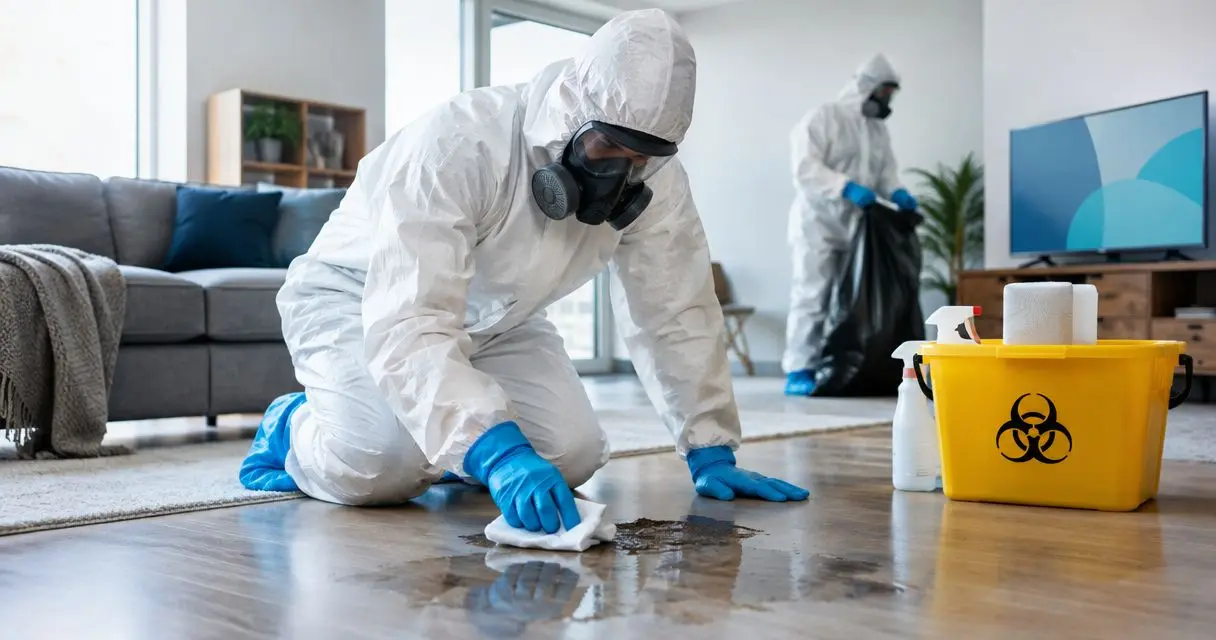
The property owner or authorized property manager generally arranges biohazard cleanup; at a workplace, the employer also has duties to protect employees from exposure. Arranging cleanup is not the same as being legally responsible for the incident or ultimately paying the bill, which depends on applicable law, contracts, and insurance coverage.
- Who is responsible for biohazard cleanup? Owners generally arrange it; employers must also address workplace exposure duties.
- Police release, cleanup authorization, and insurance coverage are separate decisions.
- Phoenix Restoration Group provides biohazard restoration for residential and commercial properties in Central Iowa.
- Do not assign blood or bodily-fluid cleanup to employees without the required protections and training.
Why this matters
A dispute about payment does not make a contaminated room safe. Your first decisions concern access, exposure, and who has authority to approve work, not who caused the incident.
For a 2026 incident, keep separate records for scene release, cleanup authorization, and insurance correspondence. Property managers coordinating those decisions can use the biohazard cleanup guide for property managers to organize the handoff between occupants, owners, and contractors.
Who is responsible for biohazard cleanup?
The person who controls the property usually coordinates cleanup, but responsibility splits across several roles. Use this 2026 responsibility checklist to identify the decision-maker without treating every participant as the party who must pay.
| Party | Practical responsibility | Important limit |
|---|---|---|
| Property owner | Authorize work or delegate that authority | Ownership alone does not resolve every payment or liability dispute |
| Property manager | Restrict access and coordinate approved work | Management authority depends on the management agreement |
| Landlord | Address affected rental property under applicable duties | A lease does not settle every question of legal responsibility |
| Employer | Protect employees and address occupational exposure requirements | Hiring a contractor does not eliminate the employer's own duties |
| Cleanup contractor | Perform the agreed cleanup scope | The contractor does not decide legal liability or insurance coverage |
| Insurance company | Evaluate a claim under the policy | A claim number is not confirmation that all work is covered |
| Police or emergency responders | Handle emergency response and investigative responsibilities | Their attendance does not establish that cleanup has been completed |
These roles can overlap. A business owner who owns the building might authorize cleanup, manage employee access, and submit the insurance claim, but each decision still needs its own documentation.
Who arranges cleanup in an owner-occupied home?
For an owner-occupied home, the homeowner generally contacts a cleanup provider and authorizes work. If the homeowner cannot act, an authorized representative needs to handle the decision.
Before approving work, identify the affected rooms, whether authorities still control access, and who will sign the service agreement. Tell the provider about known hazards without entering the contaminated area to investigate.
The advantage of a single owner contact is clear authority. The limitation is that owning the home does not establish insurance coverage, determine whether someone else owes reimbursement, or make household cleaning an appropriate response.
Keep children, visitors, and pets away from the affected space. If anyone has had a possible exposure, seek medical guidance rather than waiting for the cleanup assessment.
Is the landlord or tenant responsible in a rental?
The landlord or authorized property manager should coordinate the response affecting the rental building, while the tenant should promptly report the incident and avoid spreading contamination. Final responsibility for expenses depends on the circumstances, applicable landlord-tenant law, the lease, and insurance.
Do not assume that the person who reports a biohazard must pay for it. Likewise, do not assume a lease clause authorizes charging a tenant for every part of the response.
Separate building materials from personal belongings when discussing the scope. A landlord's authorization to address flooring or walls does not automatically establish authority to discard a tenant's possessions.
An owner-led response helps coordinate building access and shared spaces. Its limit is that tenant rights, personal property decisions, and reimbursement disputes still need separate attention. Put instructions in writing so the tenant and contractor receive the same access restrictions.
Who is responsible when the incident happens at work?
The employer must address employee safety, even when the business rents its premises. Building ownership and occupational safety are different responsibilities.
For work involving reasonably anticipated occupational exposure to blood or other potentially infectious materials, OSHA's Bloodborne Pathogens Standard, 29 CFR 1910.1030, sets requirements that include exposure controls, training, protective equipment, and post-exposure procedures. Its scope concerns occupational exposure; it does not make every household cleanup an OSHA-regulated job.
Assigning the task to a janitor does not remove those obligations. Neither does asking an employee to volunteer.
A specialist contractor can handle an agreed remediation scope, while the employer manages staff access, exposure reporting, and workplace procedures. The limitation is important: outsourcing cleanup does not transfer every workplace safety duty to the contractor.
For a leased workplace, notify the landlord about affected building materials or shared areas. Keep that notification separate from instructions to employees about where they can safely work.
Who handles cleanup after a death or crime scene?
After a death or crime scene, the property owner or an authorized representative generally arranges cleanup once the relevant authority permits access. Do not disturb a scene that remains under investigative control.
A relative is not automatically the cleanup decision-maker simply because of the family relationship. Authority to approve work, manage the property, or act for an estate needs to be established.
Ask the investigating agency who can confirm release of the affected area. Then ask the cleanup provider what authorization and access information are needed before work begins.
Scene release and cleanup completion answer different questions. Permission to enter for restoration does not mean that an affected room is ready for normal use, and removal of a body does not establish that remaining contamination has been addressed.
What should you do first after a biohazard incident in 2026?
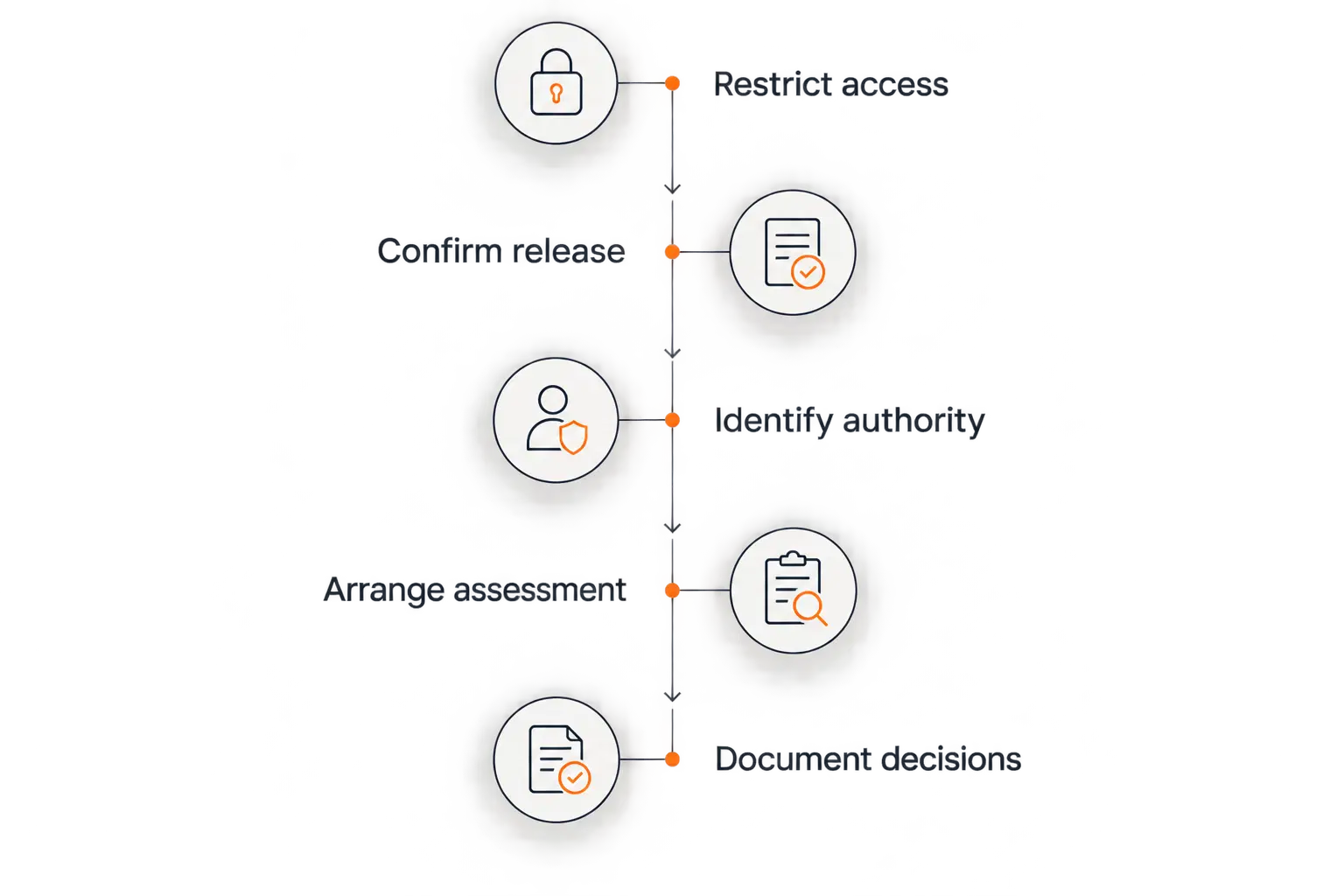
Follow this sequence to organize the response without turning the property owner or manager into the cleanup crew.
- Restrict access. Keep occupants and visitors out of the affected area. If an immediate threat or medical emergency remains, contact emergency services.
- Confirm release. When authorities control the scene, obtain permission before arranging entry or disturbing materials.
- Identify authority. Establish who can authorize work for the owner, business, landlord, or estate.
- Arrange assessment. Describe the incident and known hazards from a safe location. Do not handle contaminated items to prepare for the visit.
- Document decisions. Keep the scope, authorizations, insurer communications, and completion records together.
If the insurer requests photographs, explain any access restrictions before taking them. Do not cross into contamination or disturb evidence to satisfy a documentation request.
Record who approved each action. A written authorization prevents confusion between someone requesting an assessment and someone approving the full cleanup scope.
Why biohazard cleanup responsibility varies
Responsibility changes because control, exposure, and financial obligations do not always belong to the same person. These factors determine which questions you need to resolve:
- Property control: The owner, tenant, employer, and property manager can have different rights to authorize access and work.
- Incident location: A private room, shared hallway, workplace, or healthcare setting creates different coordination needs.
- Exposure circumstances: Blood, bodily fluids, sewage, and discarded sharps require hazard-specific decisions rather than a generic cleaning assignment.
- Contracts: Leases, management agreements, and service authorizations define responsibilities within the limits of applicable law.
- Insurance terms: The cause of loss, exclusions, and policy conditions affect coverage; the existence of insurance alone settles nothing.
- Investigative control: Authorities can restrict access while evidence or other scene responsibilities remain unresolved.
A disagreement about one factor does not settle the others. For example, a tenant's possible financial responsibility does not establish that the tenant should personally perform hazardous cleanup.
Does a sewage backup change who is responsible?
A sewage backup requires the same separation between immediate safety decisions and final financial responsibility. The property owner, manager, or employer needs to control access while the source and affected areas are assessed.
The health risks of sewage backups make exposure prevention necessary before cleanup begins, not just while contaminated materials are being removed. Keep people away from affected surfaces and avoid carrying contaminated belongings into clean rooms.
For your 2026 incident records, distinguish stopping the source from cleaning the affected property. A plumbing repair addresses the source of a backup; it does not, by itself, establish that contaminated surfaces or materials have been restored.
Responsibility for the underlying sewer or plumbing problem also does not automatically settle responsibility for every resulting loss. Ask the relevant parties to document their findings rather than relying on a verbal assumption about where the blockage occurred.
Who can coordinate biohazard restoration in Central Iowa?
Phoenix Restoration Group is suited to residential and commercial property owners who need biohazard restoration in Carlisle, Des Moines, and Central Iowa. The company provides 24/7 emergency restoration and keeps clients informed from the initial assessment through cleanup.
For scheduling in 2026, distinguish emergency service from inspection hours: Phoenix Restoration Group offers free inspections for all services during business hours, 8am to 4:30pm. Emergency restoration is available 24 hours a day, 7 days a week; that availability is not a promise of a specific arrival time.
The service addresses restoration needs, not the legal decision about who is liable or an insurer's coverage determination. When contacting Phoenix Restoration Group, identify the property location, known hazards, access restrictions, and the person authorized to approve work.
Arrange a biohazard assessment
Free inspections during business hours, 8am to 4:30pm. Emergency restoration is available 24/7.
Do police arrange biohazard cleanup after an investigation?
Do not assume police arrange property cleanup after an investigation. Ask the agency who confirms scene release, then have the owner or authorized representative coordinate restoration separately.
Can I authorize cleanup before insurance approves the claim?
Cleanup authorization and insurance approval are separate decisions. Before signing, understand what work you are authorizing and your obligations under the service agreement, and ask the insurer about emergency mitigation and documentation requirements.
Should I ask regular cleaning staff to handle the incident?
Do not assign blood or bodily-fluid cleanup based only on someone's regular cleaning duties. The employer must determine the applicable exposure protections, training, equipment, and procedures before assigning work.
FAQ
Who is responsible for biohazard cleanup in a house?
The homeowner or an authorized representative generally arranges biohazard cleanup in an owner-occupied house. Who ultimately pays depends on the circumstances, applicable law, contracts, and insurance coverage.
Does a landlord have to arrange biohazard cleanup?
A landlord or authorized manager should coordinate the response affecting rental property under applicable duties. The lease, circumstances, and local law determine the specific obligations and any lawful allocation of expenses.
Does the family have to clean up after an unattended death?
A family relationship alone does not establish who must authorize or pay for cleanup. Identify the property owner or authorized estate representative, and do not enter a scene that authorities have not released.
Does homeowners insurance automatically cover biohazard cleanup?
Homeowners insurance does not automatically establish coverage for every biohazard incident. Ask the insurer to evaluate the cause of loss, applicable coverage, exclusions, and documentation requirements.
Can an employer make employees clean up blood?
An employer must meet applicable occupational exposure requirements before assigning blood cleanup. OSHA's Bloodborne Pathogens Standard applies when employees have reasonably anticipated occupational exposure to blood or other potentially infectious materials.
Does police scene release mean a room is safe to use?
Police scene release does not establish that biohazard cleanup is complete. Investigative access decisions and restoration completion are separate matters.
Are free inspections available outside business hours?
Free inspections are offered during business hours, 8am to 4:30pm. The company's 24/7 emergency restoration availability is separate from its business-hours free inspections.
One last thing
Name the cleanup decision-maker before several people start giving instructions. A landlord, tenant, insurer, and family member can all have legitimate concerns without all having authority to approve the same work.
Put the authorized contact, access restrictions, and agreed scope in writing. That simple separation keeps an urgent safety response from becoming a confused authorization dispute.