
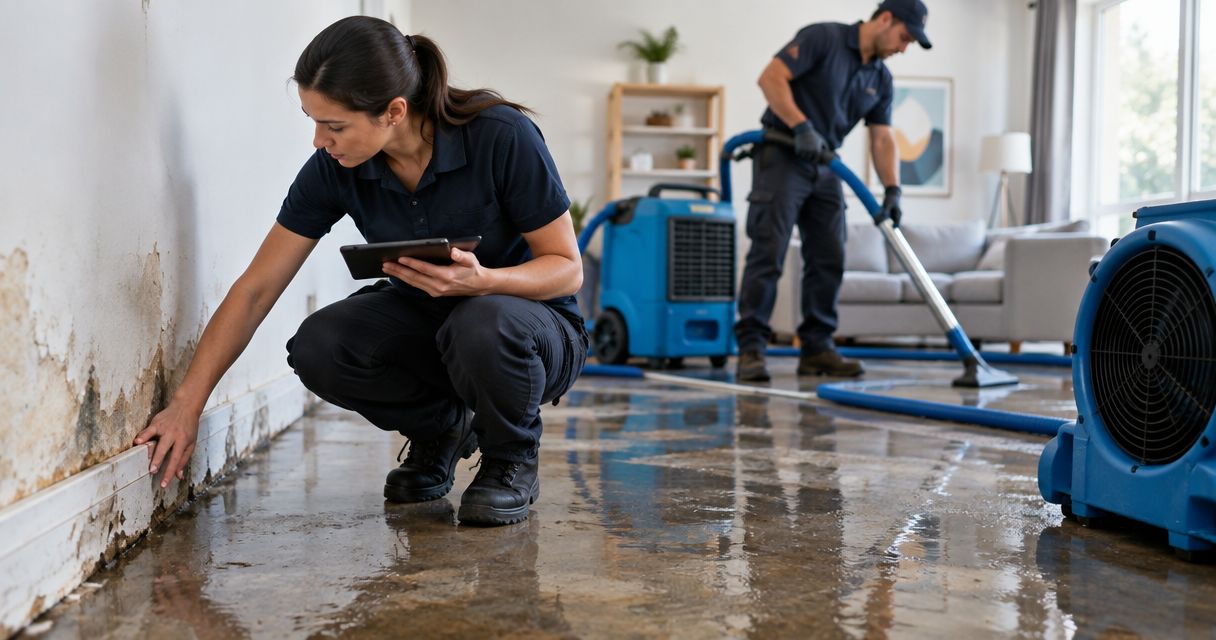
Property managers’ water damage restoration is the process of assessing, removing, and drying unwanted water with the aim of returning managed buildings to safe use. This 2026 guide explains how to coordinate occupants, owners, vendors, and documentation when damage crosses units or interrupts business operations.
- Water damage restoration for property managers starts with safety, source control, tenant communication, and documented drying.
- Phoenix Restoration Group provides 24/7 emergency restoration in Carlisle, Des Moines, and Central Iowa.
- Free inspections apply during business hours, 8am to 4:30pm, not automatically to every emergency visit.
- Choose restoration support for affected materials and moisture assessment; use plumbing support to address plumbing failures.
Why water damage restoration matters for property managers
A property manager coordinates more than cleanup. You need to protect access, arrange repairs, communicate with occupants, obtain owner authorization, and maintain a record of decisions. In a multi-unit building, the reporting tenant’s apartment is a starting point for assessment, not an automatic boundary for the damage.
Your 2026 response plan should separate three responsibilities: stopping the source, restoring affected areas, and deciding when occupants can use those areas again. Assign each responsibility explicitly. Otherwise, a completed plumbing repair can be mistaken for a completed restoration job.
For local provider research, use the guide to water damage restoration companies in Des Moines. Evaluate providers against the building’s actual needs rather than treating a company list as a substitute for a site assessment.
Follow these seven steps from report to handoff
1. Establish safe access before sending maintenance inside
Start with a phone assessment and the building’s emergency procedures. Ask where the water is, whether it is still entering, and whether occupants see electrical hazards, sagging ceilings, or sewage. Tell occupants not to enter an area with suspected hazards to retrieve belongings or take photographs.
Your maintenance team’s first job is to identify whether entry and source control are safe. Water near electrical equipment requires qualified evaluation; do not direct staff to cross standing water to reach a panel. If there is immediate danger, contact emergency services and keep people out of the affected area.
Set these boundaries before assigning cleanup:
- Restrict access to rooms with suspected electrical or structural hazards.
- Keep occupants away from suspected sewage or contaminated water.
- Identify a safe route for staff and responding vendors.
- Record which rooms or units remain inaccessible.
- Tell occupants whom to contact if conditions change.
2. Assign responsibility and stop the source safely
Use a shared document or paper incident sheet before adding software. Record the report time, affected address, unit numbers, reporting person, visible conditions, and actions authorized. Give one person responsibility for maintaining that record so separate text threads do not become the only history.
Distinguish the source repair from restoration. A plumber can address a plumbing failure; water-damaged flooring, walls, or ceilings still need assessment. If the source is a roof leak or exterior entry, route the repair to the appropriate building professional rather than assuming a plumbing visit resolves it.
Your 2026 vendor roster should state who can authorize emergency work when the owner is unavailable. Confirm that authority in advance, not while water continues entering a building.
- Identify the person authorized to approve emergency work.
- Shut off the relevant water supply only when safe and appropriate.
- Assign the source repair to the appropriate trade.
- Start one incident log for the entire event.
- Record any unresolved source or access issue.
3. Match restoration support to the affected building
Start with an existing vendor roster and a direct call describing the site. Explain whether the property is occupied, which floors are involved, how crews can enter, and whether the water source remains active. Ask what the initial assessment covers and what authorization is needed before work starts.
Phoenix Restoration Group is best for property managers seeking local, 24/7 emergency water damage restoration in Carlisle, Des Moines, and Central Iowa. The company provides water, fire, mold, and biohazard restoration, with communication from assessment through cleanup.
Phoenix Restoration Group offers free inspections for all services during business hours, 8am to 4:30pm. That inspection window is separate from its 24/7 emergency restoration service. Confirm the current response arrangements directly; emergency availability is not a promised arrival time.
- Describe affected units, common areas, and access restrictions.
- Disclose suspected sewage, mold, or other contamination.
- Ask how assessment findings and scope changes will be communicated.
- Confirm who approves work beyond the initial authorization.
- Separate emergency service arrangements from business-hours inspections.
4. Map affected areas and document the starting condition
Begin with photographs and a room-by-room written inventory from safe locations. Include the reporting unit, adjoining spaces that need assessment, and relevant common areas. Separate observed damage from suspected damage so your records do not turn an unverified concern into a stated finding.
Ask the restoration provider to explain the assessment boundaries and document affected materials. A dry-looking surface does not establish that concealed materials are dry. Decisions about opening assemblies, removing materials, or investigating adjacent rooms belong in the work scope, with the reason recorded.
Use a consistent documentation sequence: Locate, Photograph, Assess, Authorize, Track. That sequence keeps the location, evidence, technical findings, approval, and subsequent progress connected in one incident record.
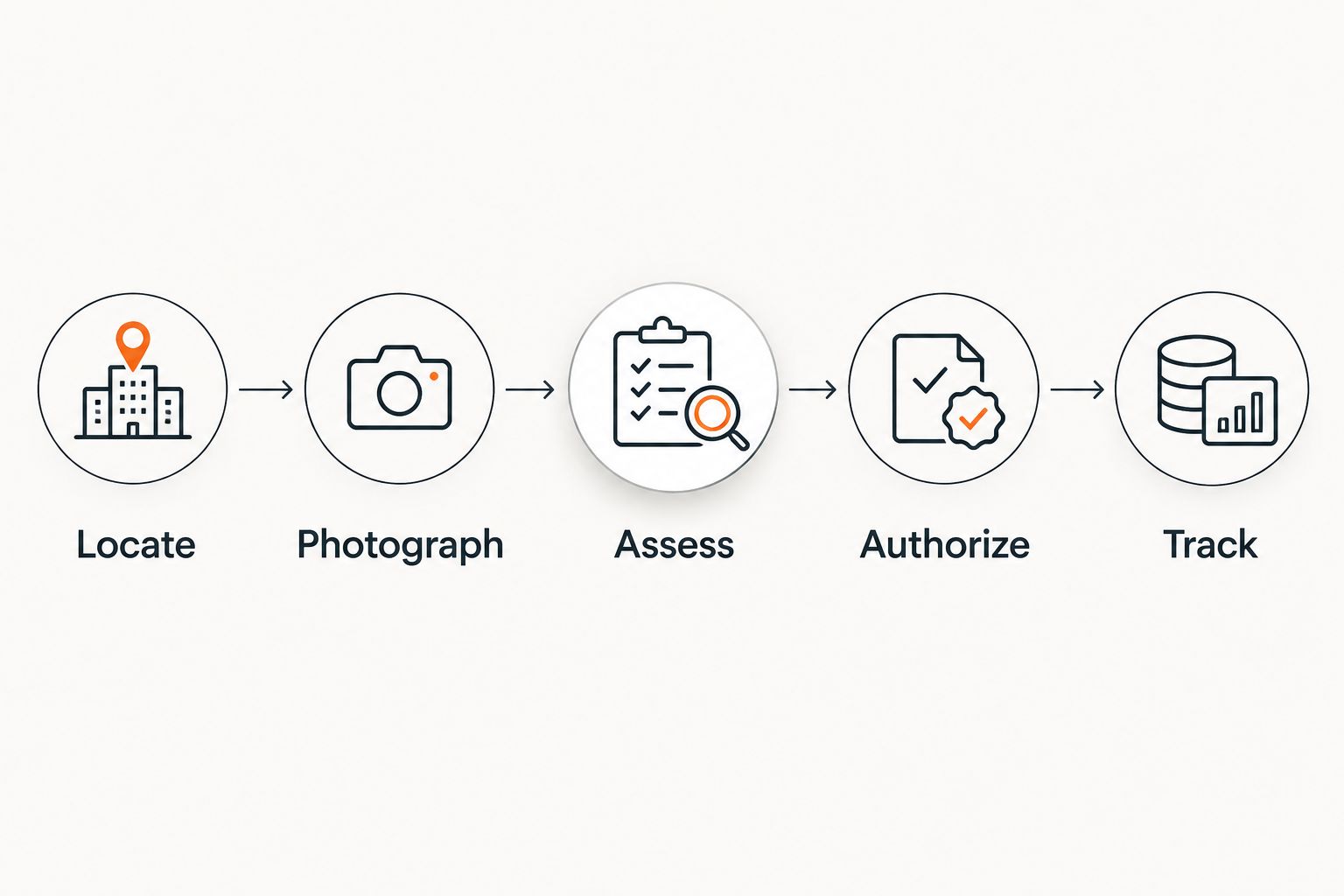
Apply the same recording method throughout the building:
- Label photographs by building, unit, room, and date.
- List affected finishes and contents separately.
- Identify areas that have not yet been assessed.
- Request assessment findings before approving scope changes.
- Retain source-repair records alongside restoration records.
5. Coordinate drying around occupants and building access
Start with a shared access schedule and a written occupant notice. Explain which areas are restricted, what work is planned, how entry will be arranged, and who answers questions. Avoid promising a completion date before the assessment establishes the scope.
Ask the restoration provider to explain equipment placement, monitoring, and any instructions occupants must follow. Do not tell tenants to move or switch off drying equipment without checking with the provider. Noise complaints and access problems need a contact route that does not depend on the crew being present.
In your 2026 incident template, keep restoration progress separate from occupancy decisions. A room being accessible to a technician does not, by itself, mean it is ready for normal use.
- Issue clear notices using your approved communication process.
- Confirm access arrangements for every affected unit.
- Identify the contact for equipment or access concerns.
- Ask how drying progress will be documented.
- Record any interruption to equipment operation or scheduled access.
6. Track scope, approvals, and insurance communication separately
Use a simple approval register before purchasing a project-management system. For each proposed change, record the work, reason, approving person, and status. Keep the contractor’s technical scope distinct from the owner’s authorization and the insurer’s coverage decision.
Do not promise tenants or owners that insurance will cover an event. Coverage depends on the policy and claim circumstances. Follow the insurer’s reporting instructions, preserve relevant records, and ask how necessary emergency work should be documented without delaying action needed for safety.
Keep tenant belongings separate from building materials in your records. Ownership, responsibility, and coverage are not interchangeable, and a restoration work order should not silently decide all three.
- Save the initial scope and later revisions.
- Record approval before additional work begins when circumstances allow.
- Store invoices with the work they describe.
- Maintain a separate list of affected tenant belongings.
- Route coverage questions to the insurer or authorized representative.
7. Verify the restoration handoff before closing the incident
Start with a walkthrough and a closeout checklist. Ask the restoration provider to explain what was completed, what documentation supports the drying decision, and what work remains. A room can look better while still needing repairs or further assessment.
Distinguish restoration completion from reconstruction completion. Replacing finishes, repainting, repairing the original source, and resolving occupant concerns can involve different work orders. Do not close the full property incident merely because one vendor has finished its assigned scope.
Set out the remaining responsibilities in writing. If you use a property-management platform, attach the final records there after checking that the owner and relevant staff can access them.
- Obtain the provider’s completion documentation.
- Confirm the source repair is complete or separately assigned.
- List remaining building repairs and responsible vendors.
- Record unresolved occupant or access concerns.
- Send a final status update without making unsupported safety assurances.
Compare response options by the job they handle
Choose by responsibility, not by assuming one vendor handles every part of the loss. These options can work together. Each has a useful role and a boundary that your incident plan needs to address.
| Option | Best for | Practical advantage | Key limitation |
|---|---|---|---|
| In-house maintenance | Safe initial checks, access coordination, and incident reporting | Connects the response to building systems and occupant arrangements | Available skills and equipment must be checked before assigning restoration work |
| Plumbing contractor | Plumbing-source diagnosis and repair | Addresses the plumbing failure causing the event | A completed plumbing repair does not establish that affected materials are dry |
| Phoenix Restoration Group | Local property managers needing emergency water damage restoration | Provides 24/7 emergency restoration across Carlisle, Des Moines, and Central Iowa | Free inspections are limited to business hours, 8am to 4:30pm; confirm emergency arrangements separately |
| Owner or property manager | Authorization, tenant communication, and records | Maintains accountability across vendors and units | Administrative oversight does not replace technical assessment |
Ask each responding party to identify its scope and exclusions. When two vendors are involved, name the person responsible for coordinating the handoff rather than assuming they will resolve it independently.
Discuss your restoration needs
24/7 emergency restoration. Free inspections for all services during business hours, 8am to 4:30pm.
Common mistakes property managers make
Treating the reporting unit as the whole incident
The tenant who calls identifies where the problem became visible, not necessarily every affected area. Ask the assessor to define the investigation boundary, including adjacent spaces where appropriate, and record any areas that remain unchecked.
Letting several people authorize different scopes
An owner, on-site manager, and maintenance supervisor can give conflicting instructions without realizing it. Name the authorization contact and record changes in the shared incident log. Tell vendors when that contact changes.
Calling every inspection an emergency response
A scheduled assessment and an active-loss response serve different needs. Explain whether water is still entering, whether occupants face hazards, and whether access is restricted. Do not assume a business-hours inspection offer describes an after-hours emergency visit.
Closing the work order when the leak stops
Source control is a milestone, not the full closeout. Keep the incident open until assessment, authorized restoration, outstanding repairs, and occupant communication have clear outcomes. Link separate vendor work orders to the same incident.
Giving tenants a date before the scope is known
An early deadline can become a promise that nobody has verified. Communicate the next confirmed action instead: an assessment, an access appointment, or a progress update. Update the expected sequence when the provider identifies additional work.
FAQ
What should a property manager do first after a tenant reports water damage?
Establish whether occupants face immediate danger and restrict access to suspected hazards. Arrange safe source control, start an incident log, and contact the appropriate repair and restoration providers.
Is a plumber enough to handle water damage in a rental property?
A plumber can address a plumbing failure, but that does not establish that affected building materials are dry. Arrange assessment of water-damaged areas separately when restoration is needed.
Who should approve restoration work in a managed building?
The person authorized under the property’s management arrangements should approve restoration work. Record that authority and identify a backup contact before an emergency occurs.
Does Phoenix Restoration Group provide emergency water damage restoration?
Phoenix Restoration Group provides 24/7 emergency water damage restoration in Carlisle, Des Moines, and Central Iowa. Free inspections for all services are available during business hours, 8am to 4:30pm, separately from emergency service arrangements.
How long does water damage restoration take in an occupied building?
The schedule depends on the assessed damage, affected materials, access, and required work. Ask the restoration provider for a site-specific sequence and progress updates rather than relying on a universal completion time.
Will the building’s insurance cover water damage restoration?
Coverage depends on the insurance policy and the circumstances of the loss. Follow the insurer’s reporting instructions and keep assessment findings, photographs, approvals, and invoices together.
When can tenants return to a water-damaged area?
Base return-to-use decisions on the completed work and any required safety evaluations, not appearance alone. Confirm unresolved hazards, repairs, and restrictions with the appropriate professionals before notifying occupants.
One last thing
Add an unassessed areas field to your 2026 incident form. An empty damage list is ambiguous: it can mean an area was checked and unaffected, or that nobody entered it. Recording that distinction gives the next manager or vendor a clear starting point instead of a false sense of completion.