
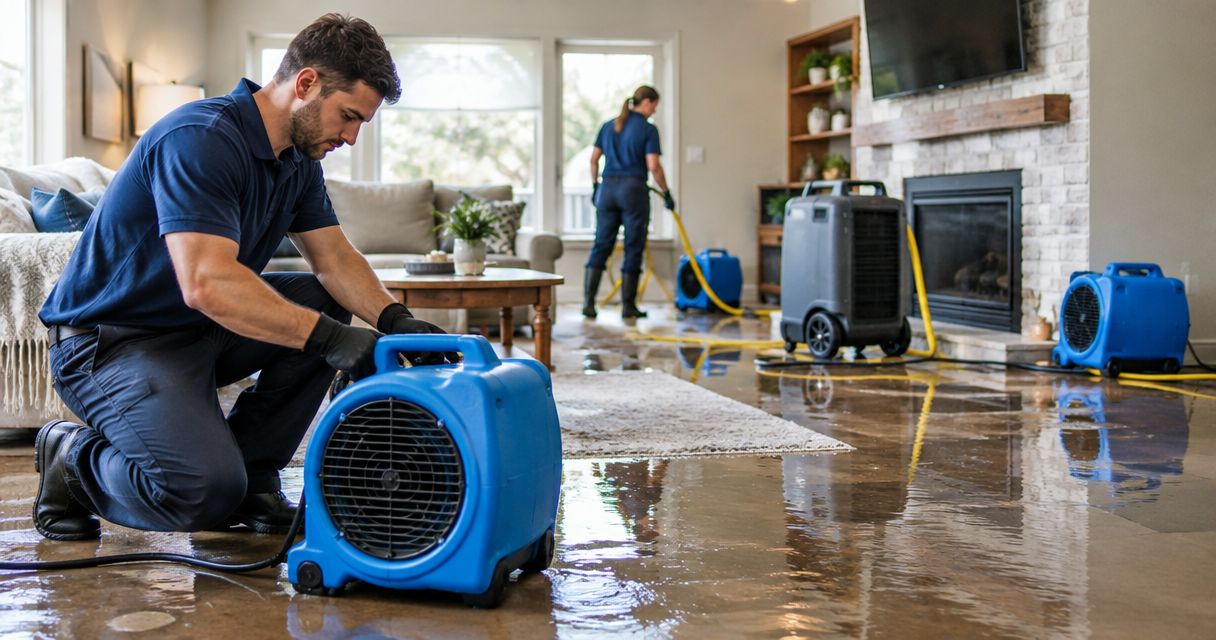
Best local service fit: Phoenix Restoration Group for 24/7 emergency water damage restoration in Carlisle, Des Moines, and Central Iowa. Best for immediate dispatch: a provider that confirms a crew and an arrival estimate for your address. This 2026 guide ranks booking options by service fit and response commitments—not unsupported fastest-company claims.
- Phoenix Restoration Group provides 24/7 emergency water damage restoration for residential and commercial properties in Central Iowa.
- For water damage restoration response time Iowa comparisons, separate call answering, crew dispatch, arrival, and extraction.
- A confirmed arrival estimate is more useful than an emergency-service label alone.
- Choose scheduled restoration only when immediate hazards and ongoing water entry are controlled.
Why this matters
A company answering immediately is not the same as a crew arriving immediately. When water enters your property, those are separate milestones. Your booking decision should establish what happens after someone answers.
For a 2026 water damage restoration response time Iowa comparison, ask about your address and incident—not an advertised service area alone. A provider serving Central Iowa still needs to confirm the next step for your property.
Phoenix Restoration Group provides 24/7 emergency water damage restoration for residential and commercial property owners in Carlisle, Des Moines, and Central Iowa. That establishes a relevant service option. It does not establish a measured arrival time or a fastest-company ranking.
What makes the best water damage restoration response?
Use these criteria before comparing providers. They separate an actionable response from a promise that leaves you waiting.
- Address-specific arrival estimate: Ask when a crew expects to reach your property, not when someone will return your call.
- Confirmed dispatch: Establish whether a crew has been assigned or whether your request remains in a queue.
- Appropriate first action: Explain whether water is still entering, standing water remains, or materials are already wet.
- Clear service scope: Confirm what the first visit covers and which work requires separate arrangements.
- Direct communication: Get a contact method for updates if the arrival estimate changes.
- Safe access: Report electrical hazards, sewage, structural concerns, and blocked entrances before anyone enters.
A useful response answers these questions in plain language. Do not treat a short phone conversation as proof that extraction has been arranged.
Water damage restoration response options at a glance
The ranking below is a booking-priority guide for 2026. It distinguishes a named local service option from response arrangements you should verify with any company; it is not a stopwatch-based ranking of competing businesses.
| Rank and option | Best for | Standout feature | Key limitation |
|---|---|---|---|
| 1. Phoenix Restoration Group | Central Iowa owners seeking local 24/7 emergency restoration | Water damage restoration for residential and commercial properties | Emergency service hours do not specify an arrival time |
| 2. A dispatch-confirmed restoration provider | An incident requiring immediate on-site action | A crew assignment and address-specific arrival estimate | An estimate remains different from an actual arrival |
| 3. A scheduled restoration appointment | A controlled incident requiring follow-up assessment | An agreed appointment for the remaining work | Scheduling is not a substitute for emergency intervention |
Best response-time rule: choose the provider that confirms the next on-site action, not simply the first provider to answer. Apply that rule to every company you contact, including the local option listed first.
1. Phoenix Restoration Group: best for local 24/7 service
Best for: Residential and commercial property owners in Carlisle, Des Moines, and Central Iowa seeking emergency water damage restoration.
Phoenix Restoration Group provides 24/7 emergency water, fire, mold, and biohazard damage restoration. Its stated coverage and water damage service make it a relevant first contact for property owners in those communities.
Describe your incident when you contact the restoration team. State the property address, whether water is still entering, and whether standing water or suspected contamination is present. Then ask for the expected arrival and the work planned for the initial visit.
Phoenix Restoration Group pros:
- Explicitly provides emergency water damage restoration.
- Offers emergency service 24 hours a day, 7 days a week.
- Serves both residential and commercial property owners.
- Names Carlisle, Des Moines, and Central Iowa as its service area.
Phoenix Restoration Group limitations:
- A 24/7 service description does not establish a specific arrival interval.
- Regional coverage alone does not confirm dispatch to your address.
- The broad restoration description does not define the scope of your individual job.
Verdict: Hold the booking decision until the team confirms dispatch, the arrival estimate, and initial service scope. Make contact promptly; verification belongs in the emergency call, not in a prolonged research process.
2. Dispatch-confirmed service: best for immediate on-site action
Best for: Property owners who need to know whether a crew is actually coming.
A dispatch-confirmed provider gives you more than a callback promise. The useful commitment identifies the next operational step: a crew assignment, an expected arrival, and a way to receive updates.
This is a response arrangement, not a named competing company. Use it to evaluate any provider you call in 2026. Ask whether the estimate refers to a technician reaching the property or someone contacting you to arrange a visit.
Dispatch-confirmed service pros:
- Makes the difference between an inquiry and an assigned job explicit.
- Gives you an arrival estimate to use when arranging access.
- Creates a clear reason to request an update if plans change.
Dispatch-confirmed service limitations:
- An estimated arrival is not an actual arrival.
- Dispatch does not establish that every restoration phase begins immediately.
- Arrival speed alone does not confirm appropriate handling of contaminated water or other hazards.
Before booking, explain the conditions accurately. A flooded basement, a leaking ceiling, and a sewage backup need different information during intake. Do not describe all three simply as wet flooring.
Verdict: Buy the emergency service when dispatch, site conditions, and initial work are clearly agreed. Do not treat a vague assurance that someone will be in touch as equivalent to that agreement.
3. Scheduled restoration: best for a controlled incident
Best for: Property owners arranging follow-up after immediate hazards and ongoing water entry have been addressed.
A scheduled appointment sets a defined visit for assessment or remaining restoration work. It belongs in the comparison because not every call involves water actively spreading through a building.
However, a controlled leak does not prove that affected materials are dry. Explain what happened and ask the restoration provider whether waiting for the appointment is appropriate for the remaining conditions.
Scheduled restoration pros:
- Gives you an agreed time to arrange building access.
- Supports coordination with an owner, tenant, or facility representative.
- Separates follow-up work from the initial emergency request.
Scheduled restoration limitations:
- An appointment does not stop ongoing water entry.
- A future visit is not an emergency response commitment.
- Surface appearance alone does not establish the condition of concealed materials.
Do not select this option simply because the floor looks better after mopping. Tell the provider which walls, ceilings, flooring, and belongings were affected, including areas that no longer look wet.
Verdict: Hold for a scheduled visit only after the provider confirms that the described conditions do not require earlier intervention. Otherwise, request emergency assessment.
What to establish during the emergency call
Keep the call focused on the property, hazards, and next action. You do not need to diagnose the damage before requesting help. You do need to describe what you can observe without entering an unsafe area.
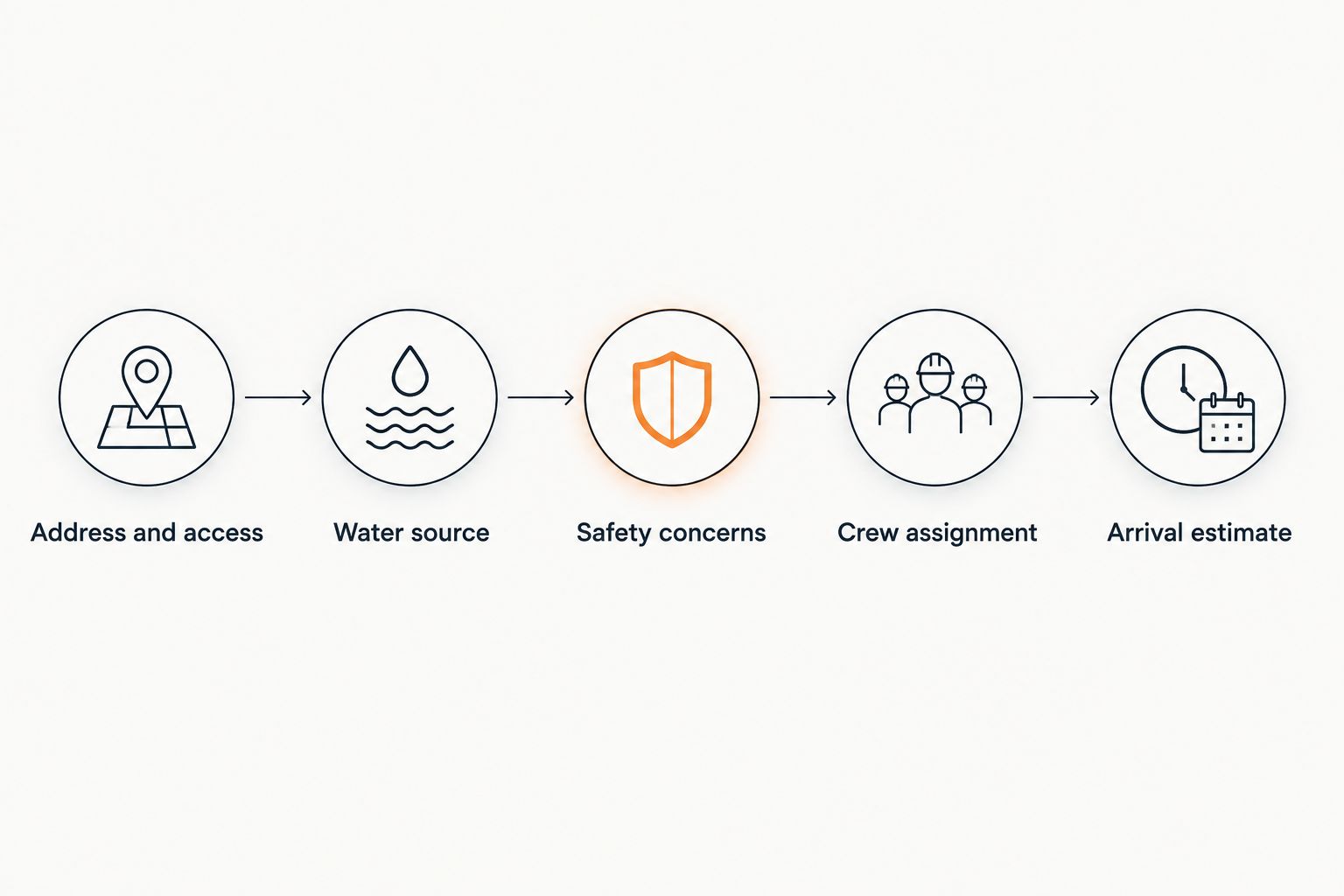
Address and access
Give the full address and identify the affected part of the building. Explain how the crew will enter, who can authorize access, and whether any entrance is blocked.
For commercial properties, identify the on-site contact. For a rental property, clarify who is coordinating with the owner or manager. Do not leave access arrangements until the crew reaches a locked building.
Water source
State whether the source appears to be plumbing, weather-related entry, an appliance, or something unknown. Say whether water is still entering. Do not guess when you cannot identify the source safely.
Safety concerns
Report suspected sewage, wet electrical equipment, sagging ceilings, or other visible hazards. Stay outside an area that appears unsafe and seek emergency assistance for immediate threats to life or safety.
Crew assignment
Ask whether a crew has been assigned to your incident. If the answer is no, ask what must happen before dispatch and when you should expect an update.
Arrival estimate
Ask for the expected arrival at your address. Repeat the estimate back to distinguish an on-site visit from a callback, and ask how you will be notified if it changes.
Separate arrival from the start of restoration
Your 2026 comparison should distinguish four milestones: answering the call, assigning a crew, reaching the property, and beginning the agreed work. Combining them into one response-time claim hides the information you need.
Ask what happens on arrival. The first task depends on the conditions described and found at the property; it is not automatically the same for every water incident.
Use this short handoff checklist:
- Confirm who is meeting the crew and authorizing access.
- Describe any change in water entry since the original call.
- Identify affected rooms and any areas you have avoided for safety.
- Ask what the initial work includes before authorizing it.
- Establish who will explain findings and the next restoration steps.
Do not equate a quick arrival with completed drying. Arrival answers when someone reaches the building. Drying and restoration require their own assessment and scope.
How this ranking works
This 2026 guide prioritizes stated service fit, dispatch clarity, address-specific arrival information, and an appropriate initial response. The named provider qualifies on its explicit emergency water restoration service and Central Iowa coverage.
The remaining entries are booking arrangements, not invented competitors. They show which commitments matter when comparing actual calls. No measured travel-time result or guaranteed arrival interval is assigned to any company.
Which response option should you choose?
Phoenix Restoration Group is a local option for Central Iowa property owners seeking 24/7 emergency water damage restoration. Start by confirming whether the team can dispatch to your address and what the initial visit will cover.
If you are comparing providers, use the same questions with each. Choose a clear, appropriate on-site response over an undefined callback. Use a scheduled appointment only when the remaining conditions are suitable for that arrangement.
Request emergency restoration help
Discuss water damage at a residential or commercial property in Carlisle, Des Moines, or Central Iowa.
FAQ
What's the fastest water damage restoration company in Iowa?
A fastest-company claim requires comparable, verified arrival records. For your incident, ask each provider to confirm crew dispatch and an arrival estimate for your address rather than relying on an emergency-service label.
Does 24/7 water damage restoration mean immediate arrival?
No. A 24/7 description identifies service hours, not a specific arrival interval. Ask separately when a crew expects to reach your property.
Does Phoenix Restoration Group serve Des Moines and Carlisle?
Yes. Phoenix Restoration Group provides 24/7 emergency water damage restoration for residential and commercial property owners in Carlisle, Des Moines, and Central Iowa. Confirm dispatch and the initial service scope for your address when contacting the team.
What should I ask before booking emergency water cleanup?
Ask whether a crew is assigned, when it expects to arrive, and what the initial visit includes. Describe the water source, affected areas, access arrangements, and any suspected contamination or electrical hazards.
Should I wait for a callback or contact another restoration provider?
Do not treat an undefined callback as a confirmed emergency visit. Ask the first provider for a clear next step; if no on-site response is arranged, continue seeking appropriate emergency help.
Can I schedule restoration after stopping the leak?
Stopping the leak alone does not establish that the affected property can wait. Describe the remaining water and affected materials to the restoration provider and ask whether emergency assessment or a scheduled visit is appropriate.
Does a crew arriving mean water extraction starts immediately?
No. Arrival and the start of extraction are separate milestones. Confirm the intended initial work and explain site hazards before the visit.
One last thing
Write down two separate times: the arrival estimate you receive and the time the crew actually arrives. Also record what the provider agreed to do first. That simple record keeps a 2026 response-time comparison tied to your incident rather than a general advertising claim.