

Instead of repeatedly searching messages, photographs, and invoices, organize the water damage insurance claim process around one claim file: document the loss, report it, track mitigation, reconcile the estimate, and confirm payment conditions. This 2026 workflow keeps emergency cleanup separate from the insurer’s coverage decision so you can address damage without treating reimbursement as guaranteed.
- The water damage insurance claim process needs documented damage, timely notice, mitigation records, and a written coverage decision.
- Phoenix Restoration Group provides water damage restoration, not an insurance coverage determination.
- Emergency mitigation and permanent repairs require separate documentation and authorization decisions.
- Match the insurance estimate to documented damage before treating a payment as the final settlement.
Why this matters
Phoenix Restoration Group provides 24/7 emergency water damage restoration for residential and commercial property owners in Carlisle, Des Moines, and Central Iowa. That service addresses the property damage; your insurer determines coverage under your policy. Cleanup authorization is not insurance approval.
Phoenix Restoration Group offers free inspections for all services during business hours, 8am to 4:30pm. Those inspection hours are separate from 24/7 emergency restoration availability. The team keeps you informed from assessment through cleanup, without promising a specific arrival time.
The claim workflow below separates three questions: what happened, what work is necessary, and what the policy covers. Keeping those questions distinct helps you give the adjuster useful evidence rather than an unexplained total.
Before you start
- Gather access and records. Have your policy, property address, insurer’s reporting instructions, contact information, and safe access arrangements ready. Locate relevant maintenance records without delaying emergency action.
- Create one claim folder. For a loss occurring in 2026, label it with the property address and loss date. Keep photographs, correspondence, estimates, authorizations, invoices, and payment notices together.
- Check the coverage trap. A burst pipe, surface flooding, and sewer backup are different causes of loss. Describe the observed source accurately, check the relevant policy provisions, and do not assume all water damage has the same coverage.
Do not enter standing water near electrical equipment or enter an unsafe structure to collect evidence. Stay out and seek appropriate emergency assistance when electrical, structural, or contamination hazards are present.
Loss documentation and claim intake
Use the bold labels below as fields in your own claim log. They are recordkeeping labels, not insurer portal buttons; reporting screens differ by insurer.
- Record the timeline. Enter Loss discovered, Last known dry, Suspected source, and Actions taken. Distinguish what you observed from what someone later diagnosed. If the start time is unknown, record the discovery time rather than inventing a precise onset.
- Document safely. Take 3 photo views where safe: a room overview, the affected material, and a close-up of the damage. Add room names and descriptions. Photograph affected belongings and identifying information before moving or discarding them when conditions permit.
- Report the loss. Follow your policy’s notice requirements and the insurer’s reporting instructions. Describe the observed event without guessing at exclusions or promising that damage is limited to visible surfaces. Request a claim number and the assigned contact’s details.
- Confirm requirements. Ask what documents, inspection access, forms, and deadlines apply. Record Claim number, Adjuster, Required documents, and Next action. Request written confirmation of instructions given by telephone.
Expected result: You have a claim reference, an evidence folder, and a written list of the insurer’s next requirements. The claim is reported, but reporting alone does not establish coverage.
For your 2026 claim record, preserve original image files alongside annotated copies. An annotation helps explain a photograph; it should not replace the original evidence. Keep a communication log that records who said what and when.
Emergency mitigation and work authorization
Mitigation means taking reasonable action to limit additional damage. Permanent repair restores damaged building components. Keep their records distinct even when the work happens in the same area.
| Work category | Best for | Practical benefit | Limitation |
|---|---|---|---|
| Emergency mitigation | Addressing active damage and limiting further loss | Creates a record of stabilization and cleanup work | Does not establish insurance coverage or authorize every later repair |
| Permanent repair | Restoring damaged finishes and components after assessment | Defines the rebuilding scope | Requires separate attention to scope, authorization, and payment responsibility |
- Address the source safely. Arrange appropriate help to stop the water source when possible. Do not operate electrical equipment in wet conditions or attempt hazardous repairs. Document the source assessment and any work completed.
- Request restoration help. Explain whether water is still entering, which areas are affected, and whether contamination is suspected. Phoenix Restoration Group provides 24/7 emergency water damage restoration; free inspections for all services take place during business hours, 8am to 4:30pm.
- Read the authorization. Identify the work being authorized, who is responsible for payment, and how changes will be approved. Ask about unclear terms before signing. A contractor’s authorization and an insurer’s coverage letter serve different purposes.
- Preserve the work record. Request documentation of affected areas, work performed, relevant measurements, equipment use, and disposal. Retain invoices and supporting photographs. Ask the insurer about inspection or evidence requirements before irreversible work when safety allows.
Expected result: Necessary emergency work has a documented scope, an authorization record, and supporting evidence. You understand your payment obligations without assuming the insurer has accepted every charge.
The sequence is simple: Document, Report, Mitigate, Reconcile, Confirm payment. Safety takes priority over collecting evidence, and active damage should not be left unaddressed merely to preserve a photograph.
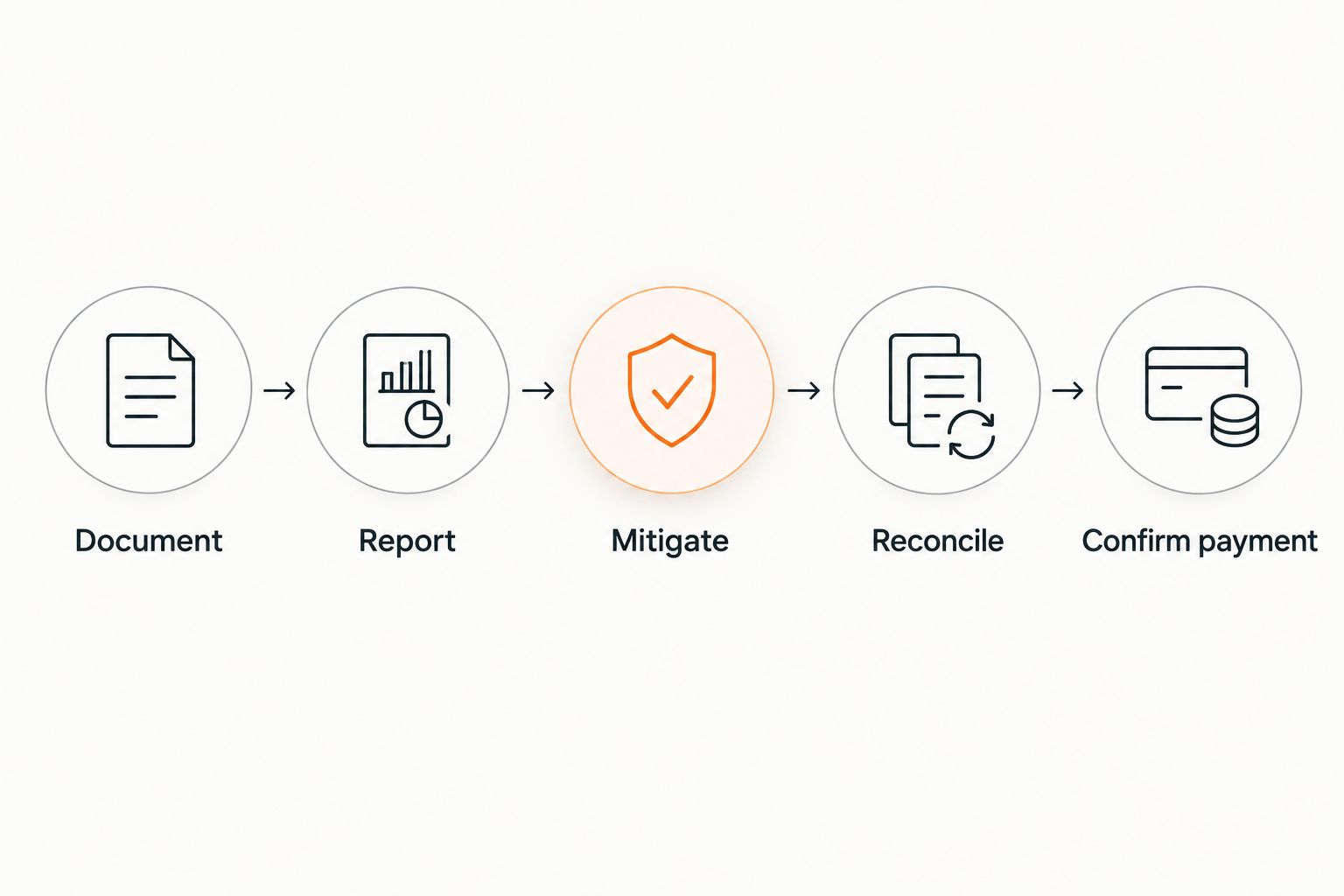
Before scheduling an inspection, distinguish emergency needs from a business-hours assessment. Tell the restoration contact about ongoing water entry and unsafe access rather than simply requesting an estimate.
Request restoration help
24/7 emergency restoration. Free inspections for all services during business hours, 8am to 4:30pm.
Adjuster review and estimate reconciliation
An estimate is easier to review when each disputed item connects to a room, material, photograph, or work record. Ask for explanations of specific differences instead of treating competing totals as the entire dispute.
- Prepare the inspection packet. Share the loss timeline, photographs, source findings, mitigation records, and relevant estimates through the insurer’s accepted channel. Keep copies of everything submitted. Identify attachments clearly so the adjuster can match them to the affected area.
- Walk through the damage. Point out observed damage room by room, including areas that were affected before cleanup. Ask how additional damage discovered during authorized work should be reported. Do not describe suspected hidden damage as confirmed damage.
- Compare the scope. Check room names, measurements, materials, removal, drying, disposal, and repair tasks. Separate omitted work from disagreements about coverage. An item absent from an estimate needs a different question from an item expressly excluded by the policy decision.
- Request written clarification. For each difference, identify the estimate line, supporting evidence, and requested correction. Ask the adjuster to explain any coverage limitation and identify the applicable policy wording. Keep revised estimates with their issue dates.
Expected result: You have an agreed scope or a specific, documented list of unresolved items. You can identify which questions concern damage, repair methods, or policy coverage.
Use your 2026 claim log to track Submitted, Acknowledged, Decision, and Outstanding for each issue. These are your tracking labels, not official insurer statuses. A sent attachment is not the same as a reviewed or accepted attachment.
Payment review and claim closure
Do not treat the first payment as proof that every claim issue is resolved. Payment structure depends on the policy, the coverage decision, and any applicable lender requirements.
- Read the written decision. Compare the coverage explanation with the estimate and payment statement. Ask which items are accepted, excluded, or still under review. Separate covered building damage from personal property or other categories included in your policy.
- Check settlement terms. Identify the deductible, depreciation treatment, and any conditions for additional payment. Replacement-cost coverage can require evidence of completed repair or replacement before recoverable depreciation is released; follow your policy’s actual terms.
- Confirm payees and paperwork. Check whether the payment names a mortgage lender or another party. Ask the named institution about endorsement and disbursement requirements before relying on the funds for contractor payments.
- Reconcile before closing. Match payments and outstanding requests against invoices, agreed work, and documented obligations. Confirm remaining submission deadlines in writing. Keep completion records and final correspondence together rather than deleting the claim file after a deposit clears.
Expected result: You understand what has been paid, what remains unresolved, and which conditions apply to any further payment. Property repairs and insurance paperwork each have a clear status.
For a claim handled in 2026, use the deadline stated in the policy or insurer’s written instructions. A generic online timeline is not a substitute for the deadline that applies to your loss.
When additional damage appears during repairs
Use the existing claim record when newly discovered damage relates to the reported loss. If the cause is uncertain or a separate event occurred, ask the insurer how it should be reported rather than assigning it to the original claim yourself.
- Document the discovery. Record the location, discovery date, photographs, and the work underway when the damage became visible. Distinguish newly visible damage from a new water event.
- Notify the adjuster. Explain what changed and ask whether inspection or additional documentation is required before the affected work proceeds. Continue necessary safety and damage-limitation measures.
- Submit the added scope. Provide an itemized explanation with supporting records. Track the request separately from the original estimate so an unresolved addition does not disappear inside a revised total.
The benefit is a clear supplement record. The limitation is that additional documentation does not guarantee additional coverage or payment.
Troubleshooting
The insurer questions the water source
Provide observed facts, photographs, and the source assessment. Ask which cause-of-loss question remains unresolved and which policy language affects the decision. Do not substitute the word “flood” for every incident involving standing water.
Cleanup happened before the adjuster visited
Submit available pre-cleanup photographs, work records, invoices, and disposal documentation. Explain what was removed and why. Do not recreate evidence or describe a later photograph as showing the original condition.
The restoration estimate and insurance estimate differ
Compare scope line by line before debating totals. Identify omitted areas, quantities, materials, or tasks, then ask the contractor and adjuster to explain the disagreement. Keep the resulting clarification in writing.
A payment arrives while questions remain open
Read the payment notice and any release language before signing settlement documents. Ask the insurer to confirm what the payment resolves and what remains open. Seek qualified advice if the effect of a release is unclear.
Customize your workflow
For rental or commercial properties, add records for tenant communications, access arrangements, and affected business operations. Keep these records separate from repair invoices so each submission has a clear purpose.
Assign one person to maintain the claim log. Contractors, tenants, owners, and adjusters can otherwise receive different versions of the same update. Phoenix Restoration Group keeps clients informed from assessment through cleanup; preserve those updates alongside the insurer’s correspondence.
FAQ
What is the water damage insurance claim process?
The water damage insurance claim process involves documenting the loss, notifying the insurer, limiting further damage, reviewing the scope, and checking payment conditions. Your policy determines coverage and required submissions.
Should I wait for insurance before starting water damage cleanup?
Do not leave active damage unaddressed while waiting for an insurance decision. Take safe, reasonable steps to limit further loss, document the condition, and follow your policy’s reporting and evidence requirements.
Does homeowners insurance cover every kind of water damage?
No, coverage depends on the cause of loss and the policy’s terms, exclusions, and endorsements. Burst pipes, surface flooding, and sewer backup require separate coverage review.
Can I choose my own water damage restoration company?
Ask your insurer about contractor selection and any applicable claim requirements. Before authorizing work, confirm the contractor’s scope and your payment responsibility rather than assuming the insurer has approved the bill.
Why is the first insurance payment different from the repair estimate?
Differences can reflect scope disagreements, deductibles, depreciation, coverage limits, or excluded work. Request the written estimate and payment explanation so you can identify the actual reason.
What should I do if more damage is found during repairs?
Document the discovery and notify the adjuster promptly. Ask what inspection and supporting evidence are required for an additional scope submission.
Does Phoenix Restoration Group offer emergency service and free inspections?
Phoenix Restoration Group offers 24/7 emergency water, fire, mold, and biohazard restoration in Carlisle, Des Moines, and Central Iowa. Free inspections for all services are available during business hours, 8am to 4:30pm, separately from emergency service availability.
One last thing
Keep the damaged-property record separate from the payment record. A bank deposit confirms money received, not that every affected area appears in the agreed scope. Before archiving a 2026 claim, compare the final room-by-room damage list with the final estimate and unresolved correspondence.