

Phoenix Restoration Group provides 24/7 emergency water, fire, mold, and biohazard damage restoration in Des Moines and Central Iowa. The limit is job fit: damage cleanup does not replace every repair needed to make a property safe and usable. For the phoenix restoration alternatives in 2026, choose a provider by the work required: restoration for damaged materials, plumbing for a failed pipe, electrical service for electrical hazards, and construction for rebuilding.
- For the phoenix restoration alternatives, compare restoration, plumbing, electrical repair, and rebuilding by scope—not interchangeable company names.
- Phoenix Restoration Group fits residential and commercial emergency restoration in Des Moines, Carlisle, and Central Iowa.
- A plumber repairs a water source; that does not establish that affected building materials are dry.
- Choose a mold specialist for a defined mold problem, not as a substitute for correcting moisture.
Why this matters
The right alternative depends on whether you need damage restoration, source repair, or reconstruction. Those are different jobs. A provider suited to one is not automatically the right choice for the others.
For a Des Moines property owner comparing options in 2026, the useful question is not simply who else to call. It is which part of the problem remains unresolved. A repaired pipe can leave wet insulation behind, while cleaned surfaces can still sit below an active roof leak.
This guide compares service routes rather than presenting an unsupported ranking of local companies. Phoenix Restoration Group is the restoration benchmark, not a separate competitor to itself. The alternatives below explain when another trade or a narrower specialist belongs on the job.
Restoration alternatives at a glance
Use this 2026 comparison to separate responsibilities before you authorize work. The standout difference is scope, not a claim that one service replaces every other service.
| Provider or service route | Best for | Defining role | Difference from emergency restoration |
|---|---|---|---|
| Phoenix Restoration Group | Residential and commercial water, fire, mold, and biohazard damage | 24/7 emergency restoration serving Carlisle, Des Moines, and Central Iowa | Restoration benchmark for this comparison |
| Licensed plumber | A leaking pipe, failed fixture, or plumbing-related water source | Diagnosing and repairing plumbing | Addresses the source rather than establishing the condition of all affected materials |
| Licensed electrician | Electrical hazards or damaged electrical components | Evaluating and repairing electrical systems | Addresses electrical safety rather than damage cleanup |
| General contractor | Rebuilding damaged building assemblies | Coordinating construction and replacement work | Focuses on reconstruction rather than treating every contamination or drying issue |
| Mold remediation specialist | A defined mold problem | Mold-focused assessment and remediation work | Narrows the engagement to mold rather than a broader damage event |
A single incident can require more than one route. Before choosing, ask who handles the immediate hazard, who addresses damaged materials, and who completes permanent repairs.
1. Phoenix Restoration Group: best for emergency damage restoration
Phoenix Restoration Group provides 24/7 emergency restoration across 4 stated service categories: water, fire, mold, and biohazard. Its stated coverage includes residential and commercial property owners in Carlisle, Des Moines, and Central Iowa.
Best for: A property owner whose immediate problem is damage from water, fire, mold, or a biohazard event, rather than an isolated mechanical repair.
Where this restoration option fits
- The service categories match common damage-cleanup needs.
- The stated service area includes Des Moines and nearby Central Iowa communities.
- Emergency service is offered 24/7 for residential and commercial properties.
Where the fit needs checking
- A restoration engagement does not, by itself, define who repairs a failed pipe, electrical component, or roof.
- A broad service category is not a property-specific work plan. Ask which rooms, materials, and tasks the proposed scope covers.
- Emergency availability is not an arrival-time guarantee. Confirm dispatch arrangements for your address.
Full restoration versus a narrow repair
| Decision point | Emergency restoration | Single-trade repair |
|---|---|---|
| Main problem | Damage affecting the property | A failed component or system |
| Scope question | What materials need treatment or removal? | What caused the failure? |
| Completion question | What condition must affected materials reach? | Has the failed component been repaired? |
| Handoff | Coordinate any remaining repairs | Identify any remaining damage |
Do not approve work based on the service label alone. Ask for the proposed scope and the responsibilities that sit outside it.
Verdict: Hold—keep this option when damage restoration matches the problem, and confirm the remaining repair responsibilities.
2. Licensed plumber: best for stopping a plumbing-related source
A licensed plumber is the appropriate trade for diagnosing and repairing a plumbing failure. That makes plumbing service an alternative to calling restoration first when the only established problem is the plumbing component itself.
Best for: A leaking supply line, failed fixture, or another plumbing issue that needs diagnosis and repair.
Where a plumber shines
- The work targets the failed plumbing component.
- Repairing the source addresses the cause of continuing plumbing-related water entry.
- The plumber can explain the repair performed and any plumbing work still needed.
Where plumbing service falls short
- A completed plumbing repair does not prove wall cavities, flooring, or insulation are dry.
- Plumbing work alone does not establish a plan for contaminated materials.
- Source repair and damage documentation are separate responsibilities unless the agreed scope includes both.
Plumbing versus restoration
| Decision point | Licensed plumber | Emergency restoration |
|---|---|---|
| Primary purpose | Repair plumbing | Address resulting property damage |
| Central question | Where is the plumbing failure? | Where has the water traveled? |
| Work boundary | Plumbing system | Affected materials and spaces |
| Handoff question | Is water still escaping? | Is source repair complete? |
If water has entered a ceiling, wall, or floor assembly, do not use a successful pipe repair as the only completion test. Ask separately how the affected materials will be assessed.
Verdict: Skip plumbing-only service as a substitute for restoration when building materials also need attention.
3. Licensed electrician: best for electrical safety and repair
A licensed electrician addresses electrical systems, not general water or fire cleanup. Choose this route when electrical equipment, wiring, outlets, or other components require evaluation after an incident.
Best for: A property with suspected electrical damage or an electrical hazard that needs qualified evaluation.
Where an electrician shines
- The work focuses on electrical safety and system condition.
- The electrician can identify electrical repairs within the agreed inspection scope.
- Electrical repair responsibilities remain separate from cleaning and rebuilding decisions.
Where electrical service falls short
- Electrical evaluation does not remove soot, contaminated water, or damaged drywall.
- Repairing an electrical component does not establish that adjacent building materials are dry.
- An electrical work order does not automatically include restoration of finishes opened during repair.
Electrical service versus restoration
| Decision point | Licensed electrician | Emergency restoration |
|---|---|---|
| Primary purpose | Evaluate and repair electrical systems | Address property damage |
| Key concern | Electrical hazards and component condition | Affected materials and contamination |
| Typical boundary | Electrical work scope | Restoration work scope |
| Coordination need | Safe access and repair sequence | Access around electrical hazards |
Do not enter standing water where electricity presents a hazard. Keep people away and seek qualified assistance. Do not operate switches or attempt to reach electrical equipment through water.
Verdict: Wait on ordinary cleanup in an electrically hazardous area until qualified professionals address safe access.
4. General contractor: best for rebuilding after damage
A general contractor is a useful route when the remaining job is construction: replacing damaged assemblies and coordinating rebuilding work. Reconstruction and restoration can overlap, but neither label proves what a particular contract includes.
Best for: A property that needs defined repairs or rebuilding after the damage conditions have been addressed.
Where a general contractor shines
- Construction work can be organized around a defined repair scope.
- The contract can identify replacement materials and installation responsibilities.
- The rebuilding plan can coordinate work between trades.
Where this route falls short
- A construction proposal does not automatically include emergency extraction, drying, or contamination control.
- Closing a wall does not establish that the cavity was ready to close.
- Cosmetic repairs do not correct an unresolved moisture source.
Reconstruction versus restoration
| Decision point | General contractor | Emergency restoration |
|---|---|---|
| Primary purpose | Repair or rebuild | Address damage conditions |
| Main decision | What must be replaced or rebuilt? | What requires treatment or removal? |
| Readiness question | Can construction proceed? | Have damage conditions been addressed? |
Before rebuilding starts, establish who accepts the condition of the underlying materials. Record that handoff rather than relying on a general statement that the area looks ready.
Verdict: Wait on enclosing affected areas until the responsible professionals establish that reconstruction can proceed.
5. Mold remediation specialist: best for a defined mold problem
A mold-focused provider is an option when mold is the central issue and you need a clearly bounded remediation scope. The scope still needs to account for the moisture conditions supporting the problem.
Best for: A defined mold concern that calls for mold-specific work rather than a broader emergency response.
Where a mold specialist shines
- The engagement can focus on affected materials and work-area controls.
- The scope can distinguish remediation from unrelated building repairs.
- You can ask for explicit completion criteria before work begins.
Where this route falls short
- Mold-focused work does not automatically include plumbing, roof, or foundation repairs.
- Treating visible surfaces does not resolve an ongoing moisture source.
- A narrow mold scope does not replace assessment of unrelated fire, water, or biohazard damage.
| Decision point | Mold-focused service | Broader restoration service |
|---|---|---|
| Main focus | Defined mold conditions | The relevant damage categories |
| Scope boundary | Mold-related work | The agreed incident-related work |
| Essential handoff | Moisture-source correction | Any work outside restoration |
Verdict: Hold—choose mold-focused service when the scope matches the problem and moisture-source responsibility is clear.
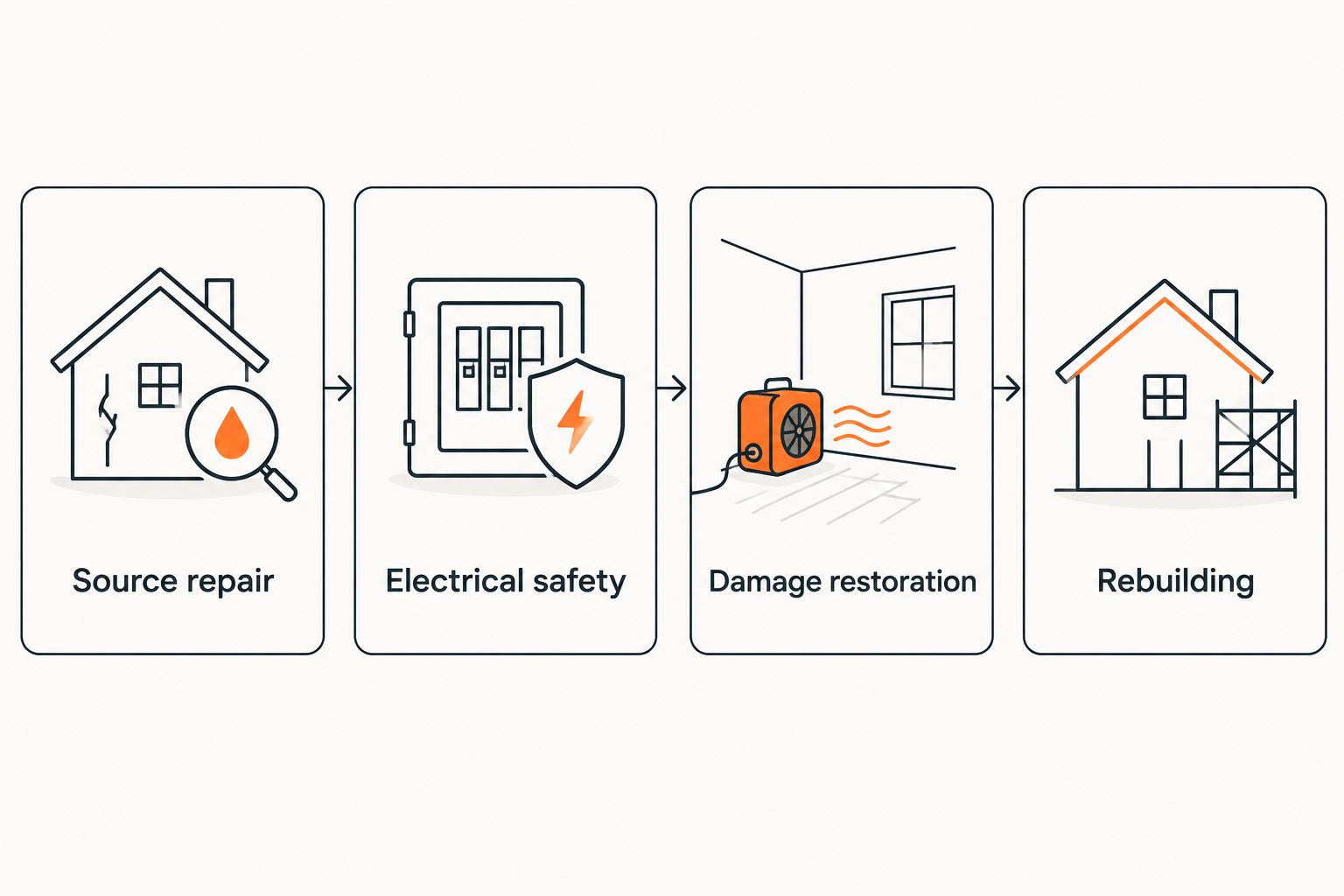
Why people consider switching restoration providers
A useful 2026 switching decision starts with scope, not a claim about another company's performance. There is no reason to infer an outage, service failure, or policy change from a search for alternatives.
Consider a different service route when your actual need falls outside the proposed work:
- Source repair: You need a failed pipe or other water-entry source repaired.
- Electrical safety: You need electrical evaluation before people can safely access the affected area.
- Damage restoration: You need affected materials addressed, not only the failed component repaired.
- Rebuilding: You need permanent construction after the damage conditions are resolved.
These are also useful handoff labels. Ask each provider which responsibility belongs to them and which requires another professional.
Ask these 3 scope questions before choosing
You do not need a long contractor interview to expose a scope mismatch. Start with questions that separate the cause, the damage, and the handoff.
- What problem will this work resolve? Ask the provider to identify the actual condition being addressed, not just a service category.
- What remains outside this scope? Get a clear answer about source repair, electrical work, damaged materials, and rebuilding where relevant.
- What establishes completion? Ask what observations, records, or other agreed criteria support closing the job.
For emergency restoration in Des Moines in 2026, confirm your address, the type of damage, and any immediate access hazards when requesting service. State whether the property is residential or commercial. Do not enter an unsafe area to collect details.
Request emergency restoration service
For water, fire, mold, or biohazard damage in Des Moines, Carlisle, and Central Iowa.
When staying with your restoration provider is right
Stay when the provider's agreed scope matches the damage, responsibilities are clear, and the next steps are defined. Switching company names without resolving a scope gap does not solve the underlying problem.
A separate plumber or electrician does not necessarily replace restoration. Those trades can address different parts of the same incident. Make the decision around unresolved work rather than treating every additional contractor as a competing alternative.
FAQ
What's the best Phoenix Restoration alternative in Des Moines?
The best alternative depends on the unresolved work: a plumber for a plumbing failure, an electrician for electrical issues, or a contractor for rebuilding. Phoenix Restoration Group remains a fit for its stated water, fire, mold, and biohazard restoration services.
Is a plumber enough after a pipe leaks?
A plumber is enough only for the plumbing repair scope, not as proof that affected building materials need no further work. Ask separately about water that entered walls, floors, ceilings, or insulation.
Should I call an electrician before water cleanup?
Seek qualified electrical assistance when the affected area presents an electrical hazard. Do not enter standing water or approach electrical equipment to investigate the problem yourself.
Can a general contractor replace a restoration company?
A general contractor can handle an agreed rebuilding scope, but the contract must establish whether damage restoration is included. Do not assume construction work includes drying or contamination control.
Is mold remediation the same as fixing a leak?
Mold remediation and leak repair address different parts of the problem. Identify who handles affected materials and who corrects the moisture source.
Does 24/7 restoration mean a guaranteed arrival time?
No. A statement of 24/7 emergency service does not specify a guaranteed arrival time. Confirm dispatch arrangements and access requirements for your address.
How should I compare restoration options in 2026?
Compare the proposed scope, exclusions, completion criteria, and responsibility for remaining repairs. Choose the provider whose work matches the unresolved condition at your property.
One last thing
Ask who owns the handoff before the first job closes. A repaired pipe, a cleaned room, and a rebuilt wall represent different completion points. For your 2026 restoration decision, the strongest practical safeguard is a clear record of what is finished and what still needs attention.