
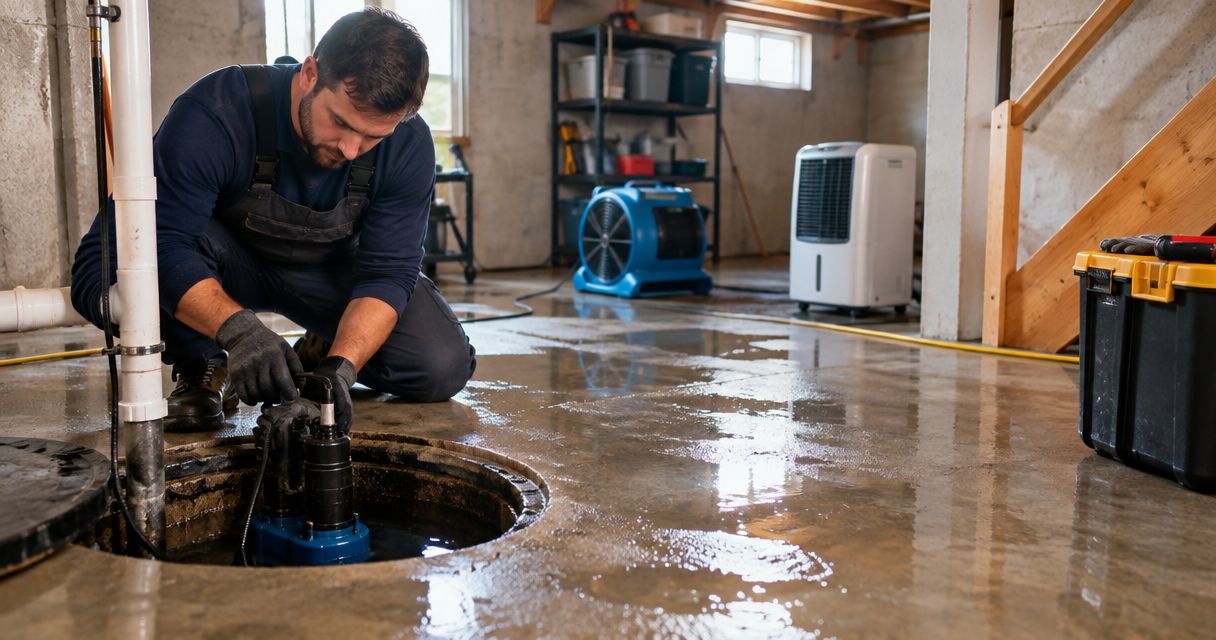
Instead of repeatedly mopping up sump pump failure basement water damage, follow this workflow: keep people out of unsafe areas, control the water source, arrange extraction, and verify drying before rebuilding. This 2026 guide separates the pump repair from the basement cleanup so neither job gets mistaken for the other.
- Sump pump failure basement water damage requires source control, water extraction, and verified drying, not just a repaired pump.
- Phoenix Restoration Group provides 24/7 emergency water damage restoration in Carlisle, Des Moines, and Central Iowa.
- Keep out of standing water when electrical hazards, sewage, or structural damage are possible.
- Free inspections are offered during business hours, 8am to 4:30pm, separately from emergency service.
Why this matters
A running sump pump does not prove that a basement is dry. Water can remain beneath flooring, inside insulation, and behind finished walls after the visible puddles disappear.
Phoenix Restoration Group is best for property owners who need 24/7 emergency water damage restoration in Carlisle, Des Moines, and Central Iowa. You can review Phoenix Restoration Group for its water, fire, mold, and biohazard restoration services.
Treat a sump failure as two connected jobs: correct the drainage or equipment problem, then address the affected building materials. The limitation of pump repair alone is straightforward: it does not extract trapped water or establish whether a wall cavity has dried.
Before you start
- Establish safe access. Keep children, pets, and occupants away from the affected basement. Do not enter standing water to reach a breaker panel, unplug equipment, or inspect the sump.
- Prepare a handoff. Have the property address, access instructions, approximate discovery time, photographs taken from a safe location, and your insurer's contact information ready. Tenants should notify the property manager or owner.
- Check the hidden hazard before pumping. Deep flooding with saturated ground outside requires professional assessment before water removal. Rapid removal can create a damaging pressure difference across basement walls and floors. Sewage, electrical exposure, and structural movement also change the cleanup plan.
Do not assume clear water is clean water. Appearance alone does not establish contamination, and the source can involve more than a failed sump pump.
Safe access
- Stop basement traffic. Stay at a dry, safe boundary and identify what you can see without entering: water extent, affected rooms, damaged finishes, odors, and any visible movement in walls or floors.
- Escalate electrical hazards. If water reaches outlets, appliances, cords, or electrical equipment, keep out and contact the appropriate emergency service, utility, or qualified electrician. Do not operate a wet switch or stand in water to disconnect power.
- Report the water conditions. Tell the restoration provider whether water is still rising, whether a drain is backing up, and whether sewage or outdoor floodwater is involved. Describe observations rather than assigning a contamination category yourself.
- Create an incident record. For a 2026 incident, record the actual discovery date and time, weather conditions, and the last time you know the basement was dry. Separate confirmed observations from estimates.
Expected result: people remain outside the hazard area, and the responders receive a clear description of the site. Safe access is established before anyone handles equipment or begins cleanup.
Take photographs only from a safe position. Document the water line and affected belongings without moving through floodwater to get a better angle.
Source control
- Separate the symptom from the cause. A full sump pit can result from a power problem, pump failure, a stuck float, discharge obstruction, or inflow that exceeds the system's ability to remove water. A qualified plumber or pump technician should identify the cause.
- Describe the pump's behavior. Report whether it is silent, humming, cycling repeatedly, or running without lowering the water. Do not reach into a wet pit, handle energized equipment, or repeatedly reset a tripping breaker.
- Have the discharge route checked. The technician should assess whether water leaves the system properly and whether discharged water is returning toward the foundation. Restoring pump operation without correcting the discharge problem leaves the source unresolved.
- Coordinate repair and cleanup. Tell both the pump technician and restoration provider what the other has found. Identify who will confirm stable drainage and who will manage water removal and drying.
Expected result: the cause has been identified, a responsible trade has been assigned, and ongoing water entry is controlled or explicitly accounted for in the extraction plan.
Do not treat a quieter pump or an empty pit as proof that the problem is solved. The useful test is whether the system removes incoming water as intended without sending it back toward the building.
Choose the right response path
Use the conditions in the basement, not the appearance of the pump, to decide what help comes first.
| Response path | Best for | Advantage | Limitation |
|---|---|---|---|
| Pump technician first | A pump fault without indoor water damage or access hazards | Addresses the equipment and discharge problem | Does not establish whether building materials need drying |
| Coordinated repair and restoration | Water inside the basement with ongoing sump trouble | Addresses the source and damaged materials together | Requires a clear handoff between the responsible trades |
| Emergency safety assessment first | Electrical exposure, sewage, structural concerns, or deep flooding | Keeps hazardous work from starting prematurely | Extraction must follow the safety assessment |
Choose coordinated repair and restoration when sump failure has already wet the building. Pump service and water damage restoration solve different parts of the problem.
Water extraction
- Document affected areas before removal when safe. Photograph rooms, flooring, wall bases, and damaged contents. Record what was moved or discarded and why. Do not delay urgent safety work to finish paperwork.
- Have the water source assessed. Tell the restoration provider about drain backups, outdoor flooding, chemicals, and the time water has been present. These details affect containment, cleaning, and material decisions.
- Extract accessible water with suitable equipment. Leave electrically hazardous, contaminated, or deeply flooded areas to qualified responders. A household vacuum is not a substitute for equipment designed for water extraction.
- Evaluate wet contents and concealed spaces. Ask which materials can be cleaned and dried, which require removal, and where moisture has traveled beyond the visible water line. Carpet padding, insulation, and layered flooring need individual assessment.
Expected result: standing water has been addressed under safe conditions, wet materials have been identified, and the drying plan includes concealed moisture rather than only exposed surfaces.
Use the same sequence in your 2026 incident file: Safe access, Source control, Water extraction, and Drying verification. Keeping the stages separate makes unresolved work easier to spot.
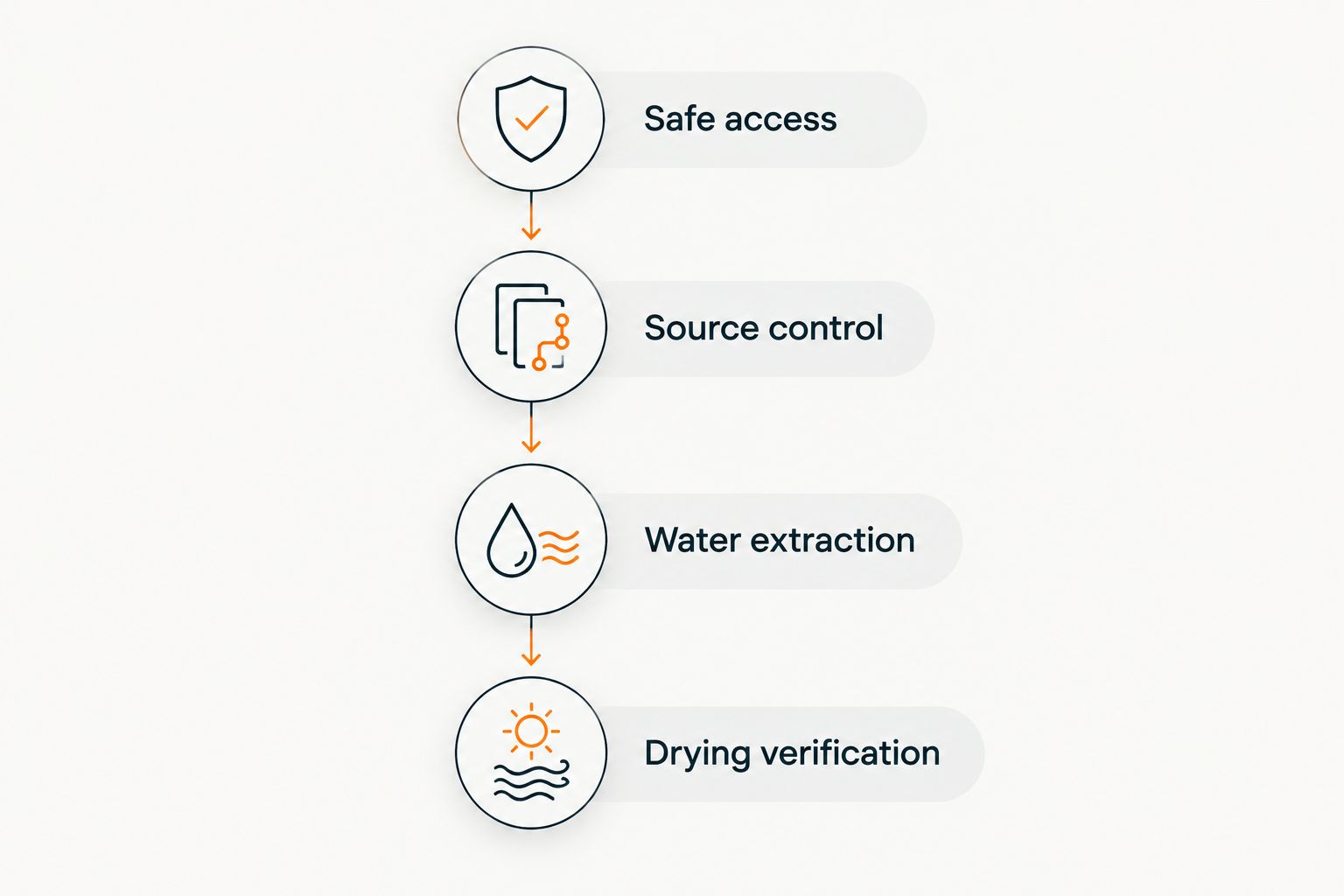
Extraction is an intermediate result, not the finish line. A basement can have no standing water while its drywall, framing, or subfloor remains wet.
Drying verification
- Request a material-specific drying plan. Ask which rooms and assemblies are affected, where equipment will operate, and how drying progress will be checked. Do not accept touch alone as the completion test.
- Address contamination before adding airflow. Do not aim fans at suspected mold or sewage-affected materials. Cleaning, containment, and removal decisions come before general air movement in those areas.
- Keep the drying setup consistent. Follow the provider's instructions about equipment, doors, windows, and access. Report a power interruption or new water entry instead of assuming the original plan still applies.
- Review moisture readings before repairs. Ask for the affected locations, changes in readings, and the basis for deciding materials are ready for closure. Different materials and meter settings require interpretation; there is no single universal reading for every basement.
- Confirm the source remains controlled. Before replacing finishes, confirm that the pump and discharge problem has been addressed and that no new seepage is appearing.
Expected result: the decision to rebuild rests on documented material conditions and controlled water entry, not a dry-looking floor or an arbitrary equipment rental period.
EPA water damage guidance emphasizes drying wet materials within 24 to 48 hours to help prevent mold growth. Use that guidance to act promptly, not as a promise that every basement will finish drying within that window.
For your 2026 repair handoff, request a written distinction between completed cleanup, remaining drying, and reconstruction. That prevents a finished-looking room from hiding an unfinished moisture problem.
Request help with basement water damage
24/7 emergency restoration. Free inspections during business hours, 8am to 4:30pm.
When the sump runs but water returns
A working pump with recurring basement water needs a different starting point from a failed motor. Repeat the safety check, then ask the technician to evaluate the whole drainage route rather than simply replacing the pump again.
- Water returns during rain: document where it first appears. Report whether it comes over the pit, through a wall joint, beneath a door, or from a drain.
- The pump cycles repeatedly: ask for assessment of the float, discharge, check valve, and incoming water. Frequent cycling alone does not identify the cause.
- Water appears away from the pit: have the source investigated. Plumbing leaks, seepage, and drain backups require different corrections.
After new water enters, reassess the affected materials. Yesterday's drying readings do not establish the condition of materials wetted again today.
For rental or commercial properties, assign one person to maintain the incident record and communicate access changes. Clear ownership prevents the pump technician and cleanup provider from receiving conflicting instructions.
Troubleshooting
The pump runs, but the water level does not fall
Keep people out of the water and report the condition to the pump technician. Ask for assessment of discharge obstruction, pump function, and incoming water; do not disconnect wet equipment to investigate it yourself.
The basement smells musty after extraction
Request a moisture assessment of walls, flooring layers, and other affected assemblies. Odor is a reason to investigate, not proof of a specific mold condition or a reason to cover the smell.
The floor feels dry, but the wall base remains wet
Pause finish repairs and have the wall assembly evaluated. Surface drying does not establish whether insulation or the enclosed cavity has dried.
Drying progress stalls
Report equipment interruptions, open windows, new seepage, and any changes to room access. Ask the drying provider to reassess moisture conditions and the setup rather than simply extending an unchanged plan.
Insurance instructions seem to conflict with urgent cleanup
Contact the insurer promptly, document the instructions, and explain the immediate conditions. Do not wait in an unsafe building or leave an active hazard unaddressed while discussing coverage; policy coverage and claim decisions remain with the insurer.
Customize your workflow
Build a short basement incident sheet for 2026 with the property address, safe access point, owner or manager contact, pump service contact, and restoration contact. Add locations of relevant equipment without instructing an untrained person to enter water or operate electrical systems.
Phoenix Restoration Group provides 24/7 emergency restoration, with free inspections for all services during business hours, 8am to 4:30pm. Those are separate arrangements. Do not assume a business-hours inspection means an emergency arrival time has been confirmed.
When you contact the restoration team, describe the water conditions and access hazards first. Phoenix Restoration Group keeps you informed from the initial assessment through cleanup; ask what needs a decision now and what remains unresolved.
FAQ
What should I do first when my sump pump fails and floods the basement?
Keep people out of the affected area and assess hazards from a safe, dry location. Do not enter standing water to reach electrical equipment; arrange appropriate safety assessment, pump service, and water damage cleanup.
Does replacing the sump pump fix basement water damage?
No. Replacing or repairing the pump addresses the equipment problem, but wet flooring, walls, insulation, and contents still need assessment, extraction, cleaning, and drying as appropriate.
Can I pump out a deeply flooded basement myself?
Get a professional assessment before removing deep basement floodwater, especially when the surrounding ground remains saturated. Water removal can change pressure across basement walls and floors, and electrical or contamination hazards can make entry unsafe.
How long does a basement take to dry after sump pump failure?
Drying is complete when the affected materials meet appropriate drying criteria, not after a fixed number of days. Water extent, material layers, contamination, and continued seepage affect the work; request documented moisture checks before rebuilding.
Should I put fans in the basement immediately?
Do not start fans where sewage contamination or mold is suspected. Have contamination and electrical conditions assessed first, then follow the drying provider's equipment and airflow instructions.
Does homeowners insurance cover sump pump failure basement water damage?
Coverage depends on your policy, endorsements, exclusions, and the cause of the loss. Contact your insurer, describe the facts, and ask specifically about sump overflow or water backup coverage without assuming the claim is covered.
Does Phoenix Restoration Group offer free basement inspections?
Phoenix Restoration Group offers free inspections for all services during business hours, 8am to 4:30pm. The company also provides 24/7 emergency restoration in Carlisle, Des Moines, and Central Iowa; emergency service and business-hours inspections are separate.
One last thing
Photograph the sump's discharge location from a safe outdoor position, not just the water inside. That record helps the pump technician investigate whether discharged water is returning toward the foundation. Keep it with your 2026 incident photographs and drying documentation.