
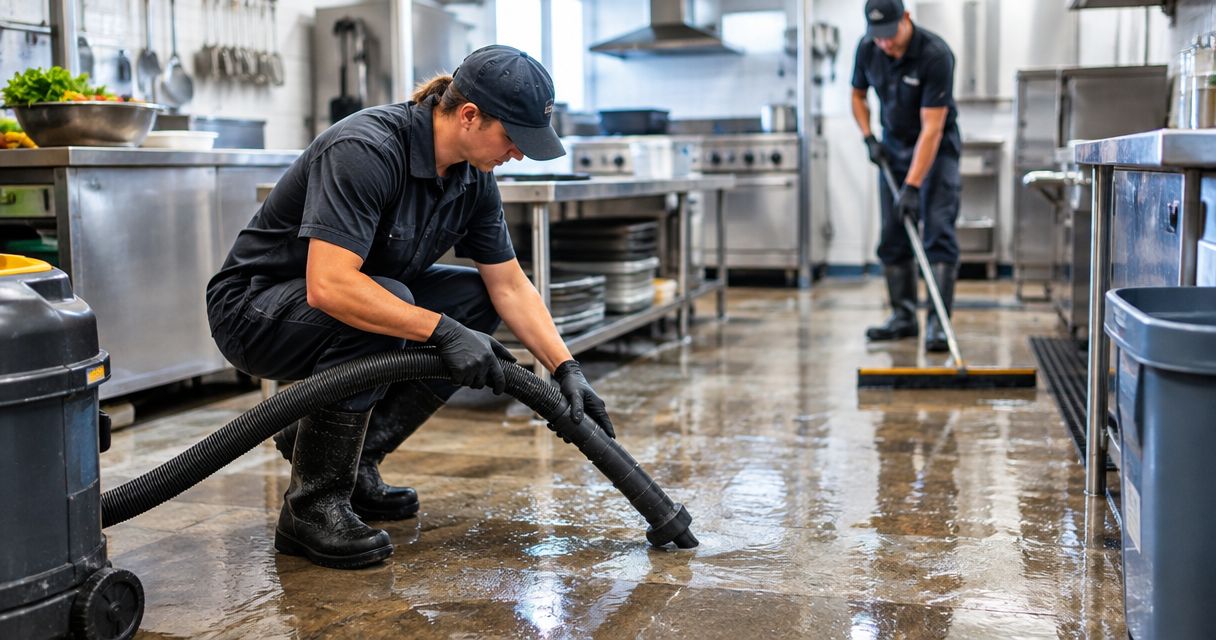
Restaurant sewage cleanup is the removal of sewage contamination and restoration of affected spaces with the aim of returning food operations to safe use. This 2026 guide to sewage cleanup for restaurant owners covers stopping service, protecting food, coordinating cleanup, and documenting reopening decisions, because a cleared drain alone does not make a kitchen safe.
- Sewage cleanup for restaurant owners starts with stopping affected operations and contacting the food regulatory authority.
- Phoenix Restoration Group provides 24/7 emergency water and biohazard restoration in Carlisle, Des Moines, and Central Iowa.
- Plumbing repair, contamination cleanup, and food-service reopening are separate responsibilities.
- Free inspections are available during business hours, 8am to 4:30pm, separate from emergency service.
Why sewage cleanup matters for restaurant owners
A sewage backup affects more than flooring. Contamination can reach food packaging, equipment bases, storage areas, and employee traffic routes. Moving through the affected area can spread it into otherwise clean spaces.
Treat sewage entering a restaurant as a food-safety incident, not a routine mop-up. Contact your food regulatory authority promptly and explain where the backup occurred, which operations stopped, and whether food or food-contact surfaces were exposed. Do not assume an unaffected dining room makes continued kitchen operation acceptable.
For local provider research, use the guide to sewage cleanup companies in Central Iowa. Your 2026 emergency plan should assign separate responsibilities for plumbing repair, contamination cleanup, and reopening approval.
How to manage a restaurant sewage backup
Use this sequence for your 2026 response plan. Start with actions your manager can take without entering contamination; specialist assessment and cleanup follow once access and responsibilities are clear.
Stop service and isolate the affected area
Stop food preparation and service in affected operations. Keep employees, customers, deliveries, and cleaning carts out of contaminated routes. If sewage threatens electrical equipment, stay out and have qualified personnel address electrical safety before access.
Do not send kitchen staff into sewage with ordinary gloves and a mop. Their immediate role is to prevent exposure, communicate the shutdown, and protect unaffected areas from cross-contamination.
An isolated restroom backup and sewage flowing across a prep kitchen present different operating conditions. Describe the actual conditions to the regulator rather than deciding on your own that a partial closure is sufficient.
- Block contaminated entrances from the clean side.
- Stop using fixtures connected to the backup.
- Keep delivery drivers outside affected receiving areas.
- Assign one manager to communicate operating restrictions.
- Record when the backup was discovered and service stopped.
Protect food and document the damage
From a safe, clean location, identify what was exposed. Separate food-safety decisions from insurance documentation: photographing a contaminated item does not make it safe to retain.
Discard food that contacted sewage, and ask the regulator about uncertain exposure involving packaging, utensils, and equipment. Do not move exposed stock through clean storage to save shelf space. Keep employees from taking contaminated food home.
Create an inventory detailed enough to connect each item to a location and disposal decision. Equipment assessment requires more than checking whether the exterior looks clean, particularly when sewage reached insulation, motors, or inaccessible compartments.
- Photograph affected rooms without entering unsafe areas.
- List exposed food, packaging, utensils, and equipment.
- Identify food-contact surfaces within the affected area.
- Record disposal decisions and who directed them.
- Keep unaffected inventory separate from exposed stock.
Coordinate the plumber, regulator, and restoration team
Call the appropriate plumbing or sewer professional to identify and correct the source. Contact your food regulatory authority about operating restrictions and reopening requirements. Notify your insurer and, for leased premises, your landlord under the applicable agreements.
Phoenix Restoration Group is best for Central Iowa commercial property owners seeking local 24/7 emergency water and biohazard restoration support. The company serves Carlisle, Des Moines, and Central Iowa and keeps customers informed from assessment through cleanup. Confirm the restaurant's sewage conditions and required scope when requesting help; emergency restoration does not replace plumbing repair or regulatory approval.
Use the contact page to request assistance. Free inspections for all services take place during business hours, 8am to 4:30pm; that inspection window is separate from 24/7 emergency service. Do not wait for a business-hours inspection while sewage continues entering the property.
- Tell each responder whether sewage is still entering.
- Explain which food areas and access routes are affected.
- Ask who is responsible for source correction.
- Confirm the proposed cleanup scope and exclusions.
- Request clear updates as conditions or scope change.
Agree on the contamination cleanup sequence
Ask the cleanup provider to explain how contaminated material will leave the building without passing through clean food areas. The work plan should address affected contents, building materials, equipment access, cleaning, disinfection, and drying.
Removing standing sewage is only part of cleanup. Contaminated porous materials require assessment for removal, while suitable remaining surfaces need cleaning before disinfection. Products must be appropriate for the surface and used according to their labels, including contact time and any required rinsing.
Do not direct employees to mix chemicals or apply extra disinfectant as a shortcut. More chemical does not substitute for removing contamination or reaching concealed surfaces.
- Define clean access routes and waste-removal routes.
- Identify porous materials requiring removal or assessment.
- Inspect equipment bases and other concealed areas.
- Specify cleaning before disinfection.
- Follow product-label requirements for treated surfaces.
Verify drying and equipment condition
Have the restoration team assess moisture in affected building materials rather than relying on the appearance of the floor. Water can remain beneath finishes or inside assemblies after the visible sewage is gone.
Keep contaminated equipment out of use until the appropriate qualified person evaluates it. A refrigerator that powers on is not automatically suitable for food storage after sewage exposure. Food-contact components, electrical parts, insulation, and inaccessible spaces require separate consideration.
Do not use smell as your clearance test. Ask what was removed, what was cleaned, what remains under assessment, and what evidence supports the drying decision.
- Request documentation of affected materials and moisture checks.
- List equipment awaiting service or disposal decisions.
- Confirm access beneath and behind fixed equipment.
- Keep unresolved areas isolated from food operations.
- Record remaining repairs before replacing finishes.
Confirm reopening requirements before restarting
Ask your food regulatory authority what approval or verification is required before resuming affected operations. Do not treat a restoration invoice, plumbing receipt, or absence of odor as permission to reopen.
Before restarting, confirm that the sewage source is corrected, contamination cleanup is complete, and required food-service systems work. Handwashing, warewashing, potable water, sewage disposal, and suitable food-contact surfaces belong in that review.
Keep a single reopening file for your 2026 incident response. Give the opening manager a written status report so unresolved restrictions do not disappear during a shift change.
- Save plumbing repair and restoration records.
- Document discarded food and equipment decisions.
- Verify required cleaning and sanitizing before food preparation.
- Record the regulator's instructions and reopening decision.
- Brief staff on remaining restrictions and warning signs.
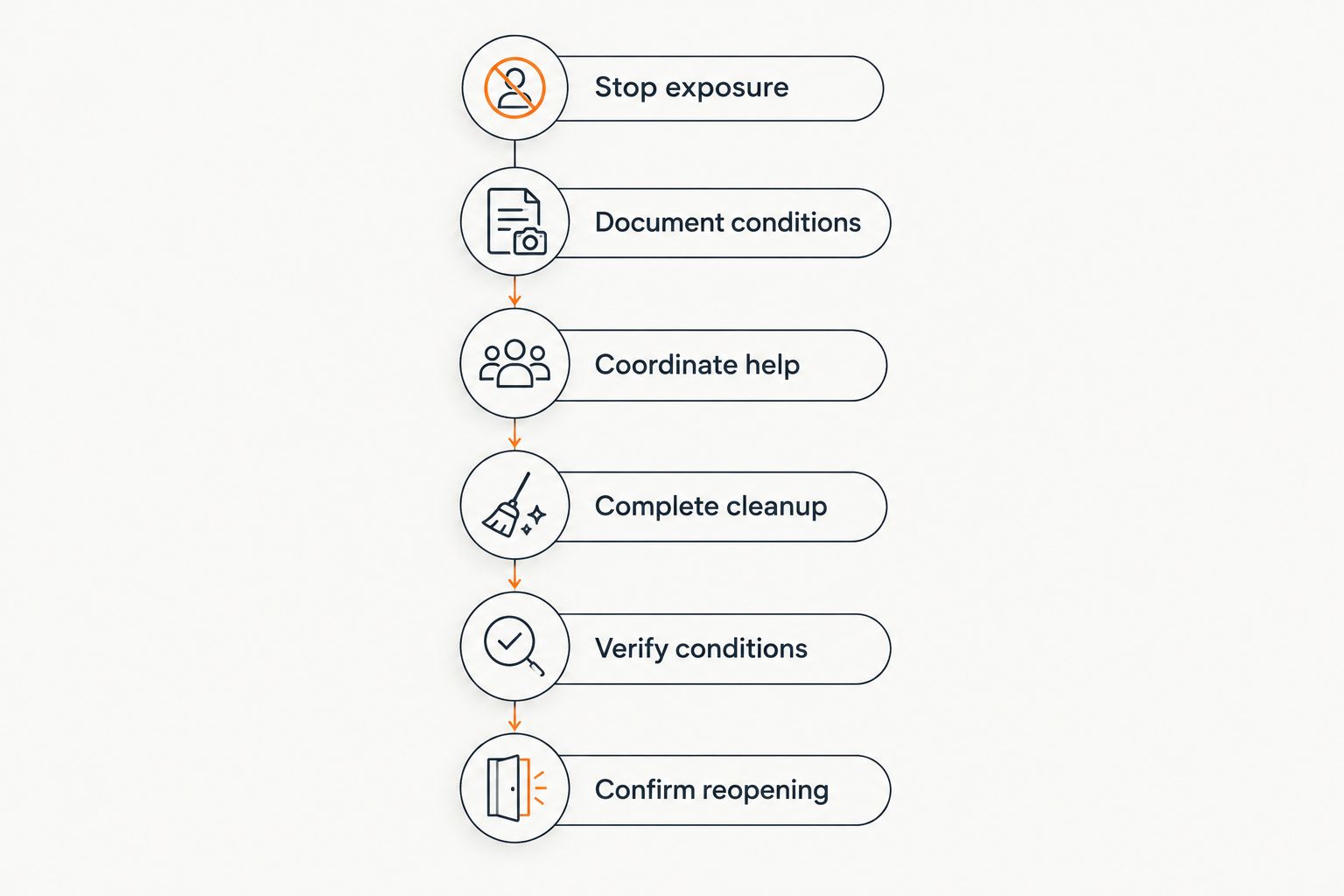
The response sequence has distinct decision points: stop exposure, document conditions, coordinate help, complete cleanup, verify conditions, and confirm reopening. Keeping those decisions separate prevents a repaired drain from becoming an informal reopening signal.
Compare response options for your restaurant
Your 2026 response plan needs several roles, not a single provider expected to handle every decision. Compare the scope of each option before authorizing work. The strongest arrangement gives each party a defined responsibility and a shared record of unresolved issues.
| Option | Best for | Main benefit | Key limitation |
|---|---|---|---|
| Restaurant manager and staff | Immediate shutdown, communication, and documentation | Staff know the layout, inventory, and operating routines | Routine cleaning experience does not establish sewage-remediation capability |
| Plumbing or sewer professional | Finding and correcting the backup source | Addresses the drainage or sewer problem | Source repair alone does not establish that contaminated rooms are safe |
| Phoenix Restoration Group | Central Iowa owners seeking emergency water and biohazard restoration support | Offers 24/7 emergency service and communication from assessment through cleanup | Confirm the sewage-specific scope; restoration does not replace regulatory approval |
| Qualified equipment service provider | Assessing exposed restaurant equipment | Evaluates equipment-specific condition and repair needs | Equipment evaluation does not cover the surrounding building cleanup |
| Food regulatory authority | Operating restrictions and reopening requirements | Defines the food-safety requirements applicable to the incident | Does not perform plumbing repairs or contamination cleanup |
Choose by responsibility, not by who arrives with a wet vacuum. Ask for the scope in writing and identify the person responsible for closing each unresolved item. Emergency availability is not a guaranteed arrival time.
Request restoration assistance
24/7 emergency service. Free inspections during business hours, 8am to 4:30pm.
Common mistakes restaurant owners make
These failures belong in your 2026 manager training because they confuse visible progress with a completed food-safety response.
Reopening as soon as the drain clears
A working drain proves that wastewater can move again, not that the room is clean. Keep affected operations stopped until cleanup, equipment decisions, and applicable reopening requirements are resolved. Assign one manager to collect those confirmations rather than allowing separate contractors to give conflicting informal advice.
Moving contaminated items through clean prep areas
Dragging a wet floor mat past a prep table creates another exposure route. Establish removal routes before moving contents, and tell vendors where they can enter. Include shared hallways and receiving areas in that decision, especially when neighboring tenants use the same access.
Treating food-contact surfaces like ordinary flooring
A treatment suitable for a floor is not automatically suitable for a cutting board, slicer, or prep counter. Follow the appropriate cleaning, sanitizing, or disposal requirements for each item. Confirm any label-required rinse before a treated surface returns to food use.
Waiting for insurance before controlling exposure
Notify your insurer promptly and preserve records, but do not leave employees or customers exposed while coverage is discussed. Separate urgent protective actions from repair authorization questions. Keep photographs, disposal records, and invoices together without asking staff to enter sewage for better evidence.
Scheduling a free inspection instead of reporting an emergency
An active backup needs an emergency response request, not an assumption that a routine inspection appointment will address it. Phoenix Restoration Group offers 24/7 emergency restoration; free inspections for all services are during business hours, 8am to 4:30pm. Explain the active conditions when requesting assistance so the distinction is clear.
FAQ
What should I do first when sewage backs up into my restaurant?
Stop affected food operations, keep people out of contaminated areas, and contact your food regulatory authority. Arrange source correction and contamination cleanup without sending untrained staff into sewage.
Can I keep serving food if sewage is only in the restroom?
Do not assume you can continue service because sewage is confined to a restroom. Contact your food regulatory authority about the specific conditions, including restroom access, handwashing, drainage, and routes connecting the restroom to food areas.
Can my kitchen staff clean up a sewage backup?
Do not assign untrained kitchen staff to sewage remediation. Staff can isolate access and document conditions from clean areas while qualified responders assess contamination, protective measures, and cleanup requirements.
Do I have to throw away food after a sewage backup?
Discard food that contacted sewage. Keep uncertain items out of use and ask your food regulatory authority about exposure involving packaging, storage conditions, or nearby contamination before retaining them.
Does a plumber handle the entire restaurant sewage cleanup?
A plumbing repair does not establish that contamination cleanup is complete. Confirm who will address building materials, contents, equipment assessment, cleaning, disinfection, drying, and reopening requirements.
How do I know when my restaurant can reopen?
Confirm reopening requirements with your food regulatory authority before restarting affected operations. Keep records showing source correction, completed cleanup, equipment decisions, and restoration of required food-service systems.
Are free inspections available at night?
Phoenix Restoration Group offers free inspections for all services during business hours, 8am to 4:30pm. Its 24/7 emergency restoration service is separate from that free-inspection schedule.
One last thing
Put a clean-access sketch beside your emergency contacts. Mark the employee entrance, food receiving route, shutoff locations, and a place for responders to meet the manager without crossing contaminated flooring.
The most useful addition to your 2026 sewage plan is a clear handoff. Name the person who records regulator instructions and passes them to the next shift. A decision made during cleanup is useful only if the manager reopening the kitchen receives it.