
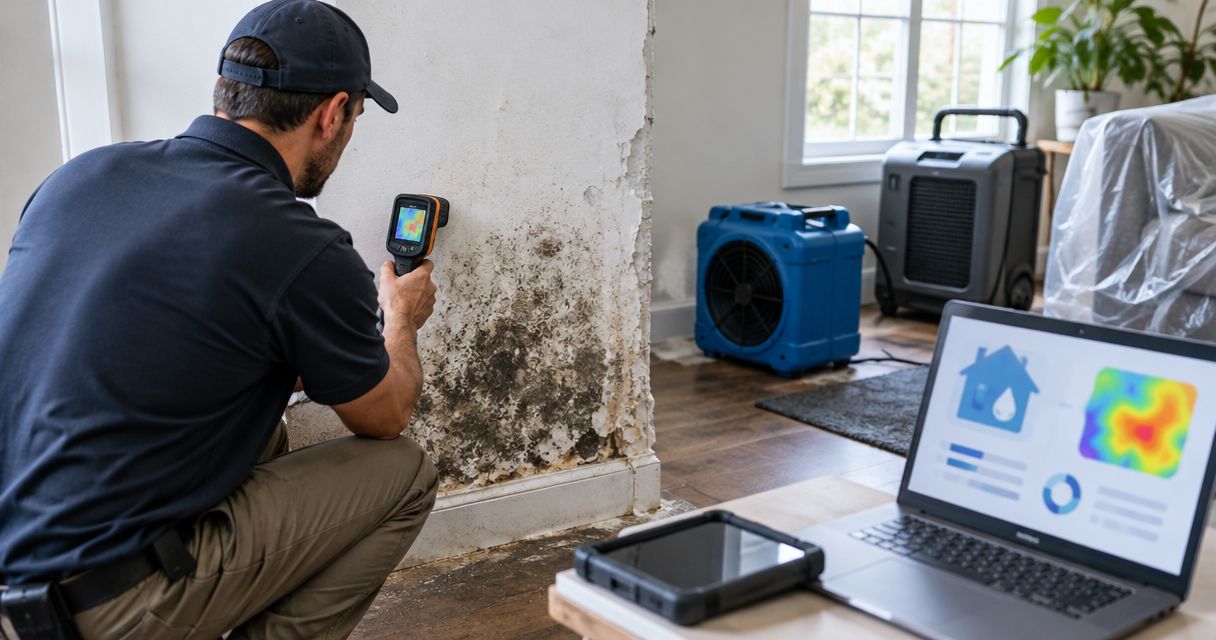
Instead of repeatedly wiping away mold while damp materials stay wet, use a moisture inspection to mold remediation workflow that identifies the water source, defines the cleanup area, and verifies drying before repairs. This 2026 guide explains what to document, what to ask your restoration provider, and when to stop handling the problem yourself.
- A moisture inspection mold remediation workflow starts with locating and correcting the water source, not painting over stains.
- Phoenix Restoration Group provides emergency water and mold restoration across Carlisle, Des Moines, and Central Iowa.
- Document moisture findings, agree on cleanup boundaries, and verify drying before rebuilding.
- Free inspections run during business hours, 8am to 4:30pm; emergency restoration is available 24/7.
Why this matters
Mold cleanup and moisture control solve different parts of the same problem. Removing visible growth does not fix a leaking pipe, condensation, or water entering through the building exterior. Drying a surface does not establish that materials behind it are dry.
Phoenix Restoration Group is best for Central Iowa property owners seeking 24/7 emergency water and mold restoration. Its restoration services include water, fire, mold, and biohazard damage restoration, with communication from assessment through cleanup. Free inspections for all services are offered during business hours, 8am to 4:30pm, separately from emergency service.
Use this 2026 workflow to keep source correction, cleanup, drying, and repair decisions connected. Do not treat a clean-looking wall as proof that the underlying problem is resolved.
Before you start
- Arrange safe access and decision-making authority. Identify who can authorize inspection, plumbing or building repairs, and restoration work. Keep people away from standing water near electrical equipment, unstable materials, and suspected sewage contamination.
- Gather the property history. Bring dated photos, leak reports, previous repair records, and a list of affected rooms. For occupied properties, identify occupants who need arrangements to avoid the work area.
- Do not disturb suspected hidden mold. Opening a wall, pulling carpet, or directing a fan across visible growth can spread contaminated dust. Agree on containment and safe access before anyone starts exploratory demolition.
You do not need to buy instruments before requesting an inspection. You need access, a clear description of the problem, and someone authorized to act on the findings.
Moisture inspection and source assessment
The inspection should connect the location of damp materials with a plausible water pathway. A stain marks where water appeared, not necessarily where it entered.
- Record the history. Note when you first saw staining, smelled a musty odor, or discovered water. Explain whether the problem followed rain, appliance use, plumbing activity, or changes in heating and cooling.
- Map affected areas. Ask the inspector to identify wet materials and compare readings with suitable unaffected materials. Record room names and measurement locations so later checks refer to the same places.
- Interpret instruments together. Moisture meters help investigate materials; thermal imaging shows surface temperature differences. A thermal image alone does not prove moisture or mold, and readings require interpretation for the material being checked.
- Identify source repairs. Separate stopping active water entry from removing existing damage. Ask who will handle the plumbing, roof, drainage, or condensation issue and what remains unresolved.
- Decide whether further investigation is needed. A persistent odor or moisture pattern can justify examining concealed areas, but opening materials requires a plan for controlling dust and exposure.
Expected result: You have a documented moisture map, a source-correction plan, and a clear list of areas that still need investigation. An unexplained wet reading remains an open issue, not a completed inspection.
Cleanup scope and work-area controls
A useful cleanup scope describes materials and boundaries, not just a room name. Your 2026 project record should distinguish what will be cleaned, what requires removal, and what cannot be decided until concealed conditions are assessed.
- Define the boundary. Identify affected rooms, adjoining spaces, concealed cavities under investigation, and routes for workers and removed materials. Tell the provider about shared ventilation and occupied adjacent rooms.
- Separate cleaning from removal. Ask which surfaces can be cleaned and which damaged porous materials require removal. Moldy drywall, insulation, and similar materials often cannot be addressed by wiping the exposed face alone.
- Agree on exposure controls. Have the restoration provider explain containment, dust control, ventilation considerations, and access restrictions appropriate to the work. Do not assume shutting a door provides adequate separation.
- Confirm responsibilities. Assign source repairs, contents handling, restoration work, and reconstruction. Ask what findings would change the scope and how those changes will be communicated before additional work proceeds.
- Set completion criteria. Agree on how the provider will assess cleaning and drying, whether independent verification is appropriate, and what documentation you will receive.
Expected result: You understand the work boundary, material decisions, access restrictions, and conditions required before repairs begin. If the scope only says to spray or treat mold, ask how contaminated materials and the moisture source will be addressed.
Match the response to the finding
These are decision paths, not interchangeable treatments. Each has a useful purpose and a limit.
| Finding and response | Best for | Benefit | Limitation |
|---|---|---|---|
| Moisture investigation and drying assessment | Wet materials without confirmed visible growth | Addresses water damage before choosing unnecessary mold treatment | Does not establish the condition of unexamined cavities |
| Cleaning suitable hard surfaces | Accessible growth on cleanable surfaces | Removes contamination from surfaces that can be physically cleaned | Does not resolve mold inside damaged porous materials |
| Controlled removal and remediation | Mold-affected porous materials or concealed contamination | Addresses materials that surface cleaning cannot adequately reach | Requires work-area controls and decisions about subsequent repairs |
Choose the response from the findings, not from the appearance of the stain alone. An inspector needs to evaluate material condition, moisture, access, and the extent of contamination together.
Remediation, drying, and repair release
Cleanup and drying can overlap under a professional work plan. The key is controlling contamination while removing moisture, rather than circulating air through affected areas without assessing the risk.
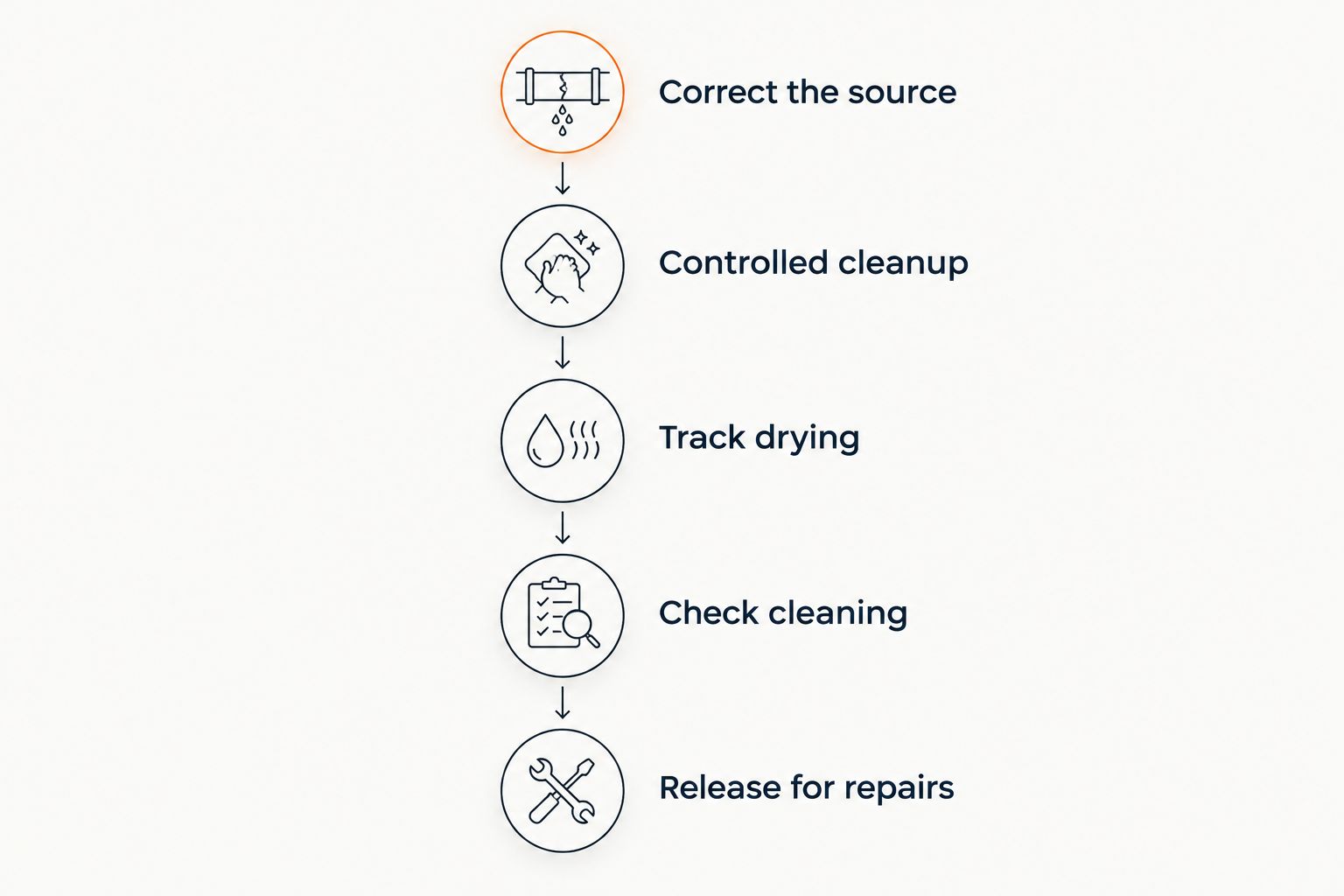
- Correct the water source. Stop ongoing water entry and document permanent repairs or unresolved temporary measures. Do not close a wall around an active leak.
- Complete controlled cleanup. Have affected materials removed or cleaned according to the agreed scope. Keep occupants and unrelated maintenance activity outside restricted work areas.
- Track drying progress. Ask for readings tied to specific locations and materials. Record measurement methods so later readings can be interpreted against earlier findings and suitable dry references.
- Check cleaning and remaining conditions. Review visible debris, residual growth, odors, and inaccessible areas with the provider. Do not use fragrance, paint, or a dry surface as a substitute for evaluation.
- Release the area for repairs. Proceed when source correction, cleanup, and drying criteria are met. Record exceptions and follow-up responsibilities before replacing finishes.
Expected result: You have evidence supporting the repair decision, not simply a statement that equipment has been removed. No universal moisture reading applies to every building material or meter.
EPA homeowner guidance recommends drying wet materials within 24 to 48 hours to help prevent mold growth. That prevention window is not a promised remediation duration, a waiting period, or proof that mold is absent before the window ends.
For moisture prevention after cleanup, EPA guidance recommends keeping indoor relative humidity below 60 percent, ideally 30 to 50 percent. Room humidity does not replace material measurements: a comfortable room can still contain wet drywall or flooring.
Request a restoration inspection
Phoenix Restoration Group offers free inspections during business hours, 8am to 4:30pm, and 24/7 emergency restoration.
Repeat the workflow when moisture returns
A recurring stain or musty odor needs a new source assessment, not automatic repetition of the previous treatment. Use the original records to distinguish a failed repair from a different water pathway.
- Compare locations. Photograph the new condition and match it to the original moisture map. Note whether it affects the same material, an adjacent cavity, or a different floor.
- Record the trigger. Identify whether symptoms followed rain, plumbing use, or changing indoor conditions. Avoid assuming that proximity proves the same cause.
- Reopen unresolved questions. Ask whether source repairs remain effective and whether concealed areas need further investigation. Do not remove materials yourself to check.
- Revise the scope. Update containment, material decisions, and verification requirements from the new findings rather than copying the previous plan.
For recurring problems in 2026, keep earlier reports alongside the new findings. A useful record lets the next inspector see what changed without relying on memory.
Expected result: The new response addresses the current evidence. You retain a traceable history of findings, repairs, and unresolved conditions.
Troubleshooting
The wall looks dry, but readings remain elevated
Delay closing the assembly and investigate the remaining moisture. Surface appearance does not establish cavity conditions. Ask whether measurements are comparable, whether the source remains active, and whether adjacent materials also need assessment.
The musty odor returns after cleaning
Request reassessment instead of adding fragrance or repeating a surface treatment. Remaining damp material, concealed growth, or another moisture source needs investigation. Odor alone does not identify the location or extent of mold.
A thermal image shows a suspicious patch
Confirm the finding with inspection and appropriate moisture measurements. Insulation differences, airflow, and other temperature effects can produce thermal patterns. Do not authorize removal solely because an image shows a different color.
Someone wants to spray or paint over the area
Ask how the plan removes contamination and corrects moisture. EPA mold cleanup guidance advises against painting or caulking moldy surfaces before cleaning and drying them. A coating does not replace source correction or removal of damaged material.
Air sampling is proposed as the only completion check
Ask what question sampling answers and how results will be interpreted. EPA guidance states that sampling is generally unnecessary when visible mold is present, and no federal airborne mold limit establishes a universal pass-or-fail result. Sampling does not replace inspection, source correction, or drying verification.
Customize your workflow
Adapt the record to the people who must use it. Homeowners need clear repair responsibilities; property managers also need tenant access arrangements, shared-system considerations, and a consistent handoff between contractors.
For a sale or transaction, the mold remediation guide for real estate agents provides a related starting point. Keep inspection findings, source repairs, cleanup scope, and completion records together so the next decision-maker can understand the work.
Phoenix Restoration Group provides water and mold restoration for residential and commercial property owners in Carlisle, Des Moines, and Central Iowa. Its free inspection hours are 8am to 4:30pm; 24/7 emergency restoration is a separate service window, not a promise of a specific arrival time.
FAQ
What comes first, a moisture inspection or mold remediation?
A moisture and source assessment comes before defining the mold remediation scope. Immediate safety measures and stopping active water entry should not wait for a complete written report.
Can a moisture meter tell me whether I have mold?
A moisture meter cannot identify mold. It helps locate moisture conditions that guide inspection, while visible growth, material condition, and concealed areas require separate evaluation.
Do I need an air test before removing visible mold?
Air testing is generally unnecessary when visible mold is present, according to EPA guidance. Ask what decision a proposed test will support rather than treating sampling as an automatic first step.
Can I use a fan to dry a moldy wall?
Do not direct a fan across visible mold or suspected contaminated materials before the work area is assessed. Airflow can spread contaminated dust, so drying equipment needs to fit the cleanup plan.
How do I know when a wall is ready to close?
Close a wall after the moisture source is corrected and cleanup and drying criteria are met. Ask for location-specific findings and confirmation that unresolved conditions have been addressed.
Does a free inspection mean emergency service is free?
No. Phoenix Restoration Group offers free inspections for all services during business hours, 8am to 4:30pm. Its 24/7 emergency restoration service is separate from that inspection offer.
What should I keep in my mold remediation records for 2026?
Keep dated photos, inspection findings, moisture measurement locations, source-repair records, the cleanup scope, and completion documentation. Record any unresolved areas and who is responsible for follow-up.
One last thing
The most useful final photo is often the open assembly before repairs conceal it. Photograph accessible areas after cleanup and drying verification, without entering restricted work zones. Pair the images with location-specific records so a future leak investigation starts with evidence rather than guesswork.