
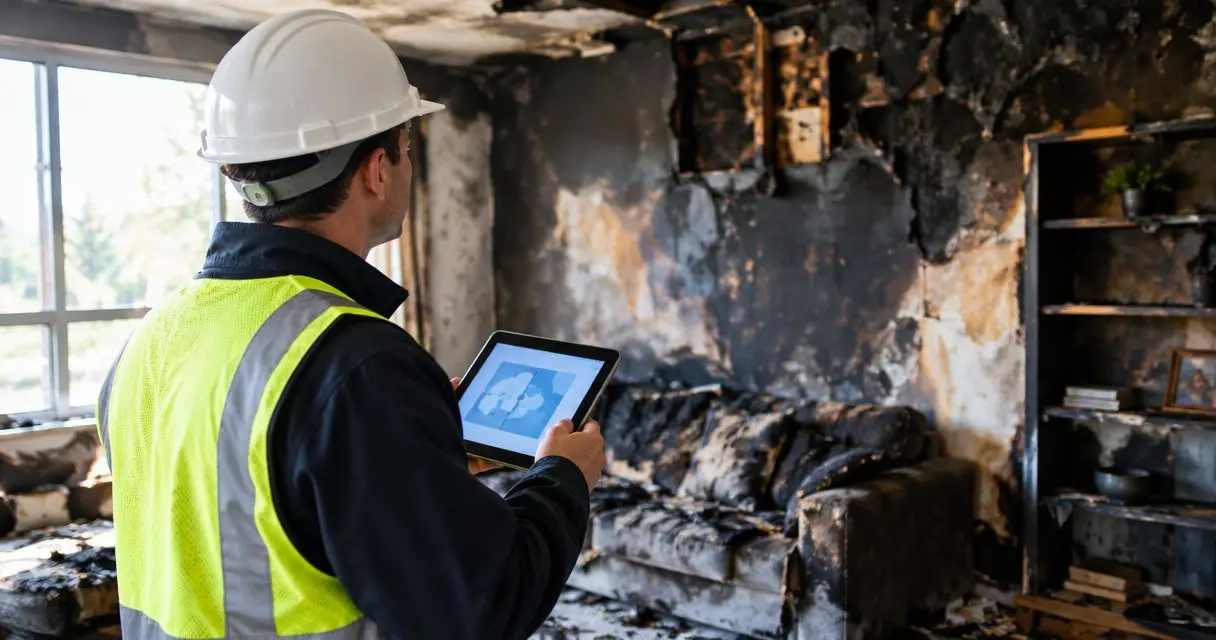
Fire damage restoration cost in 2026 depends on the extent of fire, smoke, soot, and water damage and the work needed to make your property usable again. Get a written, property-specific estimate that separates emergency cleanup from contents work and repairs; a cleanup-only estimate does not tell you the full recovery cost.
- Fire damage restoration cost 2026 estimates should separate cleanup, contents work, and repairs.
- Compare written scopes, not totals that cover different work.
- Phoenix Restoration Group serves Central Iowa property owners needing emergency fire damage restoration.
- Free inspections run during business hours, 8am to 4:30pm; emergency restoration is available 24/7.
Why this matters
After a fire, you need to know what work must happen now, what requires further assessment, and what your estimate leaves out. A single total without those distinctions makes it difficult to authorize work or compare contractors.
Start by identifying the restoration services relevant to the damage, then ask for a scope that addresses your building and belongings separately. The useful estimate is the one that explains what you are authorizing, not simply the one with the lowest total.
How much does fire damage restoration cost in 2026?
Your fire damage restoration cost in 2026 requires an assessment of the affected property. The estimate should identify damaged areas, proposed treatment, removal work, and exclusions rather than treating every fire as the same job.
Use the following breakdown to check what an estimate covers. These are scope categories, not service packages or a promise that every property needs every task.
| Scope category | What to look for | Best for understanding | Limitation to check |
|---|---|---|---|
| Emergency stabilization | Work proposed to address immediate damage and protect affected areas | What needs authorization first | Whether later cleanup and repairs are excluded |
| Smoke and soot cleanup | Affected rooms, surfaces, materials, and proposed cleaning methods | What the cleaning allowance actually covers | Whether concealed areas and contents are included |
| Water removal and drying | Water left by firefighting and materials requiring drying assessment | Whether the estimate addresses moisture as well as fire damage | Whether removal of unsalvageable materials is separate |
| Contents work | Inventory, handling, cleaning assessment, storage, and return arrangements | What happens to your belongings | Whether building cleanup excludes personal property |
| Repairs and reconstruction | Materials and building components proposed for repair or replacement | What remains after cleanup | Whether separate contractors or estimates are required |
Ask the estimator to mark each category as included, excluded, or subject to further assessment. A blank line is not a clear answer.
Also ask whether the document is an initial estimate, an emergency-work authorization, or a proposed scope for the entire project. Those documents serve different purposes. Treating them as interchangeable creates confusion about both responsibility and the remaining work.
Smoke and soot cleanup: define the affected areas
Smoke and soot cleanup should describe where residues are present and which materials the proposed work addresses. A room-by-room scope is easier to check than a general line labeled fire cleanup.
Ask how the assessment handles walls, ceilings, cabinets, fixtures, and other affected surfaces. If smoke traveled beyond the burned room, ask whether those additional areas were inspected and included.
Cleaning preserves materials that can be restored, but it does not resolve every type of damage. Ask what finding would change the recommendation from cleaning to removal or replacement. That explanation helps you understand later revisions without assuming every material can be saved.
Do not judge completion by fragrance alone. Ask how the contractor will evaluate remaining residue and odor, and what follow-up is proposed if an affected area still needs attention.
Water damage after a fire: check the moisture scope
Firefighting water creates a separate assessment need. A surface that looks dry does not establish that the materials beneath or behind it are dry.
Ask whether the scope addresses wet flooring, wall assemblies, insulation, and other affected materials. The estimate should explain proposed water removal, drying, monitoring, and removal work where relevant.
Drying and fire cleanup address different conditions, so confirm how the work fits together. An estimate that covers soot removal alone should not be read as confirmation that moisture has been assessed.
Before anyone closes a wall or installs replacement finishes, ask how the condition of the underlying materials will be checked. This is a scope question, not a reason to enter unsafe areas or investigate concealed damage yourself.
Contents and repairs: separate belongings from the building
Building cleanup and belongings cleanup are not the same scope. Ask whether furniture, clothing, electronics, documents, and other affected contents are being assessed separately.
A contents inventory helps you track decisions. Request a record of items proposed for cleaning, items proposed for disposal, and items awaiting a decision; keep your own photographs when it is safe to take them.
Repair work also needs clear boundaries. Removing damaged drywall does not, by itself, mean replacement drywall, painting, electrical work, or finish repairs are included.
Get the handoff in writing. Ask who is responsible for the next phase, what must happen before that phase starts, and which authorizations remain outstanding. Do not assume one contractor's cleanup estimate includes every trade needed to restore use of the space.
Why fire damage restoration costs vary
For a 2026 fire damage restoration estimate, focus on the conditions and tasks that define the job. These factors explain scope differences without relying on an unrelated property's bill:
- Affected area: The estimate needs to identify which rooms and building components require work, not just where the fire started.
- Material condition: Surface residue, charring, saturation, and physical damage require different assessments and treatment decisions.
- Smoke movement: Smoke outside the burned area changes which spaces and surfaces need inspection.
- Firefighting water: Wet materials introduce water removal, drying, and moisture-assessment needs alongside fire cleanup.
- Contents handling: Inventory, moving, cleaning assessment, storage, and return are distinct from work on the building.
- Repair boundaries: An estimate limited to cleanup is not equivalent to one that also includes reconstruction and finish work.
Ask the contractor to connect each proposed task to an observed condition. You should be able to understand why the task appears in the estimate and what area or material it covers.
When a condition cannot be assessed until damaged material is removed, ask how that uncertainty will be documented. A clear revision process is more useful than a promise that an initial estimate can never change.
How to get an estimate you can compare
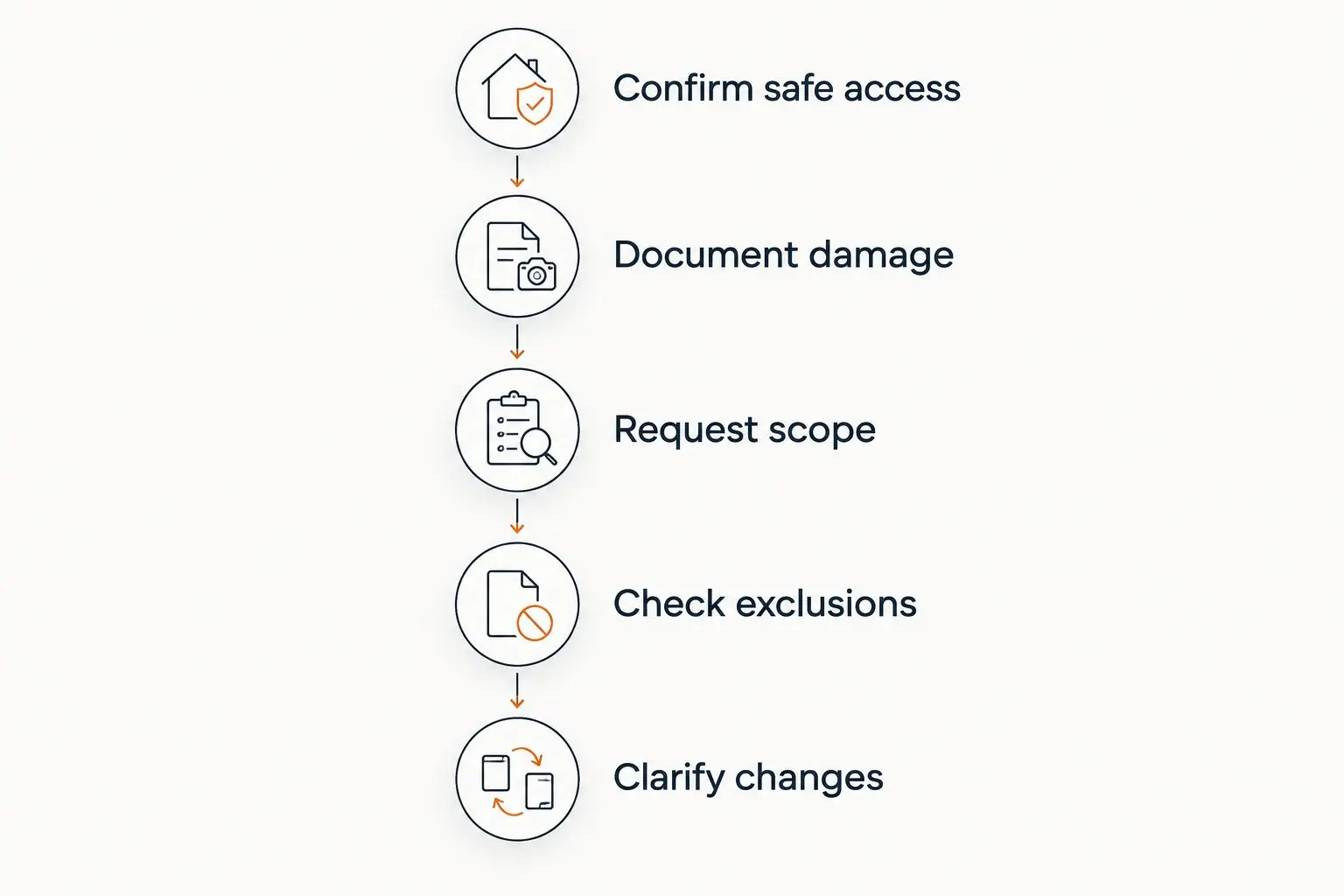
Use this sequence when requesting fire damage restoration estimates in 2026. Keep emergency safety decisions separate from a longer comparison of repair proposals.
- Confirm safe access. Follow fire department and relevant utility guidance before entering or using affected systems. Do not enter a damaged structure to collect estimate details.
- Document damage. When access is safe, photograph affected rooms and belongings. Record what you know about the fire and any work already performed.
- Request scope. Ask for written tasks, affected areas, proposed methods, and the division between emergency work and later phases.
- Check exclusions. Identify contents, repairs, storage, disposal, and other work not included in the proposed authorization.
- Clarify changes. Ask how additional findings, revised work, and your approval will be recorded before extra work proceeds.
This sequence gives you a usable comparison without asking contractors to guess from a brief description. Keep the estimate, photographs, authorizations, and subsequent revisions together so you can track what changed.
Compare estimates without overlooking missing work
Put the estimates side by side and check the same rooms, materials, and tasks. A lower total does not establish better value when one proposal leaves out work another includes.
Look for these details before making a decision:
- Area descriptions: Can you tell where each task will take place?
- Treatment decisions: Does the estimate distinguish cleaning from removal and replacement?
- Responsibility: Is it clear who handles contents, repairs, and any separate trades?
- Documentation: Will you receive records of findings and authorized changes?
- Completion criteria: What will be checked before each phase is considered complete?
Avoid choosing solely on a verbal assurance that everything is included. Ask the contractor to identify the relevant work in the written scope.
For commercial properties, also identify access restrictions and the areas needed for operations. Do not assume a restoration estimate includes lost business income, temporary premises, or every requirement for reopening; those need separate discussion with the responsible parties.
Will insurance cover my fire restoration bill?
Insurance payment depends on your policy, the loss circumstances, and the insurer's coverage decision. A contractor's estimate describes proposed work; it does not establish what your insurer will pay.
Notify your insurer and ask about documentation, required authorizations, deductibles, limits, and the handling of emergency mitigation. Keep receipts and written communications, and ask before discarding damaged belongings unless safety authorities direct otherwise.
Do not treat an insurance estimate, contractor authorization, and coverage decision as the same document. Ask who pays any disputed or excluded amount before signing an agreement you do not understand.
Does an inspection include the restoration work?
An inspection assesses conditions; it is not the cleanup or repair itself. Ask what the assessment will cover and what written information you will receive afterward.
Phoenix Restoration Group offers free inspections for all services during business hours, 8am to 4:30pm. Its 24/7 emergency restoration service is separate from that business-hours inspection offer.
Phoenix Restoration Group is best for residential and commercial property owners in Carlisle, Des Moines, and Central Iowa who need local emergency fire damage restoration. The team keeps you informed from the initial assessment through cleanup; your property-specific scope still needs to establish the work required.
Use the contact page to explain whether you need emergency restoration or a business-hours inspection. Do not delay an active emergency while waiting for a routine assessment, and contact emergency services for an active fire or immediate danger.
FAQ
What's included in fire damage restoration cost in 2026?
Fire damage restoration cost in 2026 depends on the written scope for your property. Check whether it includes smoke and soot cleanup, firefighting-water damage, contents work, removal, and repairs rather than assuming every task is covered.
Can I get an accurate fire restoration estimate from photos?
Photos help explain visible damage, but they do not establish concealed conditions or the full restoration scope. Ask which findings require an on-site assessment and whether the initial estimate remains subject to those findings.
Is smoke cleanup the same as complete fire restoration?
Smoke cleanup is not the same as complete fire restoration. A smoke-cleaning scope does not automatically include water damage, contents handling, structural repairs, or replacement finishes.
Should I choose the lowest fire damage restoration estimate?
Choose based on comparable written scopes, not the lowest total alone. Check affected areas, exclusions, repair responsibilities, and the process for approving changes before deciding.
Does Phoenix Restoration Group offer free fire damage inspections?
Phoenix Restoration Group offers free inspections for all services during business hours, 8am to 4:30pm. Emergency water, fire, mold, and biohazard restoration is available 24/7; that availability is separate from the free inspection hours.
Will my insurance pay everything the restoration contractor charges?
Your insurance payment depends on your policy and the insurer's coverage decision. Confirm deductibles, limits, excluded work, and responsibility for any unpaid balance rather than assuming the contractor's entire estimate is covered.
What should I ask before signing a fire cleanup authorization?
Ask exactly which work you are authorizing and what remains excluded. Confirm how additional findings, revised work, and approval for changes will be documented.
One last thing
Before signing a 2026 fire restoration estimate, ask the contractor to identify the work that will still be unfinished when the proposed scope ends. That question exposes the boundary between cleanup and a usable property more clearly than asking whether the estimate covers everything.
Keep that answer with the authorization. You need a record of both what happens next and what remains your responsibility.