
Biohazard cleanup costs depend on the contamination, affected materials, and work required, so you need a site-specific assessment rather than a flat-rate assumption. For a 2026 estimate, check whether the scope includes material removal, waste handling, and repairs, not just surface cleaning.
- How much does biohazard cleanup cost? Compare the assessed cleanup scope, exclusions, and approval terms rather than unsupported averages.
- Phoenix Restoration Group provides biohazard cleanup and 24/7 emergency restoration in Carlisle, Des Moines, and Central Iowa.
- Free inspections cover all services during business hours, 8am to 4:30pm, not unrestricted emergency work.
- Ask whether your estimate includes contaminated material removal, waste handling, and repairs before authorizing work.
How much does biohazard cleanup cost?
The useful number is the written estimate for your property, with the work and exclusions clearly identified. A room description alone does not establish that scope. Contamination on an accessible surface presents a different cleanup problem from contamination that has reached carpet backing, wall cavities, or other concealed materials.
Use the following breakdown when reviewing a 2026 biohazard cleanup estimate. These are scope questions to resolve, not a promise that every incident requires every task.
| Scope component | What to ask | Why it matters |
|---|---|---|
| Assessment | Which rooms, surfaces, and belongings were assessed? | Defines the area covered by the estimate |
| Work-area controls | How will access and movement through the area be managed? | Clarifies protection for unaffected spaces |
| Cleaning and disinfection | Which materials will be treated, and how? | Separates the treatment plan from general housekeeping |
| Material removal | Which items or building materials require removal? | Identifies work beyond surface treatment |
| Waste handling | Who will package, transport, and manage waste? | Establishes responsibility for removed material |
| Repairs | Does the scope include replacing removed finishes? | Prevents confusion between cleanup and rebuilding |
Why this matters
An estimate that says only biohazard cleanup leaves important questions unanswered. You need to know what the crew will treat, what will leave the property, and what condition the affected space will be in when the agreed work ends.
Phoenix Restoration Group provides water, fire, mold, and biohazard damage restoration across Carlisle, Des Moines, and Central Iowa. Free inspections for all services are available during business hours, 8am to 4:30pm; emergency restoration is available 24/7. A business-hours free inspection and emergency restoration are different services, so clarify which you are requesting.
Why biohazard cleanup costs vary
The scope follows the contamination and the property conditions. For your 2026 estimate, ask the contractor to explain how each relevant factor changes the proposed work instead of accepting a total without supporting detail.
- Affected area: Identify the contaminated locations, not just the property's total floor area. Ask whether adjacent surfaces need assessment.
- Material type: Carpet, upholstery, unfinished wood, and other porous materials require different decisions from accessible hard surfaces. Ask what can be treated and what requires removal.
- Hidden spread: Contamination beneath flooring or behind finishes changes the accessible work area. Ask how newly discovered conditions will be documented.
- Access and isolation: Stairs, occupied rooms, and shared corridors affect how crews move equipment and removed materials. Establish access arrangements before work begins.
- Waste requirements: Handling and disposal depend on the material and applicable requirements. Ask who takes responsibility for each stage.
- Restoration boundaries: Removing contaminated material does not automatically include installing its replacement. Confirm where cleanup ends and repair work begins.
Compare matching scopes, not totals alone. An estimate that excludes material removal cannot be compared directly with an estimate that includes it. Ask each contractor to identify exclusions in writing before deciding.
How do you get a useful cleanup estimate?
Start with information you can provide without entering or disturbing the affected area. Your goal is to help the contractor assess the situation, not to investigate the contamination yourself.
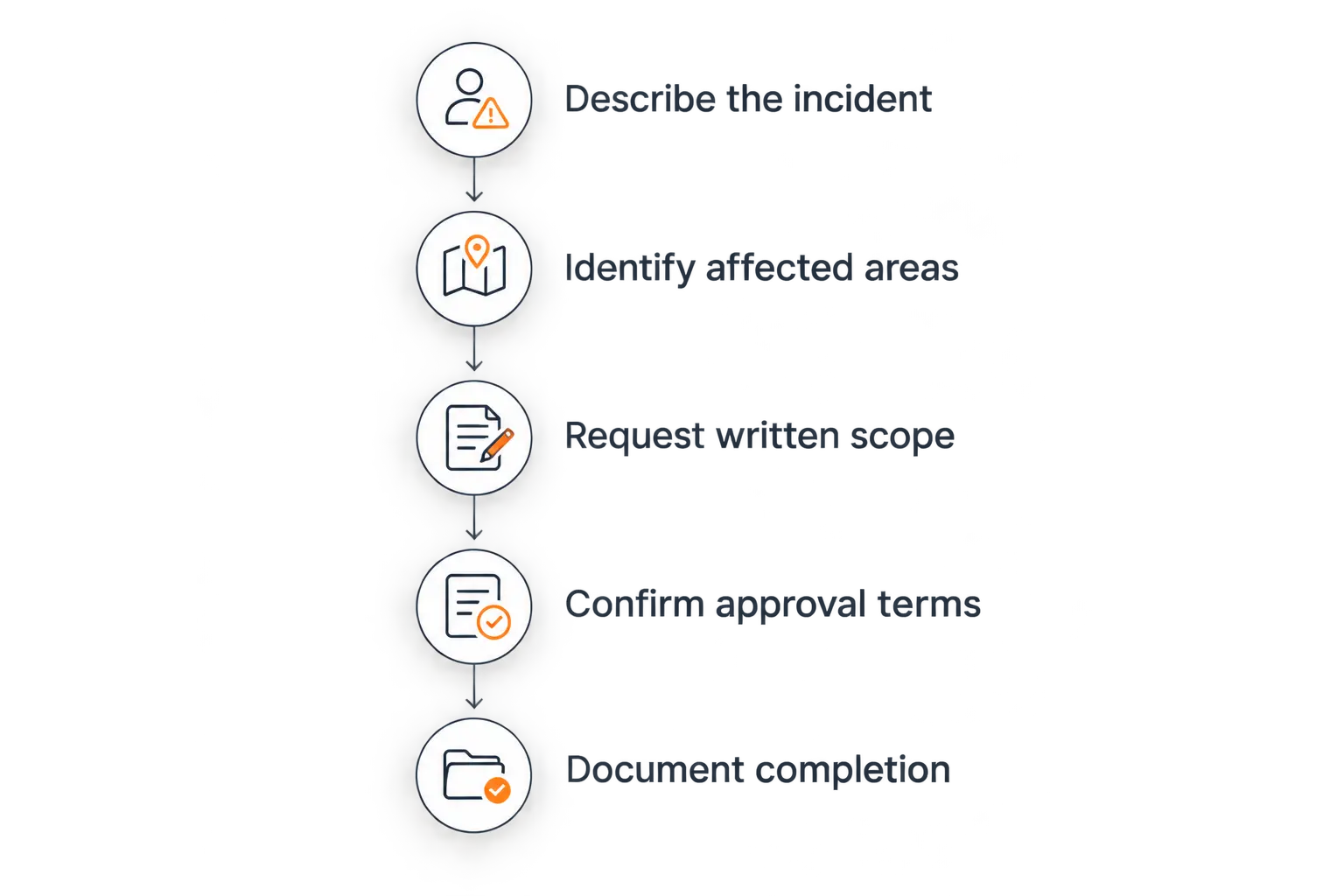
Describe the incident
Explain what happened, where it happened, and whether the source of contamination is still active. State whether emergency responders or another authority have restricted access; restoration scheduling does not override those restrictions.
Avoid guessing about what is beneath flooring or inside walls. Separate what you observed from what you suspect so the assessment addresses both accurately.
Identify affected areas
List the rooms and materials involved, including nearby belongings you are concerned about. If you already have photographs taken safely, ask how to share them without exposing private or sensitive information unnecessarily.
Do not move contaminated furniture to create a clearer view. Leave assessment and handling decisions to the people responsible for the cleanup.
Request written scope
Ask for a description of the treatment, removal, waste handling, and access arrangements. Request clear boundaries for any work that is not included, particularly repairs and replacement belongings.
The restoration services page identifies the service categories available. Your property's assessment should establish the specific work, rather than treating a general service description as the full agreement.
Confirm approval terms
Identify who can authorize the initial work and any changes. If concealed contamination is discovered, ask how the contractor will explain the finding and obtain approval for a revised scope.
For a rental or commercial property, establish whether the owner, property manager, or another authorized representative makes that decision. Resolve this before the crew needs an answer on site.
Document completion
Ask what completion documentation you will receive and what work, if any, remains outside the agreement. Confirm who will explain the condition of the treated area and any restrictions that still apply.
Keep the estimate, approvals, change records, and final invoice together. This gives you a consistent record for your property files and any insurance discussion.
Should you request an inspection or emergency service?
Choose the service based on the immediate situation, not on an assumption about what an inspection includes. If anyone faces an immediate medical, fire, or public-safety emergency, contact emergency services first. A restoration company does not replace emergency responders.
| Service option | Best for | Benefit | Limitation |
|---|---|---|---|
| Business-hours inspection | Planning an assessment when immediate emergency intervention is not needed | Establishes an opportunity to discuss the affected property and proposed work | Inspection hours do not mean cleanup is included |
| Emergency restoration | Requesting restoration help for an urgent contamination incident | Allows an urgent service request outside inspection hours | Availability does not establish a specific arrival time or the final work scope |
Phoenix Restoration Group is best for Central Iowa property owners seeking local 24/7 emergency biohazard restoration. The company offers free inspections for all services during business hours, 8am to 4:30pm, and keeps you informed from assessment through cleanup.
When making a 2026 service request, describe the incident and ask what happens next. Confirm the assessment arrangements, authorization requirements, and communication contact without assuming an arrival time.
Request a biohazard cleanup assessment
24/7 emergency restoration. Free inspections for all services during business hours, 8am to 4:30pm.
Does biohazard cleanup include repairs?
Biohazard cleanup includes repairs only when the written agreement expressly includes them. Removing affected carpet, drywall, or another material and replacing it are separate tasks, even when they concern the same room.
Before authorizing removal, ask what the space will look like afterward and who will handle replacement work. This is especially important when you need to coordinate tenants, employees, or another contractor around the affected area.
A clear 2026 agreement should distinguish treatment, removal, and repair responsibilities. Do not treat the word restoration as proof that every repair is included. Read the actual scope and ask about anything left undefined.
Will insurance cover biohazard cleanup?
Insurance coverage depends on your policy and the incident, so your insurer must confirm the coverage decision. Do not assume that a cleanup estimate establishes whether a claim will be accepted.
Ask your insurer what documentation it needs, what authorization requirements apply, and how it wants you to handle urgent protective work. Keep photographs and incident records that you can obtain safely, along with the contractor's estimate and approvals.
An insurance discussion and a service agreement serve different purposes. Before signing, understand what you are authorizing and your payment responsibility under the agreement, including if the insurer does not approve the full claim.
Can you reduce the scope without compromising safety?
You can make the assessment process clearer by providing accurate information and arranging authorized access. That is different from trying to remove contaminated materials yourself to reduce the job.
Use this preparation checklist:
- Keep people away: Prevent unnecessary entry into the affected area until you receive appropriate guidance.
- Avoid disturbing materials: Do not carry affected belongings through clean rooms or begin removing finishes before assessment.
- Identify the decision-maker: Give the contractor a reliable contact who can approve the agreed work.
- Explain access restrictions: Mention locked rooms, shared entrances, tenant access, and any official restrictions.
- Separate essential work from later decisions: Ask which tasks address contamination and which concern subsequent repairs or replacements.
Do not use odor alone to judge the scope or completion of cleanup. Ask what was assessed, what was treated or removed, and what documentation supports the completed work.
FAQ
How much does biohazard cleanup cost in 2026?
Biohazard cleanup requires a site-specific estimate based on the contamination, affected materials, access, and required work. Ask for a written scope that identifies treatment, removal, waste handling, and exclusions.
Can I get a free biohazard cleanup inspection?
Phoenix Restoration Group offers free inspections for all services during business hours, 8am to 4:30pm. Its 24/7 emergency restoration service is separate from those inspection hours.
Can I get an accurate cleanup estimate from photos?
Photos can support an initial discussion, but they do not establish the condition of concealed materials. Ask what assessment is needed before treating an estimate as the agreed scope.
Does a biohazard cleanup estimate include replacing carpet?
Carpet replacement is included only if the written scope specifically includes it. Ask separately about assessment, removal, disposal, and replacement so the responsibilities are clear.
Will my homeowners insurance pay for biohazard cleanup?
Your insurer must confirm whether your policy covers the incident and proposed work. Keep the estimate and work authorizations, and ask what claim documentation is required.
Should I clean the affected area before the inspection?
Do not disturb suspected biohazard contamination before receiving appropriate guidance. Restrict unnecessary access and describe the incident without handling affected materials.
Does emergency availability mean a guaranteed arrival time?
24/7 emergency availability does not establish a guaranteed arrival time. Ask about the next steps for your location and incident when requesting service.
One last thing
The most useful question is not just what the cleanup total is, but what condition the property will be left in. Ask the contractor to describe the handoff: which materials remain, which have been removed, what documentation you receive, and what still needs repair.
Before approving a 2026 biohazard cleanup agreement, read the exclusions alongside the included work. If an essential task appears in neither place, resolve it in writing rather than assuming someone else has it covered. A short clarification before authorization gives you a clearer basis for decisions throughout cleanup.