
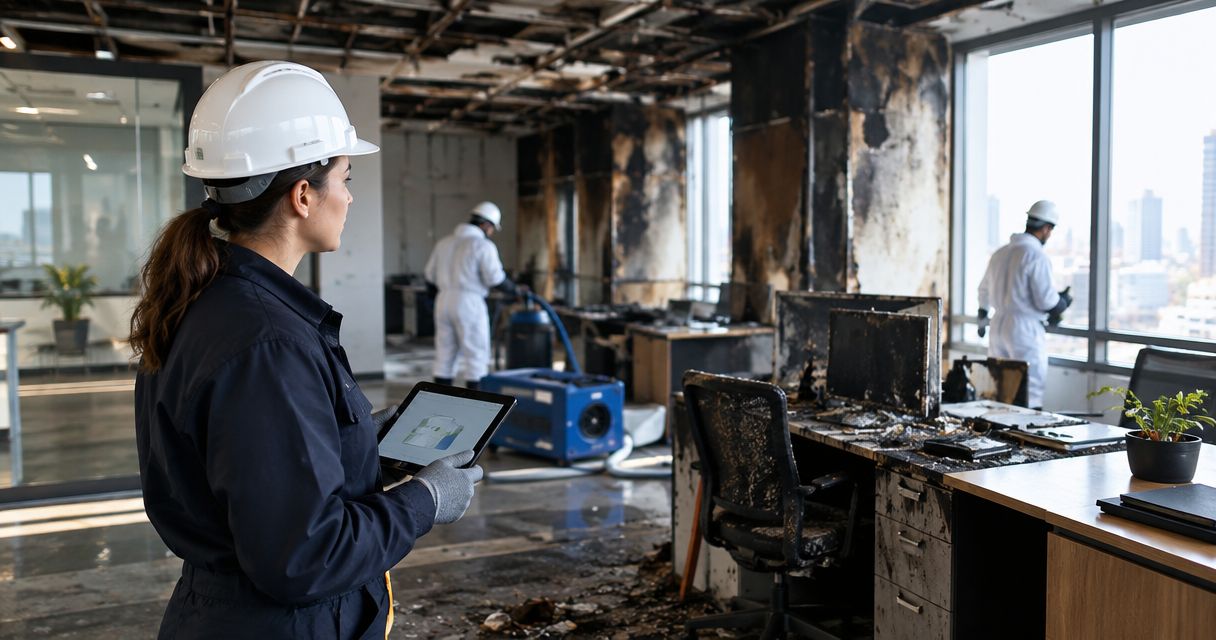
Commercial property fire restoration is the assessment, cleanup, and repair of fire-related damage with the aim of returning a business property to safe use. This 2026 guide covers fire damage restoration for commercial properties, where tenant access, equipment, insurance documentation, and reopening decisions require separate attention.
- Fire damage restoration for commercial properties requires separate decisions about safe access, smoke cleanup, water damage, and reopening.
- Phoenix Restoration Group is best for Central Iowa commercial property owners seeking local, 24/7 emergency fire restoration.
- Document affected rooms, equipment, and business interruptions before cleanup changes the evidence, without entering unsafe areas.
- Free inspections run during business hours, 8am to 4:30pm; emergency restoration is available 24/7.
Why fire restoration matters for commercial properties
A commercial fire creates more than a cleanup task. You must control access, distinguish building damage from tenant-owned losses, and decide which operations can remain suspended or relocate. Smoke, soot, and firefighting water also require assessment beyond the visibly burned area.
Treat emergency stabilization and business reopening as separate decisions. Permission to enter a building does not establish that equipment, utilities, inventory, or individual workspaces are ready for use.
For your 2026 response plan, identify the person authorized to approve emergency work and the people responsible for insurance, tenants, and facilities. Review the available restoration services before an incident so your team knows which damage categories to report.
Commercial properties need particular attention to:
- Shared corridors, exits, and tenant boundaries.
- Business equipment and inventory ownership.
- Firefighting water and concealed moisture.
- Access for employees, contractors, and customers.
- Documentation supporting separate property and business-interruption claims.
How to manage commercial fire damage restoration
1. Establish safe access before documenting damage
Start with the access instructions issued by emergency responders and the authority controlling the scene. Do not enter to retrieve files, inspect stock, or take photographs until entry is permitted. A familiar building is not a safe building simply because the flames are out.
Create an access log using a paper sheet or shared document. Record who enters, why they enter, and which areas remain restricted. Keep employees and tenants informed through a single designated contact rather than allowing separate teams to make access decisions.
Do not restart utilities or enter an area with suspected structural or electrical damage to check conditions yourself. Assign those questions to the appropriate qualified professionals. Keep emergency stabilization moving without treating a general access decision as approval for every task inside.
- Record the incident address and affected tenant spaces.
- Identify who controls access to the property.
- Mark restricted areas from a safe location.
- List utility concerns for qualified assessment.
- Assign one contact for access updates.
2. Build a damage record before conditions change
Once access is permitted, document conditions without handling damaged materials unnecessarily. Use a phone camera, a room list, and an inventory spreadsheet. Photograph overall conditions before recording individual items, keeping room names consistent across photos and written notes.
Separate observed damage from assumptions. Write that a ceiling is stained or a machine has visible soot rather than deciding its repairability yourself. Record firefighting water, damaged packaging, affected documents, and areas where access prevents inspection.
Contact your insurer about reporting requirements, emergency mitigation, and damaged-item documentation. Do not delay necessary safety measures to complete an inventory. Keep emergency work records and ask how the insurer wants disposal decisions documented.
Make the file usable by someone who was not present. Your 2026 incident folder should connect each photograph, invoice, and inventory entry to a location and date.
- Photograph rooms before close-up details.
- Separate building, tenant, and business-owned items.
- Record model and serial information when safely accessible.
- Save incident reports and emergency-work records.
- Keep receipts for temporary operating arrangements.
3. Request an assessment that covers every damage category
Prepare a plain-language summary before contacting a restoration provider: what burned, which spaces are affected, whether firefighting water is present, and which areas remain inaccessible. This gives the assessment a clear starting point without asking your staff to diagnose contamination or structural conditions.
Phoenix Restoration Group provides fire damage restoration for commercial properties, along with water, mold, and biohazard restoration, across Carlisle, Des Moines, and Central Iowa. Its emergency restoration service operates 24/7. Free inspections for all services take place during business hours, 8am to 4:30pm, not around the clock.
Use the contact page to discuss the property and inspection needs. Ask which tasks belong in the restoration scope and which require other specialists. Emergency availability is not a promise of a particular arrival time or a completed reopening schedule.
- Identify the fire origin area without guessing its cause.
- Report visible soot and smoke-affected spaces.
- Describe standing water or wet materials.
- Flag equipment and inventory requiring specialist review.
- Ask for clear scope boundaries and updates.
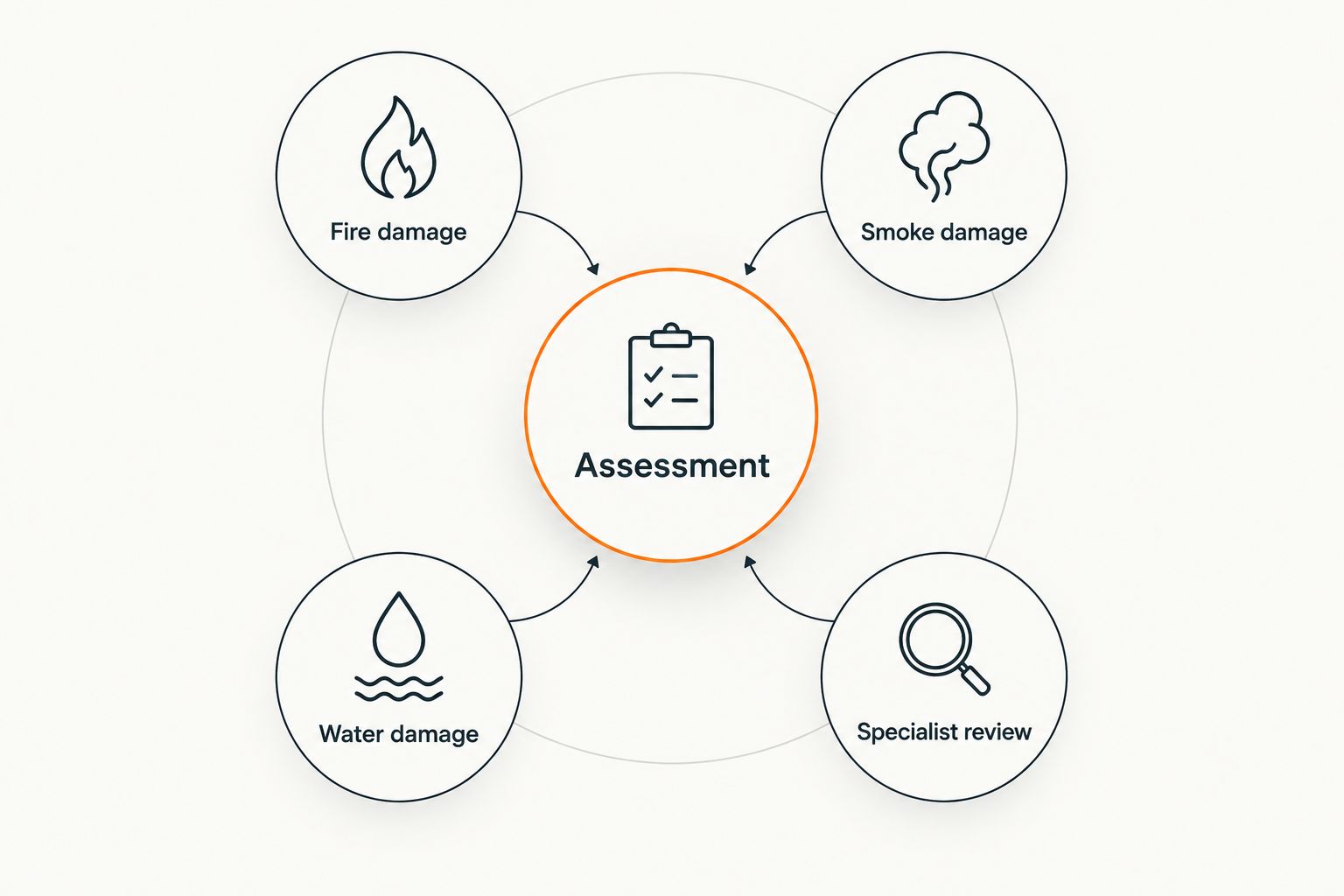
4. Separate stabilization, cleanup, and repair decisions
Use a shared task list to distinguish work that prevents further damage from work that cleans or rebuilds the property. These tasks have different approval needs. Combining everything into a single instruction to restore the building makes omissions harder to spot.
Ask the restoration provider to explain the proposed treatment of affected materials. Some items require cleaning assessment; others require removal or specialist evaluation. Do not assume that a dark surface needs replacement or that a surface without visible soot is unaffected.
Phoenix Restoration Group keeps property owners informed from the initial assessment through cleanup. Use those updates to maintain a written decision record, including unresolved questions. Confirm responsibility for repair work rather than assuming every trade is included in a restoration agreement.
Give each work area a documented status. This helps tenants understand the difference between a room awaiting assessment, a room undergoing cleanup, and a room awaiting a separate repair decision.
- List emergency stabilization tasks separately.
- Confirm the cleanup scope by room.
- Identify materials awaiting treatment decisions.
- Record who authorizes removal or disposal.
- Assign repair questions to the responsible contractor.
- Track changes to the agreed scope.
5. Protect business equipment and tenant-owned contents
Start with an ownership inventory before moving contents. Identify what belongs to the building owner, each tenant, employees, and outside suppliers. A shared commercial property creates practical problems when equipment is relocated without recording its original room or responsible owner.
Do not power up smoke-affected or wet electronics simply to test them. Ask the appropriate equipment specialist to assess safe handling, inspection, and return to service. Restoration of the surrounding room does not establish that a machine, server, refrigeration unit, or electrical component is usable.
Record business priorities separately from salvage decisions. An item can be operationally critical without being suitable for immediate reuse. Tell the restoration provider which records, equipment, and inventory affect essential operations, then obtain a clear assessment of the next action.
Keep tenant communications specific. Explain what has been inspected, what remains restricted, and who will decide the next step. Avoid presenting an estimated project sequence as a reopening commitment.
- Label contents by owner and original location.
- Photograph items before authorized relocation.
- Keep clean and affected contents separated.
- Identify equipment needing specialist inspection.
- Record operational priorities without promising recovery.
6. Address firefighting water and building-system controls
Document wet areas separately from soot damage, using a marked floor plan or room checklist. Firefighting water requires its own assessment and drying decisions. A surface that looks dry does not establish the condition of concealed materials.
Give the restoration provider access to relevant building information, including equipment locations and known water shutoffs, without operating damaged systems yourself. Keep questions about electrical isolation, plumbing repairs, and building controls with the responsible qualified professionals.
For properties with building automation, integrating water damage alerts into the incident plan means assigning a person to receive notifications and a procedure for acting on them. An alert supports detection; it does not inspect wet materials, remove water, or establish that a fire-damaged area is safe.
Review those responsibilities in your 2026 facilities plan. Building staff, tenants, and contractors should know where to report new moisture without changing control settings or silencing unresolved alerts.
- Map visible water and affected rooms.
- Request assessment of concealed moisture concerns.
- Identify the person responsible for building alerts.
- Record who handles utility and control-system questions.
- Keep water assessment findings with the fire records.
7. Set reopening criteria before announcing a date
Begin with a written list of reopening questions, not a calendar announcement. Identify the approvals, inspections, repairs, and operational checks required for your specific property. Requirements depend on the damage, occupancy, and work performed, so confirm them with the responsible authorities and professionals.
Keep restoration completion separate from equipment readiness and occupancy decisions. A cleaned office does not establish that its electrical supply is ready, and an accessible tenant space does not establish that shared exits or services are ready for normal use.
Ask whether restricted access or partial use is permitted before planning either. Do not assume that an unaffected-looking section can operate independently. Shared utilities, access routes, and adjacent work areas still need consideration.
Close your 2026 restoration file with the documents needed to explain what happened and what work was completed. Retain unresolved issues as assigned tasks rather than treating them as informal reminders.
- Identify required approvals and their decision-makers.
- Confirm utility and equipment readiness separately.
- Resolve restrictions on shared access routes.
- Document any approved limits on property use.
- Give employees and tenants confirmed instructions.
- Retain completion records and outstanding-task owners.
Compare commercial fire response options
Choose by task, not by who can promise the broadest outcome. For a 2026 commercial incident plan, distinguish the convenience of internal coordination from the technical work and independent decisions the property requires.
| Option | Best for | Main advantage | Key limitation |
|---|---|---|---|
| Internal facilities team | Access coordination, records, and tenant communication | Knows the building and its operating priorities | Building familiarity does not establish qualification for hazardous cleanup or specialist inspections |
| Phoenix Restoration Group | Central Iowa owners seeking 24/7 emergency fire restoration | Covers fire, water, mold, and biohazard restoration with communication from assessment through cleanup | Free inspections are limited to business hours, 8am to 4:30pm; confirm the specific commercial scope |
| Specialist equipment or trade contractor | Machinery, utilities, or repairs needing discipline-specific assessment | Addresses the systems within the contractor's specialty | Does not replace a coordinated assessment of the whole fire loss |
| Authority responsible for occupancy decisions | Determining applicable access or reopening requirements | Clarifies the approvals relevant to the property | Does not perform restoration or manage business recovery |
These options serve different roles rather than replacing one another. Keep one owner-side coordinator responsible for recording decisions across them. Ask each party to identify what falls outside its assignment before work reaches that boundary.
Common mistakes commercial property owners make
Treating visible burn damage as the full scope
A room-by-room assessment should address smoke, soot, firefighting water, and affected systems, not just the fire's origin. Request a documented scope before treating untouched-looking rooms as unaffected. Record areas that remain uninspected rather than silently excluding them.
Mixing tenant losses with building losses
An unlabeled contents list creates confusion about ownership, authorization, and insurance reporting. Separate tenant property from building components at the start. Record who can approve moving, inspecting, or disposing of each category.
Restarting equipment to find out whether it works
A successful startup is not a safety assessment. Keep affected equipment out of service until the appropriate specialist has addressed its condition. Tell staff which items remain restricted so a later shift does not repeat the same test.
Publishing a reopening date before confirming dependencies
Cleanup, repairs, utilities, equipment checks, and applicable occupancy decisions are separate milestones. An announcement made before those dependencies are confirmed creates a deadline the work cannot validate. Communicate completed milestones and unresolved requirements instead.
Confusing emergency service with free inspection hours
Emergency restoration and a business-hours inspection are different service arrangements. Plan urgent reporting separately from routine assessment scheduling. Do not postpone an active safety concern simply to fit an inspection window.
FAQ
What does fire damage restoration for commercial properties include?
Fire damage restoration for commercial properties involves assessing fire-related damage and defining the necessary cleanup and repair work. The scope should address smoke, soot, firefighting water, affected contents, and any systems requiring specialist evaluation.
Who should coordinate restoration for a multi-tenant building?
The property owner or an authorized representative should coordinate access, approvals, and communication across the building. Each tenant should identify a contact for tenant-owned contents and business-specific requirements.
Can employees enter after the fire department leaves?
Employees should enter only when the authority controlling the scene permits access and the relevant restrictions are understood. Departure of emergency crews is not, by itself, approval to resume normal operations.
Does Phoenix Restoration Group offer emergency commercial fire restoration?
Phoenix Restoration Group provides 24/7 emergency fire restoration for residential and commercial property owners in Carlisle, Des Moines, and Central Iowa. Free inspections for all services take place during business hours, 8am to 4:30pm, rather than throughout the emergency-service schedule.
Can a business reopen while restoration continues?
Partial reopening requires confirmation that the proposed use is permitted and that relevant safety and operational requirements are met. Ask the responsible authorities and professionals about shared exits, utilities, restricted areas, and ongoing work before making an announcement.
Should damaged inventory be thrown away immediately?
Do not discard damaged inventory without documenting it and confirming the appropriate authorization, unless an immediate safety requirement dictates otherwise. Keep ownership records and ask the insurer how disposal should be recorded.
Does removing smoke odor mean the property is ready to reopen?
No. Odor removal does not establish structural, electrical, equipment, or occupancy readiness. Reopening requires the separate decisions and checks applicable to the damaged property.
One last thing
Write down who can say yes. Before the next incident, name the person who can authorize emergency work, the tenant contact who can release contents for assessment, and the person responsible for confirming reopening requirements. Your 2026 response plan needs clear decision authority as much as it needs contractor contact details.