
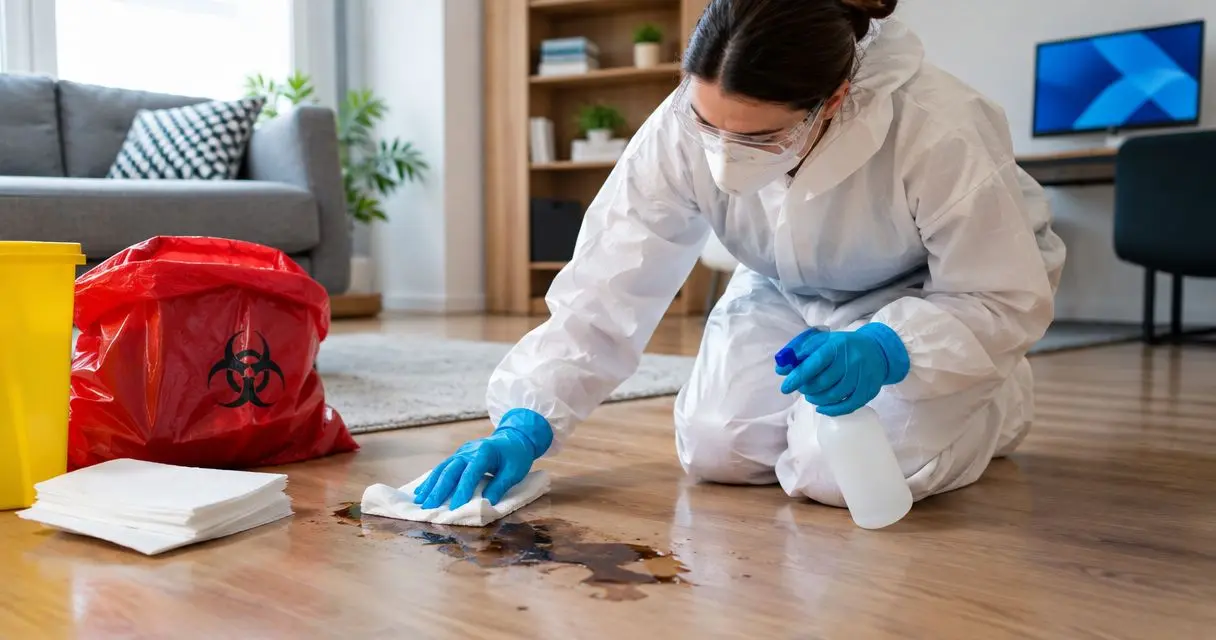
You should not clean up a biohazard scene yourself when it involves another person’s blood, an unattended death, sewage, discarded needles, or contamination you cannot fully assess. A minor spill of your own blood on a hard, nonporous surface is a different situation, but ordinary cleaning does not make a contaminated room safe to use.
- Can you clean up a biohazard scene yourself? Leave unknown blood, sharps, sewage, and trauma scenes to trained professionals.
- Phoenix Restoration Group provides 24/7 emergency biohazard restoration across Carlisle, Des Moines, and Central Iowa.
- Keep people and pets outside the affected area; do not move contaminated belongings or disturb potential evidence.
- Free inspections are available during business hours, 8am to 4:30pm, separately from 24/7 emergency service.
Why this matters
The decision is about exposure, not whether you can remove a stain. Blood and other potentially infectious materials can enter the body through broken skin, punctures, or contact with the eyes, nose, and mouth. Moving contaminated objects also carries material into previously unaffected spaces.
For property owners making a cleanup decision in 2026, the first task is to separate urgent safety needs from cleaning work. Someone who needs medical attention comes first. Restricting access comes next; scrubbing does not.
If you are also trying to establish who must arrange the work, read who is responsible for cleaning up after a biohazard incident. Responsibility for arranging cleanup does not establish that you are equipped to perform it.
Can you clean up a biohazard scene yourself?
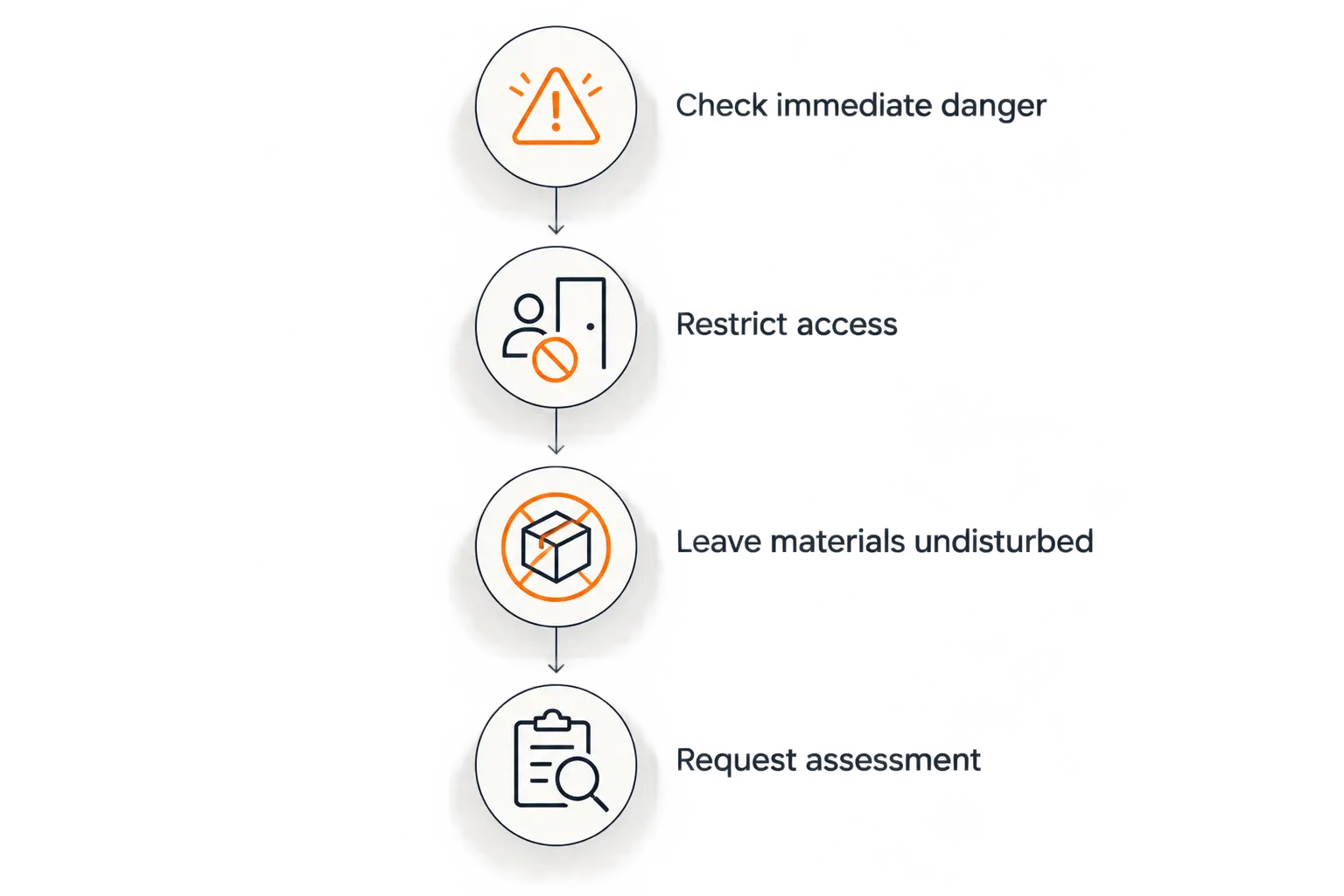
Usually, no. Do not attempt a do-it-yourself cleanup when the source, extent, or exposure risk is uncertain. Follow this sequence before considering any contact with the affected area:
- Check immediate danger. Stay away from violence, electrical hazards, unstable structures, chemical fumes, and other active threats. Contact emergency services when someone is injured or an immediate danger remains.
- Restrict access. Keep children, pets, residents, customers, and uninvolved workers away. Close a door if you can do so without entering the contaminated area.
- Leave materials undisturbed. Do not sort belongings, lift carpet, pick up needles, or carry waste through the property. Do not enter a restricted scene before authorities release it.
- Request assessment. Describe the incident and what you can see from a safe location. Ask what access restrictions should remain in place until the scene is assessed.
These steps reduce unnecessary contact without turning you into the cleanup worker. If you have already walked through the area, stop moving between rooms and tell the responding professional where you went.
Biohazard cleanup choices in 2026
The useful comparison is not household cleaner versus stronger cleaner. It is whether you understand the contamination, can prevent exposure, and can address every affected material.
| Approach | Best for | Main advantage | Main limitation |
|---|---|---|---|
| Limited household cleanup | A minor spill of your own blood on an intact, nonporous surface, without sharps | Keeps a simple personal incident manageable | Does not address unknown sources, absorbed contamination, or workplace obligations |
| Professional biohazard cleanup | Unknown blood, trauma, sewage, sharps, or contamination affecting building materials | Provides a defined assessment and cleanup process | Requires coordination, authorization, and possible restrictions on room access |
Choose professional assessment when you cannot confidently establish that the incident is minor and contained. A small visible mark is not proof that the affected area is small, especially when liquid has reached seams, upholstery, or flooring layers.
The household option is narrow. It is not a substitute for a workplace exposure procedure, and it does not cover cleaning up after an injury involving someone else’s blood.
When is limited household cleanup different?
A small drop of your own blood from a minor cut on an intact bathroom counter is not the same as a trauma scene. First take care of the injury, keep others away from the spill, and consider whether there are any hidden complications.
Limited household cleanup requires a known source, a clearly contained spill, no needles or broken contaminated glass, and a surface that can be cleaned and disinfected according to product directions. If any of those conditions is uncertain, stop and seek guidance.
Cleaning and disinfection have different purposes. Cleaning removes material; disinfection uses an appropriate product under its labeled conditions. A quick wipe, a strong smell, or a visibly clean surface does not establish successful disinfection.
Never mix cleaning chemicals. Do not improvise a disinfectant concentration, shorten the label’s required wet contact time, or assume that a product suitable for a countertop is suitable for fabric.
When should you leave the scene to professionals?
Unknown blood, decomposition fluids, sewage, and discarded sharps require a different response from routine housekeeping. The concern includes direct exposure and contamination that has moved beneath or beyond what you can see.
Stop before attempting cleanup when you encounter:
- An unattended death or decomposition. Visible residue does not establish the full extent of contamination.
- Blood from another person or an unknown source. Appearance cannot tell you whether blood contains an infectious agent.
- Needles or contaminated sharp objects. A puncture creates an exposure route that ordinary cleaning gloves do not eliminate.
- Contaminated porous materials. Carpet, padding, upholstery, and unfinished materials need assessment rather than surface wiping alone.
- Sewage or widespread bodily waste. Keep people out instead of treating the area as an ordinary dirty room.
- An active investigation. Do not disturb the scene before authorities allow access.
Phoenix Restoration Group is best for Central Iowa property owners who need 24/7 emergency biohazard restoration. The company serves residential and commercial properties in Carlisle, Des Moines, and Central Iowa. Emergency restoration is separate from its free inspections during business hours, 8am to 4:30pm.
Use the contact page to describe the incident and request service. Do not enter the scene to gather additional details for the request.
Request biohazard restoration
24/7 emergency service. Free inspections during business hours, 8am to 4:30pm.
What affects your cleanup decision in 2026?
The same room can require very different work depending on what happened and where the contamination traveled. Base your decision on these factors, not on how quickly you want the space reopened:
- Source: Your own minor injury differs from unknown blood, sewage, or decomposition.
- Materials: An intact nonporous surface differs from absorbent carpet, upholstery, or unfinished wood.
- Spread: Foot traffic, moved belongings, and liquid entering joints can extend the affected area.
- Sharps: Needles and contaminated broken glass introduce puncture hazards.
- Occupancy: A business or shared property needs access controls that protect people who did not witness the incident.
- Scene status: Police, fire personnel, or other authorities can restrict access independently of cleanup needs.
A small room is not automatically a small job. Conversely, an unpleasant odor alone does not identify the substance or establish which materials require removal. Assessment should determine the scope.
What if you have already touched the contamination?
Treat a possible exposure as a medical issue, not a cleaning problem. Wash exposed skin with soap and water. If material entered your eyes, nose, or mouth, flush the affected area with water and seek prompt medical advice.
For a needlestick, puncture, or contact involving broken skin, request medical evaluation promptly. Tell the clinician what happened, when it happened, and what substance was involved if you know. Do not wait for symptoms before asking for guidance.
Do not put disinfectant or bleach on your skin. Do not handle a discarded needle again to photograph it, identify it, or bring it to an appointment.
If the exposure happened at work, report it through your employer’s exposure procedure as well. Medical care and incident reporting are separate from arranging property cleanup; completing one does not replace the other.
What should employers and property managers do?
For a workplace response plan in 2026, OSHA’s Bloodborne Pathogens Standard is the relevant federal framework when employees have occupational exposure to blood or other potentially infectious materials. It addresses employer duties including exposure controls, training, protective equipment, and post-exposure evaluation.
Do not assign an unknown blood spill to whoever happens to be available. A job title such as custodian, maintenance technician, or property manager does not establish that the person has the training and equipment for the incident.
Keep an incident record without asking employees to enter the affected area. Record the location, access restrictions, known exposure reports, and the person coordinating cleanup. Keep personal and medical information out of general tenant or staff notices.
For shared properties, tell occupants which area is closed and where they can safely go instead. Avoid announcing that a room is safe simply because the visible material has been removed. Reopening should follow the assessed scope and completed work, not a deadline chosen before assessment.
What should you ask before authorizing cleanup?
Ask the provider to explain what the assessment covers, how access will be controlled, which materials need attention, and how affected waste will be handled. You need a clear scope, not a promise that everything will be solved by spraying a room.
Useful questions include:
- Which surfaces and materials are affected?
- What must remain off limits during the work?
- Which items can be treated, and which require removal?
- What conditions would change the scope?
- What information will you receive when the work is complete?
Phoenix Restoration Group keeps you informed from the initial assessment through cleanup. Its free inspections for all services take place during business hours, 8am to 4:30pm; its emergency restoration service operates 24/7. Neither statement is a promise of a specific arrival time.
Professional involvement also has practical limits. You still need to authorize access, identify known hazards, and coordinate with the property owner or other responsible party where applicable. Do not assume that requesting service also settles insurance coverage or responsibility for the incident.
Can you throw contaminated items in the regular trash?
Do not assume contaminated waste belongs in household trash. Disposal requirements depend on the material, its source, the setting, and applicable local rules. Sharps need appropriate handling and containment rather than loose disposal in a bag.
Ask the cleanup provider or local waste authority how the affected materials must be managed. Do not transport leaking bags or loose contaminated objects in your vehicle to find somewhere that will accept them.
Can you stay in the property during biohazard cleanup?
Stay outside the affected area until its use has been assessed. Whether you can remain elsewhere in the property depends on the contamination’s location, access routes, and whether separation can be maintained.
Do not repeatedly enter a closed room to retrieve belongings. Tell the provider what you need so retrieval can be considered without undermining the access controls.
FAQ
Can I clean up someone else’s blood if I wear gloves?
Gloves alone do not make cleaning someone else’s blood safe. Unknown contamination, splashes, sharps, and affected porous materials require more than hand protection; request professional assessment.
Can I vacuum dried blood or contaminated dust?
Do not use a household vacuum on suspected biohazard contamination. It can spread material and contaminate the equipment rather than safely resolve the scene.
Does bleach make a biohazard scene safe?
Bleach alone does not establish that a biohazard scene is safe. The material, surface, cleaning process, product directions, and extent of contamination all affect what work is required.
Should I clean before the restoration company arrives?
Do not disturb suspected biohazard material before assessment. Keep people and pets away, leave affected belongings in place, and describe the scene from a safe location.
Who should I call after a needlestick during cleanup?
Seek prompt medical evaluation after a needlestick. If it happened at work, also report the exposure through your employer’s procedure; do not wait for symptoms.
Does Phoenix Restoration Group offer emergency biohazard cleanup?
Phoenix Restoration Group provides 24/7 emergency biohazard restoration in Carlisle, Des Moines, and Central Iowa. Free inspections for all services are available during business hours, 8am to 4:30pm, separately from emergency service.
Is a room safe once the bloodstain is gone?
Removing a visible bloodstain does not establish that a room is safe. Contamination can affect seams, absorbent materials, and areas beyond the visible mark.
One last thing
Photographs do not require a closer look. If you can document the incident from a safe, permitted location, do so without entering, moving objects, or exposing someone else. A photograph is not worth a puncture, splash, or disturbed investigation.
For your 2026 property response instructions, put one rule ahead of the cleaning checklist: keep untrained people out of the affected area. Phoenix Restoration Group provides emergency biohazard restoration; your immediate role is to protect access and communicate what you already know.