
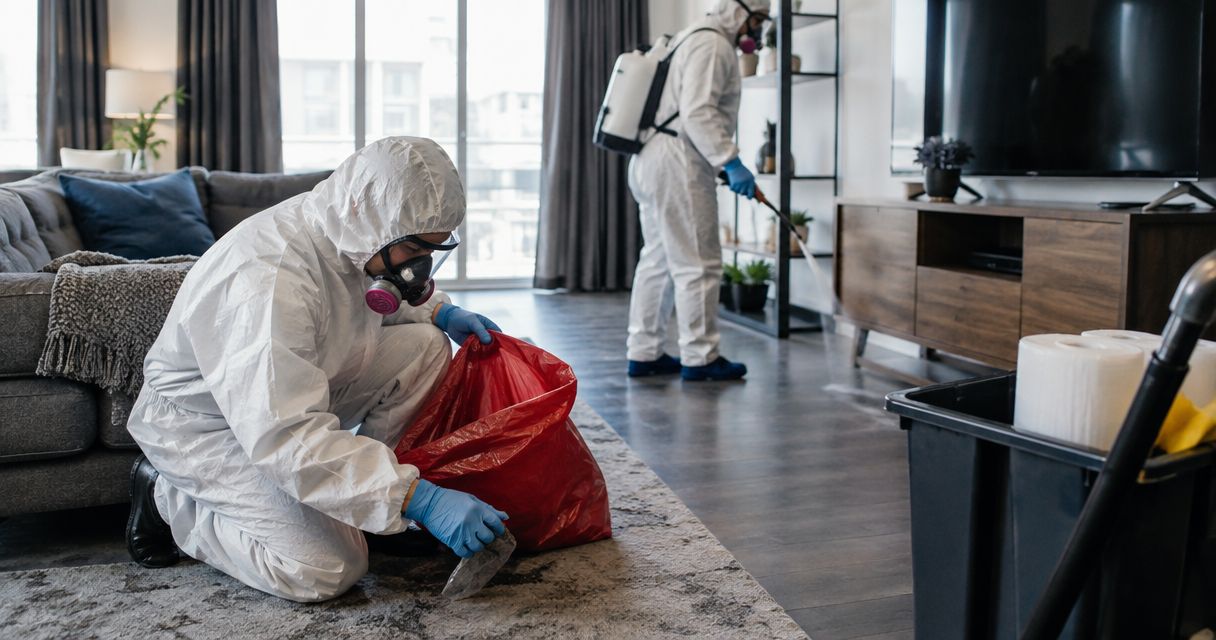
Biohazard cleanup for property managers is the controlled removal and treatment of biological contamination to restore affected spaces for their intended use. This 2026 guide explains how to restrict access, coordinate qualified cleanup, communicate with tenants, and document completion without turning an incident into a routine maintenance assignment.
- Biohazard cleanup for property managers starts with restricting access, not assigning ordinary janitorial staff.
- Phoenix Restoration Group provides 24/7 emergency biohazard restoration in Carlisle, Des Moines, and Central Iowa.
- Separate contamination cleanup, source repairs, and occupancy decisions in your written scope.
- Free inspections are available during business hours, 8am to 4:30pm, distinct from emergency service.
Why biohazard cleanup matters for property managers
A contamination incident affects more than the room where it starts. Your maintenance team needs work boundaries, tenants need access instructions, and the owner needs a record of what happened and what was authorized. These responsibilities remain separate even when one person coordinates them.
Blood, bodily fluids, sewage, and discarded sharps require different precautions from ordinary dirt. Do not use the appearance or smell of a room as your cleanup standard. Keep routine cleaning staff outside the affected area until the hazards and work requirements have been assessed.
Phoenix Restoration Group serves Central Iowa property managers who need 24/7 emergency biohazard restoration. The company provides water, fire, mold, and biohazard restoration across Carlisle, Des Moines, and Central Iowa, with communication from the initial assessment through cleanup.
For your 2026 response plan, distinguish availability from arrival time. Emergency service operates 24 hours a day, 7 days a week; that does not establish when a crew will reach a particular property. Confirm the next action directly rather than giving tenants an unsupported arrival estimate.
How to manage a biohazard cleanup incident
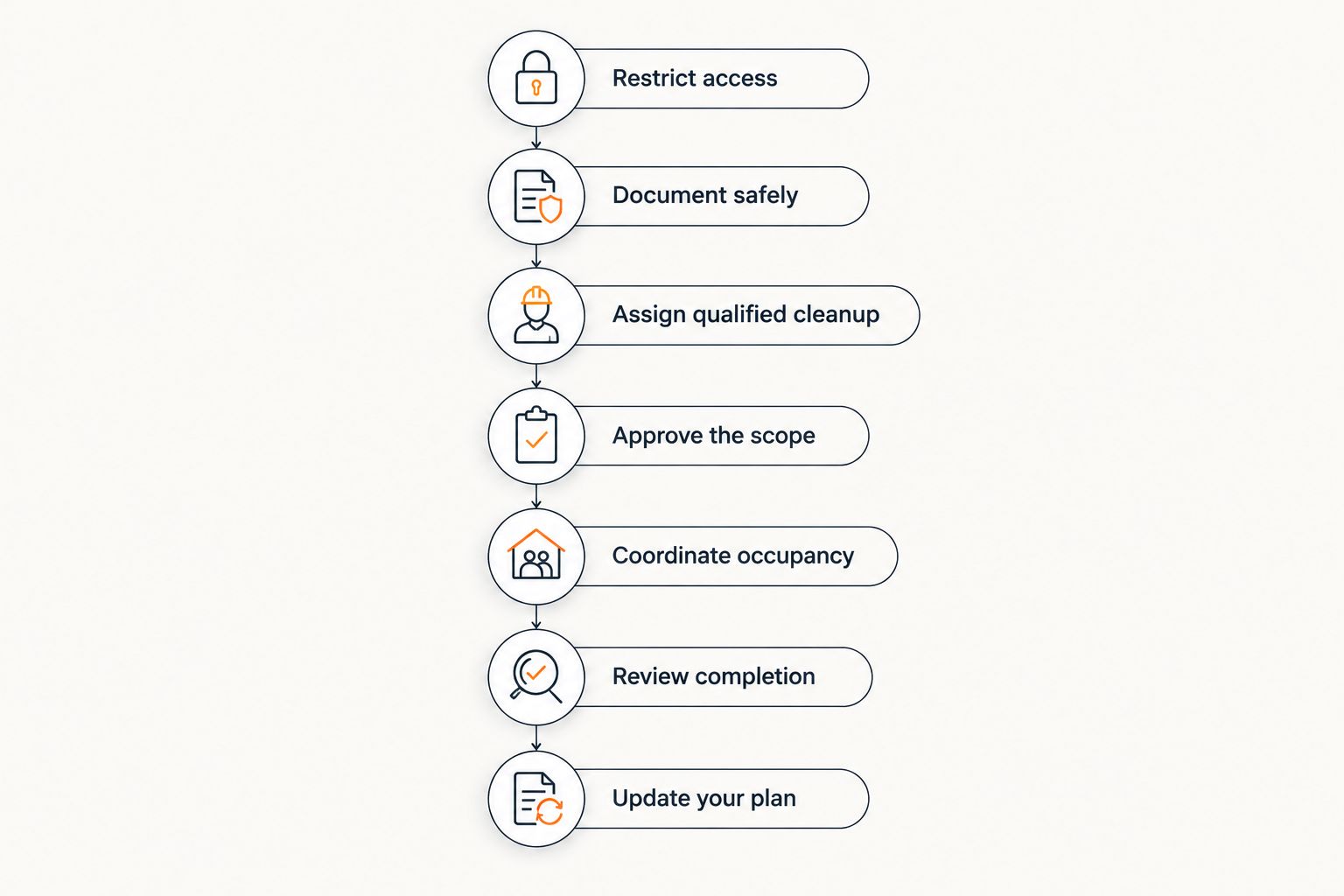
Start with the actions you control: access, records, authorization, and communication. The following sequence keeps those responsibilities separate from hands-on contamination removal. If an incident involves immediate danger or someone needs emergency medical assistance, contact emergency services before arranging property cleanup.
Restrict access
Your first job is to keep people away from contamination without exposing yourself. Close an affected room or control access from a clean location when that is safe. Do not walk through sewage, move contaminated furniture, or handle sharps to make the area look orderly.
When police, fire personnel, or other authorities control a scene, confirm that they have released it before arranging cleanup access. A contractor's appointment does not replace that release.
Keep restrictions specific enough for staff to follow. A message saying a building has a maintenance problem does not tell a cleaner which room to avoid or which route remains open. Use neutral wording that protects privacy while making the boundary clear.
- Identify the affected room, unit, corridor, or shared facility.
- Keep tenants, visitors, pets, and unassigned workers outside the boundary.
- Provide an alternative route when an affected area blocks normal access.
- Tell maintenance staff which work orders must pause.
- Escalate immediate life-safety hazards to emergency services.
Document safely
Create an incident record from a safe location. Start with the discovery time, reported conditions, affected spaces, and access restrictions. Record what you know separately from what someone suspects; a tenant report is not a confirmed assessment of the contamination.
Photographs help explain scope, but obtaining them must not require entering a hazardous area. Ask the cleanup provider to document inaccessible conditions during assessment. Avoid circulating sensitive photographs through broad tenant messages or general staff group chats.
For a 2026 incident file, keep authorization and communication in the same record as the physical observations. That gives the next manager enough context to continue the response without reconstructing decisions from scattered messages.
- Record who discovered the incident and who received the report.
- Describe visible conditions without guessing their cause.
- Photograph only from locations you can access safely.
- Keep personal information out of general maintenance notices.
- Log access restrictions, notifications, and owner instructions.
Assign qualified cleanup
Use your existing maintenance records to identify the right service category before contacting providers. A leaking pipe needs source repair; sewage contamination needs a cleanup assessment as well. Repairing the pipe does not by itself resolve contaminated materials or surfaces.
Do not assign blood, sewage, or sharps cleanup to ordinary cleaning staff simply because they are already on site. OSHA's Bloodborne Pathogens standard addresses occupational exposure to blood and other potentially infectious materials. Where employee duties involve that exposure, training and protective measures belong in the employer's safety program, not an improvised work order.
Phoenix Restoration Group offers 24/7 emergency biohazard restoration and free inspections for all services during business hours, 8am to 4:30pm. Use the contact page to discuss the incident; do not assume a free inspection means emergency cleanup is free.
- Describe the suspected contamination and affected materials.
- Explain access restrictions and any authority-controlled scene.
- Ask who will assess conditions and define the cleanup scope.
- Confirm what the provider needs before entering the property.
- Ask about documentation, waste handling, and completion records.
Approve the scope
A useful scope explains what the provider will address and what remains outside the assignment. Ask for affected spaces, materials, proposed treatment, removal work, and waste handling to be described clearly. A general instruction to clean the unit leaves too much unresolved.
Separate cleanup from repairs and reconstruction. Removing contaminated carpet is not the same task as installing replacement flooring, and treating surfaces does not repair a failed sewer line. Assign ownership for each remaining task before approving work.
Authorize defined work, not an open-ended promise to make the property ready. If assessment reveals additional affected materials, require an explanation and updated authorization. This keeps the owner informed without asking the cleanup crew to make decisions outside its approved assignment.
- Identify the rooms and materials included in the work.
- Distinguish cleaning and treatment from material removal.
- Clarify how contaminated waste will be managed.
- List source repairs and reconstruction separately.
- Establish who can approve changes to the scope.
Coordinate occupancy
Give occupants practical instructions rather than technical assurances you cannot support. Tell them which spaces are restricted, which routes remain available, and who will provide the next update. Do not promise that a unit will reopen at a particular time before the work and review requirements are known.
Protect the privacy of affected residents. Other tenants generally need access and scheduling information, not the identity, medical history, or circumstances of the person involved. Keep contractor access details separate from broad resident communications.
Coordinate with the owner and appropriate advisers when temporary relocation, lease obligations, or accommodation questions arise. Those decisions depend on the circumstances and applicable requirements; a cleanup appointment does not settle them.
- Name a primary property-management contact for updates.
- Explain restricted areas using plain, location-specific language.
- Confirm how contractors will obtain authorized access.
- Coordinate affected deliveries, maintenance visits, and shared facilities.
- Communicate changed conditions without promising an unconfirmed reopening.
Review completion
Before removing restrictions, compare the completed work with the approved scope. Ask the provider to explain what was cleaned, treated, removed, or left for another trade. Resolve unclear descriptions while the people who performed the work are available to answer questions.
A completion record should support the decisions it actually documents. Do not describe an invoice as a laboratory clearance report or imply that testing occurred when it did not. If testing or another verification step is specified, confirm its scope and who interprets the result.
Check outstanding physical hazards as well as cleanup status. A room can have completed contamination removal while still needing flooring, plumbing, or other repairs before normal use resumes. Make the occupancy decision with those remaining conditions in view.
- Match completed tasks against the authorized scope.
- Request available work records and supporting photographs.
- Identify excluded spaces, materials, and unfinished tasks.
- Confirm who handles remaining repairs or verification.
- Document the basis for removing access restrictions.
Update your plan
Close the incident by correcting the process, not just filing the invoice. Review where access instructions, authorization, or communication broke down. Keep the review focused on decisions and responsibilities rather than sharing sensitive incident details with people who do not need them.
Update your 2026 property procedures with current contacts and after-hours authorization rules. An emergency contact list is useful only if the person answering can approve access and explain who makes spending decisions.
Keep cleanup coordination distinct from employee exposure response. If a worker reports contact with blood, sewage, or a sharp, follow your workplace reporting and medical-evaluation procedures rather than treating the event solely as property damage.
- Record the incident's discovery, authorization, and completion sequence.
- Update owner contacts and after-hours decision authority.
- Revise access instructions for recurring trouble spots.
- Review staff duties against applicable safety requirements.
- Store records where authorized managers can retrieve them.
Compare response options for your property
Choose an option by the work required, not by who is easiest to reach. Routine cleaning, contamination removal, and source repair have different purposes. Your 2026 response plan should identify the appropriate role before an incident puts staff under pressure to improvise.
| Option | Best for | Main advantage | Key limitation |
|---|---|---|---|
| In-house maintenance coordination | Access control, records, and contractor access | Keeps property decisions with staff who know the building | Does not establish training or qualification for contamination removal |
| Routine janitorial service | Ordinary cleaning outside restricted contamination areas | Supports normal building operations | Do not assume routine cleaning covers blood, sewage, or sharps |
| Qualified biohazard cleanup provider | Assessment and removal of biological contamination | Addresses the contamination-specific scope | Confirm qualifications, exclusions, documentation, and verification requirements |
| Phoenix Restoration Group | Property managers needing emergency biohazard restoration in Central Iowa | Offers 24/7 emergency service and communication from assessment through cleanup | Free inspections are limited to business hours; confirm the incident-specific scope |
| Licensed repair trade, where required | Plumbing, electrical, or other source repairs | Addresses the failed building system | Repair work alone does not complete contamination cleanup |
The practical choice is often coordinated work, not one provider doing everything. Keep a single property-management lead while assigning cleanup, source repair, and reconstruction to the appropriate parties. Confirm who hands the space back to whom so unfinished work does not disappear between assignments.
Common mistakes property managers make
Treating contamination as a turnover cleaning task
A vacant unit is not automatically safe for a leasing walkthrough, painter, or cleaner. Assess suspected contamination before adding routine turnover trades to the schedule. Keep those work orders paused until their access conditions are clear.
Waiting for insurance decisions before restricting access
Coverage discussions and immediate access control are different tasks. Restrict the affected area and notify the appropriate parties while you clarify claim requirements. Do not promise tenants that an insurer will cover cleanup, damaged belongings, or temporary accommodation.
Using odor as the completion test
An odor change does not document what was removed or treated. Review the scope and completion records instead of accepting a fragrance or lack of smell as proof of resolved contamination. Ask for an explanation of any remaining odor rather than guessing its cause.
Sharing incident details too widely
A building-wide message can explain a closed laundry room without disclosing a resident's circumstances. Limit photographs and personal details to people who need them for authorized work. Keep operational notices separate from the restricted incident record.
Confusing emergency availability with free inspections
Emergency service and inspection scheduling are separate arrangements. Confirm the service being requested, its authorization, and the applicable inspection hours before making commitments to the owner or tenant. Never describe all after-hours work as a free inspection.
FAQ
What should a property manager do first after finding a biohazard?
Restrict access from a safe location and determine whether emergency services are needed. Document the report without entering contamination, then arrange an assessment by an appropriately qualified provider.
Can my maintenance team clean up blood or sewage?
Do not assign blood or sewage cleanup based only on a worker's maintenance role. Confirm the hazards, applicable training and protective requirements, and the employer's procedures before assigning any exposure-related work.
Does Phoenix Restoration Group provide emergency biohazard cleanup?
Phoenix Restoration Group provides 24/7 emergency biohazard restoration in Carlisle, Des Moines, and Central Iowa. Free inspections for all services are available during business hours, 8am to 4:30pm, separately from emergency service.
Can tenants stay in the building during biohazard cleanup?
Occupancy decisions depend on the affected spaces, exposure routes, access restrictions, and work requirements. Do not assume that either the entire building must close or every unaffected unit can remain occupied; coordinate the decision with the appropriate professionals and authorities.
Does fixing a sewage backup finish the cleanup?
No. Repairing the source and addressing contaminated materials are separate tasks. Confirm that the cleanup scope covers affected surfaces and materials, and identify any repairs still needed before normal use resumes.
What documents should I keep after biohazard cleanup?
Keep the incident record, approved scope, authorizations, provider work records, and documentation of remaining repairs. Retain any specified verification records without describing them as tests or certifications they do not represent.
Will property insurance cover biohazard cleanup?
Coverage depends on the policy and the circumstances of the incident. Contact the insurer or authorized claims representative, preserve relevant records, and avoid promising reimbursement to tenants or owners.
One last thing
Closing the cleanup work order is not the same as reopening the space. Before restoring access, check that contamination work is documented, remaining repairs are assigned, and the person responsible for occupancy has the information needed to decide.
Add a separate reopening decision to your 2026 incident form. That small distinction prevents a completed contractor assignment from being mistaken for confirmation that every property-management responsibility is finished.