
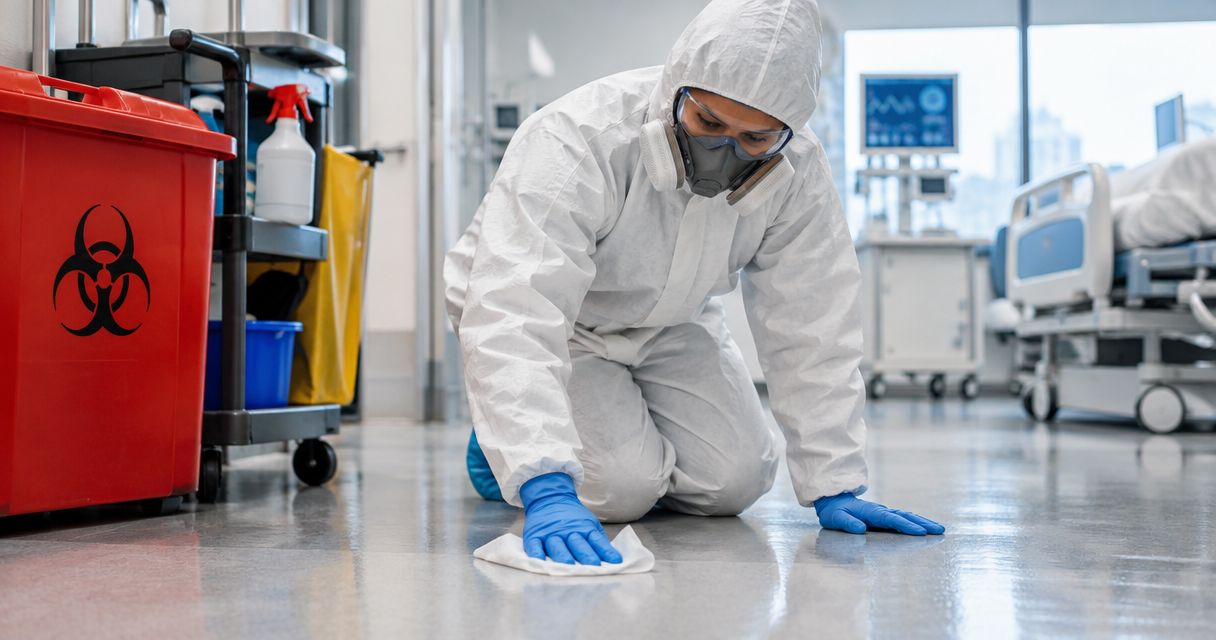
Healthcare facilities’ biohazard cleanup is the controlled removal and treatment of biological contamination with the aim of protecting patients, staff, and clinical operations. Unlike ordinary property cleanup, healthcare work requires infection-prevention oversight, exposure controls, and a clear decision about when the affected space can reopen.
- Biohazard cleanup for healthcare facilities starts with restricted access, exposure assessment, and infection-prevention oversight.
- Phoenix Restoration Group provides 24/7 emergency biohazard restoration in Carlisle, Des Moines, and Central Iowa.
- Use trained environmental services staff for incidents within their approved procedures; escalate work outside that scope.
- Separate cleanup completion from clinical reopening approval, and document both decisions.
Why biohazard cleanup matters for healthcare facilities
A contaminated treatment room creates two problems: an exposure hazard and a disruption to patient care. Your response must address both without moving contamination into corridors, equipment storage, or another care area.
Phoenix Restoration Group is best for Central Iowa property owners seeking 24/7 emergency biohazard restoration. For healthcare work, confirm the incident-specific scope, required precautions, and coordination with your infection-prevention team before authorizing cleanup. Review Phoenix Restoration Group for its stated service categories and coverage area.
Your 2026 response plan should distinguish routine environmental cleaning from an incident requiring additional assessment. A small spill covered by an approved procedure is different from contamination beneath flooring, an uncontrolled sewage release, or an incident involving an unidentified substance.
Healthcare facilities also have responsibilities that an outside restoration provider does not replace:
- Protect patients whose conditions increase their susceptibility to infection.
- Evaluate employee exposures separately from the property cleanup.
- Protect patient information in incident records and photographs.
- Keep contaminated equipment out of service until appropriately processed.
- Authorize clinical use only after the responsible facility personnel approve it.
How to manage biohazard cleanup in a healthcare facility
Restrict access and protect patient care
Start with your facility’s incident procedure, not an improvised cleaning attempt. Notify the responsible supervisor and infection-prevention personnel, restrict access, and redirect patient movement through an unaffected route.
Do not send an untrained employee into the area to identify the substance or retrieve supplies. Where contamination involves an active clinical emergency, patient treatment and emergency response take priority over property restoration.
Assign 1 incident lead to coordinate facilities, clinical operations, environmental services, and outside contractors. This is a recommended coordination structure, not a staffing standard. It prevents separate teams from issuing conflicting instructions.
Close this first stage with clear boundaries:
- Mark the restricted area without exposing private patient information.
- Relocate care activities through the facility’s approved process.
- Keep carts and reusable equipment from crossing the boundary unnecessarily.
- Record who controls access and who can change the boundary.
- Escalate sharps, unknown chemicals, or suspected airborne hazards immediately.
Assess the hazard before choosing the cleanup method
Use existing spill procedures and exposure-control documents to identify what your staff can safely handle. Determine the suspected material, affected surfaces, possible exposure routes, and whether contamination extends beyond the visible spill.
For occupational exposure to blood or other potentially infectious materials, OSHA’s Bloodborne Pathogens standard, 29 CFR 1910.1030, addresses exposure-control plans, engineering and work-practice controls, protective equipment, housekeeping, and post-exposure follow-up. Treat this as a workplace safety requirement, not a substitute for clinical infection-control judgment.
Do not group every biological incident under the same procedure. Sewage, blood, laboratory material, and a suspected high-consequence pathogen require different assessments. In your 2026 procedures, identify who can resolve uncertainty before work starts.
Build the initial assessment around these questions:
- What material is present, and how was it identified?
- Which rooms, surfaces, equipment, and building materials are affected?
- Did anyone experience a splash, puncture, or other potential exposure?
- Does the incident exceed the staff’s training or available equipment?
- Are specialist clinical, laboratory, or public-health instructions required?
Choose a response team that matches the incident
Your trained environmental services team is the first option for incidents explicitly covered by its procedures, equipment, and authority. An outside contractor is not automatically necessary for every bodily-fluid spill.
Escalate when the contamination exceeds that scope, involves building materials, or requires capabilities your facility does not have. Phoenix Restoration Group provides biohazard restoration among its restoration services, with communication from assessment through cleanup. Confirm healthcare-specific requirements directly rather than assuming that a general service listing establishes them.
Emergency restoration is available 24/7; free inspections for all services are available during business hours, 8am to 4:30pm. These are separate arrangements. Do not delay an urgent safety response while waiting for a business-hours inspection.
Before authorizing outside work, confirm:
- The exact contamination and materials included in the scope.
- The contractor’s ability to follow your infection-prevention requirements.
- Responsibility for waste classification, packaging, transport, and records.
- Protection of adjacent patient-care areas and occupied routes.
- The documentation and facility approvals required before reopening.
Establish containment and a controlled work sequence
Use the facility’s existing isolation and traffic-control procedures first. Select additional containment through an incident-specific assessment with infection prevention and the people performing the work.
A sign on a door controls entry, but it does not address every route by which contamination can spread. Consider footwear, carts, tools, waste containers, and ventilation where relevant. Do not change airflow or install equipment in a clinical area without the facility’s approval.
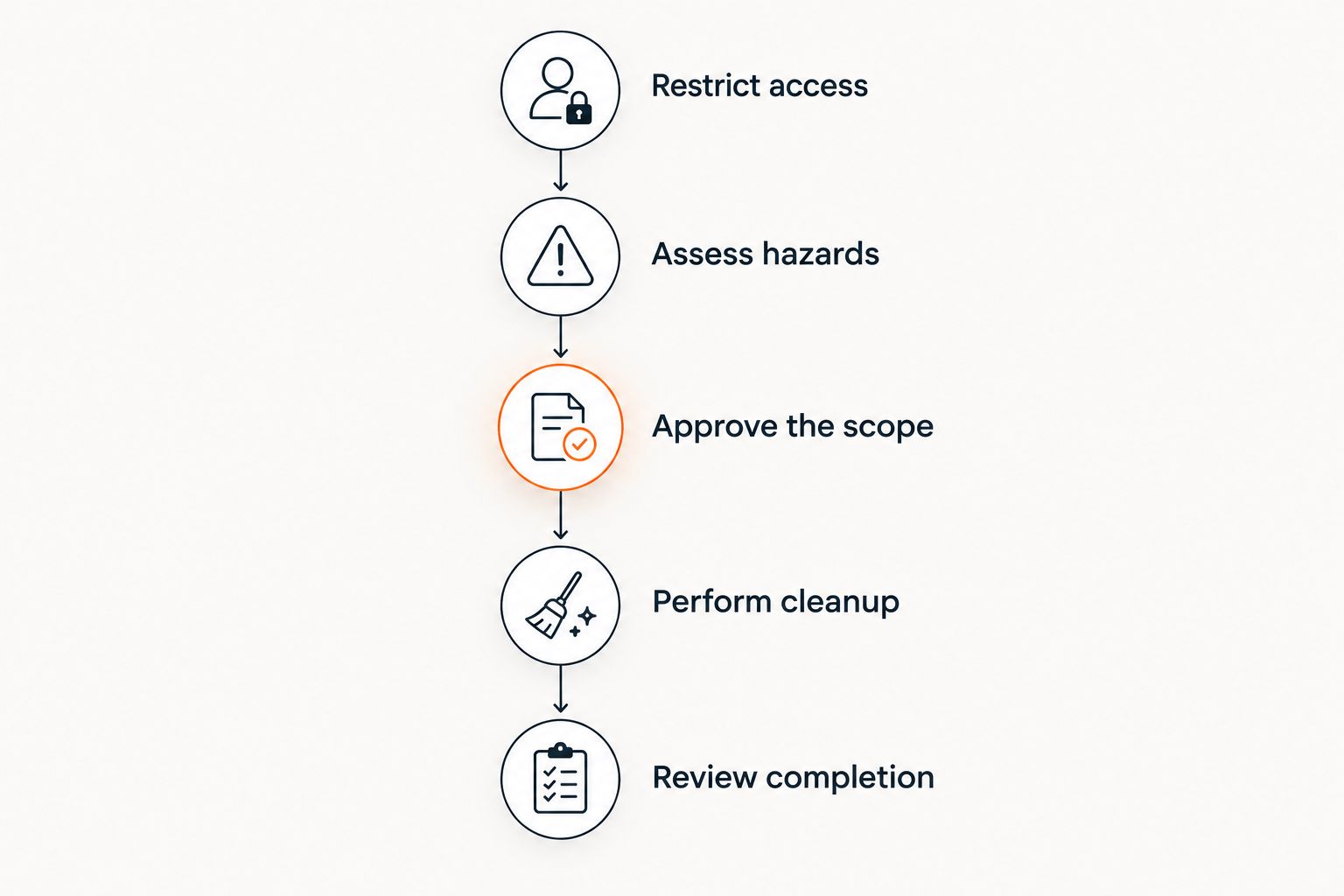
Organize the work into a sequence that keeps assessment, cleanup, and reopening distinct. The sequence below is a planning aid, not permission to enter a hazardous area.
- Restrict access before cleanup begins.
- Assess hazards before selecting controls.
- Approve the scope before authorizing work.
- Perform cleanup using the agreed procedures.
- Review completion before reopening the space.
Clean and disinfect according to the material and hazard
Have trained staff follow the approved procedure and product label rather than choosing a chemical by smell, strength, or familiarity. CDC environmental-cleaning guidance distinguishes cleaning from disinfection; removing soil and applying a disinfectant are not interchangeable tasks.
For products used against a particular pathogen, check the EPA registration, labeled use sites, target organisms, surface compatibility, and required contact time. There is no single contact time suitable for every product. Keep the surface wet for the label’s required period when directed.
Assess porous materials and inaccessible spaces separately. A cleaned visible surface does not establish that contamination beneath flooring or inside an assembly has been addressed. Reusable medical devices also require their own manufacturer-directed processing, not a general building-surface procedure.
Check the work against these controls:
- Use protective equipment selected for the assessed exposure.
- Remove soil through the approved method before disinfection when required.
- Follow the disinfectant label and equipment instructions.
- Keep chemicals separate unless their instructions explicitly permit mixing.
- Document affected materials that require removal or further assessment.
Separate waste handling from employee exposure follow-up
Start with the facility’s established waste procedures and occupational-health process. Do not assume every discarded cleaning item belongs in the same waste stream, or that placing material in a red bag completes the disposal requirements.
OSHA requirements for regulated waste and applicable waste-management rules address different responsibilities. Confirm classification and handling with the facility’s responsible personnel and waste provider. Do not assume a restoration contractor is also the authorized transporter for every waste category.
A potential employee exposure needs prompt evaluation through your exposure-control plan even while cleanup continues. Property restoration and medical follow-up are separate workstreams; completing one does not close the other.
Keep these responsibilities explicit:
- Identify who classifies and packages each waste stream.
- Use the designated sharps container for contaminated sharps.
- Keep waste movement away from patient-care traffic where practicable.
- Preserve required waste records through the responsible party.
- Route potential exposures to occupational health without waiting for cleanup completion.
Verify completion before reopening the space
Use a documented walkthrough against the agreed scope, not an informal assurance that the room looks clean. Review treated surfaces, removed materials, equipment status, unresolved hazards, and any follow-up work.
Record 2 separate decisions: whether the agreed cleanup scope is complete and whether the facility authorizes clinical use. This recommended distinction keeps a contractor’s work-completion statement from becoming an automatic reopening approval.
Your 2026 incident record should identify who made each decision and what evidence supported it. Infection prevention determines whether incident-specific verification or testing is appropriate; routine testing is not a substitute for following the correct procedure.
Before returning the space to service:
- Match completed work to the approved scope.
- Confirm contaminated equipment remains restricted until appropriately processed.
- Resolve outstanding repairs or clearly separate them from usable areas.
- Record the facility’s reopening approval and any remaining restrictions.
- Update the response plan with specific problems found during the incident.
Compare response options for healthcare facilities
Choose the response by hazard and capability, not by which team answers first. For your 2026 vendor review, separate general emergency restoration availability from documented suitability for the particular clinical setting.
| Option | Best for | Practical advantage | Key limitation |
|---|---|---|---|
| Trained in-house environmental services | Incidents covered by existing facility procedures | Works within established clinical cleaning and reporting systems | Must remain within staff training, equipment, and authorized scope |
| Phoenix Restoration Group | Central Iowa properties needing emergency biohazard restoration | Provides 24/7 emergency service and communication from assessment through cleanup | Healthcare-specific controls, waste responsibilities, and incident scope require confirmation |
| Incident-specific specialist | Hazards requiring capabilities outside routine cleaning or general restoration | Allows selection around the identified hazard | Suitability depends on verified qualifications and the exact work required |
| Coordinated facility and contractor response | Incidents affecting both clinical operations and building materials | Keeps clinical decisions with the facility while assigning restoration work separately | Requires clear handoffs, access controls, and approval responsibilities |
For an active incident, describe the suspected contamination and affected care areas when requesting help. State whether access is already restricted and who will coordinate the assessment.
Discuss your biohazard cleanup needs
24/7 emergency restoration. Free inspections during business hours, 8am to 4:30pm.
Common mistakes healthcare facilities make
Treating clinical equipment like building surfaces
A room-cleaning procedure does not establish that a reusable medical device is ready for patient use. Route affected devices through the facility’s approved processing system and manufacturer instructions.
Using emergency availability as proof of specialist capability
A provider’s 24/7 availability describes when emergency service is offered. It does not establish competence for every pathogen, clinical environment, laboratory incident, or waste category. Confirm the actual scope before work begins.
Reopening when visible contamination is gone
Appearance alone does not resolve inaccessible contamination, unfinished repairs, or equipment restrictions. Keep reopening authority with the designated facility personnel and record the decision.
Letting incident documentation expose patient information
Photos help explain affected materials, but they can also capture charts, labels, screens, or identifying details. Limit images to what the incident requires and use the facility’s approved storage and sharing process.
FAQ
What is biohazard cleanup for healthcare facilities?
Biohazard cleanup for healthcare facilities is the controlled removal and treatment of biological contamination under facility-approved safety and infection-prevention procedures. The response includes access restrictions, appropriate cleaning and disinfection, waste handling, and a separate reopening decision.
Can our environmental services team handle a blood spill?
A trained environmental services team can handle a blood spill when the incident falls within its approved procedures, equipment, and authority. Escalate incidents involving unknown hazards, inaccessible contamination, or work beyond the team’s training.
Does every biohazard incident require an outside contractor?
No, an outside contractor is not required for every biohazard incident. Use the facility’s approved assessment process to determine whether in-house capabilities match the hazard and affected materials.
Does Phoenix Restoration Group offer emergency biohazard restoration?
Phoenix Restoration Group provides 24/7 emergency biohazard restoration in Carlisle, Des Moines, and Central Iowa. Free inspections for all services are available during business hours, 8am to 4:30pm; confirm the healthcare-specific scope before authorizing work.
What disinfectant should a healthcare facility use after a biohazard spill?
Use a disinfectant selected for the identified hazard, surface, and healthcare use site, following its EPA-approved label. Follow the required preparation, application, and contact-time instructions rather than applying a universal dwell time.
Who decides when a treatment room can reopen?
The facility’s designated personnel decide when a treatment room can reopen under its infection-prevention and operational procedures. Contractor completion documentation supports that decision but does not replace facility authorization.
Should staff wait until cleanup ends to report an exposure?
No, staff should report a potential exposure promptly through the facility’s exposure-control process. Occupational-health evaluation proceeds separately from property cleanup.
One last thing
Write the reopening authority into your 2026 response plan before an incident occurs. A cleanup team can finish its assigned work while a treatment room remains unsuitable for clinical use. Naming the decision-maker in advance prevents that handoff from becoming an assumption.