

Best fit for emergency property damage: Phoenix Restoration Group. Best fit for sorting and coordinated cleanouts: a dedicated hoarding cleanup provider. Best fit for removing approved, nonhazardous contents: a junk removal company. For hoarding cleanup in Central Iowa, choose by the work required—not by whether a company advertises general cleaning.
- For hoarding cleanup Central Iowa property owners should separate sorting, debris removal, and damage restoration.
- Phoenix Restoration Group provides emergency water, fire, mold, and biohazard restoration—not a confirmed full-service hoarding cleanout.
- Dedicated hoarding cleanup providers fit projects requiring careful sorting, occupant coordination, and staged removal.
- Junk removal fits approved, nonhazardous contents; professional organizing fits retained belongings after hazards are addressed.
Why this matters
A crowded property can require several different services. Removing furniture does not resolve contaminated flooring, and drying a building does not decide which personal records to keep.
The best provider is the one whose written scope matches the property's actual condition. This 2026 guide compares a named local restoration company with provider categories you can evaluate for the remaining work. The categories are not verified endorsements of individual local businesses.
If someone faces immediate danger from fire, structural failure, or a medical emergency, call 911. Do not enter an unsafe building to begin sorting.
What makes the best hoarding cleanup provider?
Use these criteria before comparing proposals:
- Hazard recognition: The provider identifies conditions outside ordinary cleaning, including sewage, sharps, suspected mold, and unstable contents.
- Sorting controls: You know who approves disposal and how documents, medication, valuables, and sentimental belongings are protected.
- Clear service boundaries: The proposal distinguishes sorting, hauling, cleaning, damage restoration, and repairs.
- Occupant coordination: The plan identifies who can authorize work and how the occupant participates without entering unsafe areas.
- Documented completion: The agreement defines the finished condition, exclusions, and the next contractor's responsibilities.
Ask for evidence of insurance and any credentials relevant to the proposed work. A general statement about experience is not a substitute for a description of how the company will handle your property's specific hazards.
Central Iowa cleanup options at a glance in 2026
| Option | Best for | Standout role | Key limitation |
|---|---|---|---|
| Phoenix Restoration Group | Emergency damage restoration | 24/7 water, fire, mold, and biohazard restoration in Carlisle, Des Moines, and Central Iowa | Hoarding-specific sorting, hauling, and organizing require confirmation |
| Dedicated hoarding cleanup provider | Sorting and coordinated cleanouts | A proposed plan connecting retention decisions with removal | Capabilities vary; confirm hazardous-material handling and restoration boundaries |
| Junk removal company | Approved, nonhazardous contents | Loading and hauling items already cleared for disposal | Removal alone does not establish that the property is clean or safe |
| Professional organizer | Retained belongings after hazard control | Helping establish usable storage and routines | Organizing does not replace contamination cleanup or damage restoration |
1. Phoenix Restoration Group: best for emergency property damage
Phoenix Restoration Group provides 24/7 emergency water, fire, mold, and biohazard damage restoration for residential and commercial property owners in Carlisle, Des Moines, and Central Iowa. Those services address damage that can accompany a hoarding situation, but they do not establish a complete sorting-and-cleanout service.
Phoenix Restoration Group is best for Central Iowa property owners who need emergency damage restoration alongside a hoarding cleanout. Describe the damage and access conditions when you make contact, rather than requesting only a general cleanup.
Phoenix Restoration Group pros:
- Explicit coverage of water, fire, mold, and biohazard damage restoration.
- Emergency service available 24/7.
- Serves residential and commercial properties in the stated Central Iowa area.
Phoenix Restoration Group cons:
- Hoarding-specific sorting and belongings-management services require confirmation.
- Do not assume hauling, organizing, repairs, or every disposal category falls within the restoration scope.
Best for: Properties with damage or contamination requiring restoration assessment.
Review the company's restoration services against the conditions at your property. Ask which work belongs in the restoration proposal and which work needs another provider.
Verdict: Buy the applicable restoration service when the assessment and written scope match the damage; do not assume a complete hoarding cleanout is included.
2. Dedicated hoarding cleanup provider: best for coordinated sorting
A dedicated hoarding cleanup provider is the first category to evaluate when the main problem is a large volume of belongings requiring careful decisions. Ask the provider to explain its process for retaining, discarding, and setting aside uncertain items before removal starts.
The proposal should identify the decision-maker and address what happens when the occupant disagrees with a disposal decision. It should also separate ordinary contents from material that requires specialist assessment or handling.
Dedicated hoarding cleanup provider pros:
- A single proposed workflow can connect sorting with removal.
- Staged decisions give you a way to protect records and personal belongings.
- A room-by-room scope makes progress and unfinished work easier to inspect.
Dedicated hoarding cleanup provider cons:
- The service label alone proves neither hazardous-material capability nor restoration expertise.
- Unclear disposal authority can interrupt work or result in disputed removals.
Best for: A property where contents decisions—not just transportation—control the project.
Ask what the company does when workers uncover contamination beneath belongings. The answer should identify a stop-work boundary and the appropriate next assessment, not promise that every condition is covered.
Verdict: Buy only after the provider documents sorting rules, disposal authority, and hazard exclusions.
3. Junk removal company: best for approved contents removal
A junk removal company fits the hauling portion of a cleanout when items have already been approved for disposal and the work area is safe to access. Treat this as a defined removal task, not automatic authorization to empty the building.
Give the crew a clear description of the contents and access restrictions. Confirm accepted materials before loading begins; ordinary hauling arrangements should not be treated as permission to remove sharps, chemicals, or contaminated waste.
Junk removal company pros:
- Separates loading and transport from personal retention decisions.
- Fits a clearly marked removal area or an approved item list.
- Provides a distinct scope that you can coordinate with cleaning or restoration work.
Junk removal company cons:
- Removing contents does not resolve damage beneath them.
- Hazardous or contaminated materials require explicit acceptance and appropriate handling.
Best for: Nonhazardous belongings already cleared for removal.
For your 2026 comparison, ask each company to describe the same removal boundary. Proposals are difficult to compare when one includes interior sorting and another assumes everything is already staged.
Verdict: Buy for approved hauling; skip as a substitute for contamination cleanup or restoration.
4. Professional organizer: best for retained belongings
A professional organizer is the category to evaluate when the property is safe and the remaining work involves deciding where retained items belong. Keep the assignment focused on usable space, storage decisions, and routines the occupant accepts.
Do not start with shelving or containers while contaminated contents or unsafe access remain unresolved. Organizing belongs after the relevant safety work, not in place of it.
Professional organizer pros:
- Keeps attention on belongings the occupant intends to retain.
- Provides a separate scope for storage and room use.
- Supports decisions about what belongs in each usable area.
Professional organizer cons:
- Organizing does not replace damage restoration or hazardous-material cleanup.
- The work depends on the occupant's participation and decision-making authority.
Best for: Safe spaces that need practical arrangements for retained belongings.
Ask what the organizer will deliver: an agreed room layout, labeled storage, or a documented maintenance routine. Avoid an open-ended assignment with no definition of completion.
Verdict: Wait until hazards are addressed, then buy organizing support for clearly defined spaces.
How these options are ranked
The order follows the consequences of choosing the wrong service: address emergency damage, establish contents decisions, remove approved material, then organize what remains. It is a service-fit ranking for 2026, not a customer-review leaderboard or a claim that every property needs every provider.
For a dry, uncontaminated home with safe access, coordinated sorting can be the first relevant service. For a property with active damage, restoration assessment takes priority.
Compare hauling with restoration before signing
A removal proposal answers what leaves the property. A restoration proposal answers what damage or contamination will be addressed. Keep those questions separate even when a contractor offers both services.
The same distinction applies outside Iowa: hoarding cleanout services in Boise should be evaluated by their sorting, hauling, and hazard-handling scope, not by the cleanout label alone. A service name does not define the condition the contractor will leave behind.
Ask each provider to identify what happens after contents are moved. If damaged flooring, contaminated surfaces, or moisture remains, the next step must be assigned before you treat the project as complete.
An empty room is not the same as a restored room. Put both the removal endpoint and the property-condition endpoint in writing.
Plan the work in the right order
Use this sequence to discuss responsibilities with your providers. It is a planning framework, not permission to enter or work in an unsafe property.
Assess hazards
Describe known water damage, smoke residue, suspected mold, animal waste, sharps, or blocked access before an on-site visit. Let qualified responders determine whether affected areas are safe to enter.
Authorize sorting
Name the person who can approve disposal. Establish a hold process for identification documents, financial records, medication, valuables, and disputed belongings.
Remove contents
Separate approved ordinary contents from anything requiring specialist handling. Keep workers informed when the contents or conditions differ from the original description.
Restore damage
Have the relevant provider assess exposed damage and define the necessary work. Do not cover damaged or contaminated materials simply because removal has finished.
Review completion
Walk through the agreed scope with the responsible provider. Record unfinished areas, exclusions, and work assigned to another contractor.
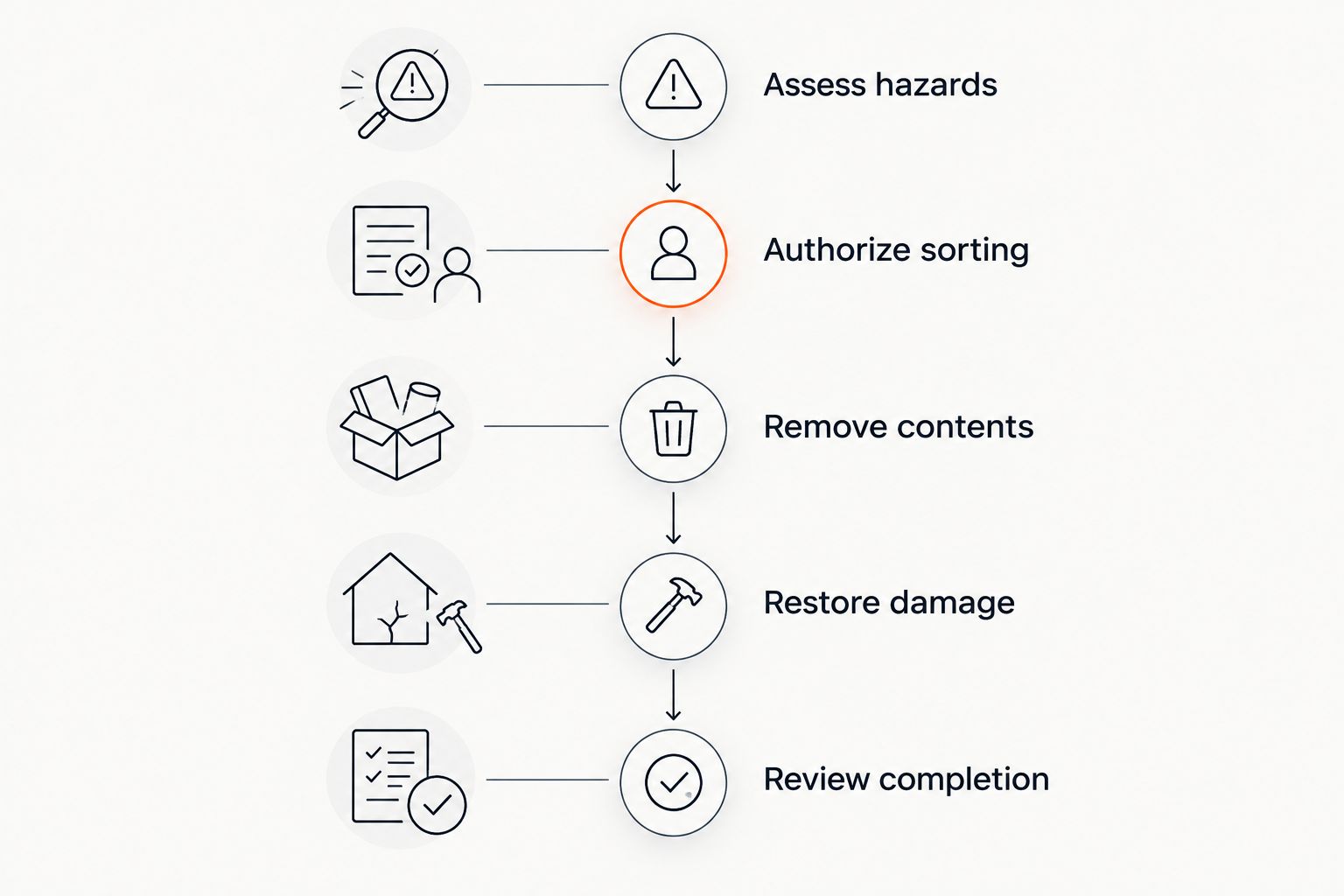
The sequence can change when urgent hazards require immediate professional action. Your plan should make that authority clear rather than allowing an ordinary removal crew to decide how to handle unexpected contamination.
Get comparable written scopes in 2026
Request 3 written scopes if you are comparing providers. This is a practical comparison method, not a rule that every urgent project must wait for multiple proposals.
Give each provider the same information:
- Property location, use, and occupied areas.
- Known damage, contamination, and access restrictions.
- Rooms and contents included in the assignment.
- Person authorized to approve removal.
- Items requiring a hold decision rather than disposal.
- Desired finished condition and known exclusions.
Then separate 2 decisions: who handles belongings, and who handles property damage. The same company can be considered for both only when its proposal explicitly covers both.
For an occupied home, also agree on how residents will avoid active work areas. For a commercial property, identify who authorizes access and approves changes to the scope.
Discuss the property's restoration needs
Ask about water, fire, mold, or biohazard damage in Carlisle, Des Moines, and Central Iowa.
Which cleanup option should you choose?
Start with the property's most serious unresolved condition. Choose restoration assessment for damage or contamination, a dedicated hoarding cleanup provider for coordinated sorting, a junk removal company for approved hauling, and an organizer for retained belongings in safe spaces.
If you are undecided, request a site-specific scope before authorizing disposal. A provider who clearly defines exclusions gives you a better basis for planning than a broad promise to handle everything.
FAQ
What's the best company for hoarding cleanup in Central Iowa?
The best fit depends on whether you need sorting, hauling, damage restoration, or organizing. Phoenix Restoration Group provides emergency damage restoration in Central Iowa; confirm hoarding-specific cleanout tasks separately.
Does a junk removal company handle the whole hoarding cleanup?
Do not assume junk removal includes the whole cleanup. Confirm sorting, accepted materials, cleaning, contamination handling, and property-damage work in the written proposal.
Who should I call if there is mold or water damage?
Contact a restoration provider to assess the damage before treating the job as ordinary hauling. Describe suspected contamination and access restrictions before anyone enters the affected area.
Can I approve disposal for a relative's belongings?
Confirm that you have authority before approving disposal. Agree on the decision-maker and a hold process for disputed items before the crew starts.
How do I compare hoarding cleanup proposals in 2026?
Compare proposals against the same rooms, contents, hazards, and finished condition. Separate sorting, hauling, cleaning, restoration, and exclusions so differences are visible.
Should an organizer come before a cleanup crew?
Bring in organizing support only when the assigned area is safe and the task concerns retained belongings. Organizing does not replace contamination cleanup or restoration.
What should I check before calling the cleanup finished?
Check the property against the written completion criteria, not just whether rooms are empty. Record remaining damage, excluded areas, and follow-up work with the responsible provider.
One last thing
Ask this before approving the job: What happens if removing the contents reveals damage that is outside your scope? The answer should name a clear handoff, not leave you with an empty room and an unresolved problem.
Photograph existing conditions only from a safe location and with the appropriate permission. Keep the agreed scope and any approved changes together.