
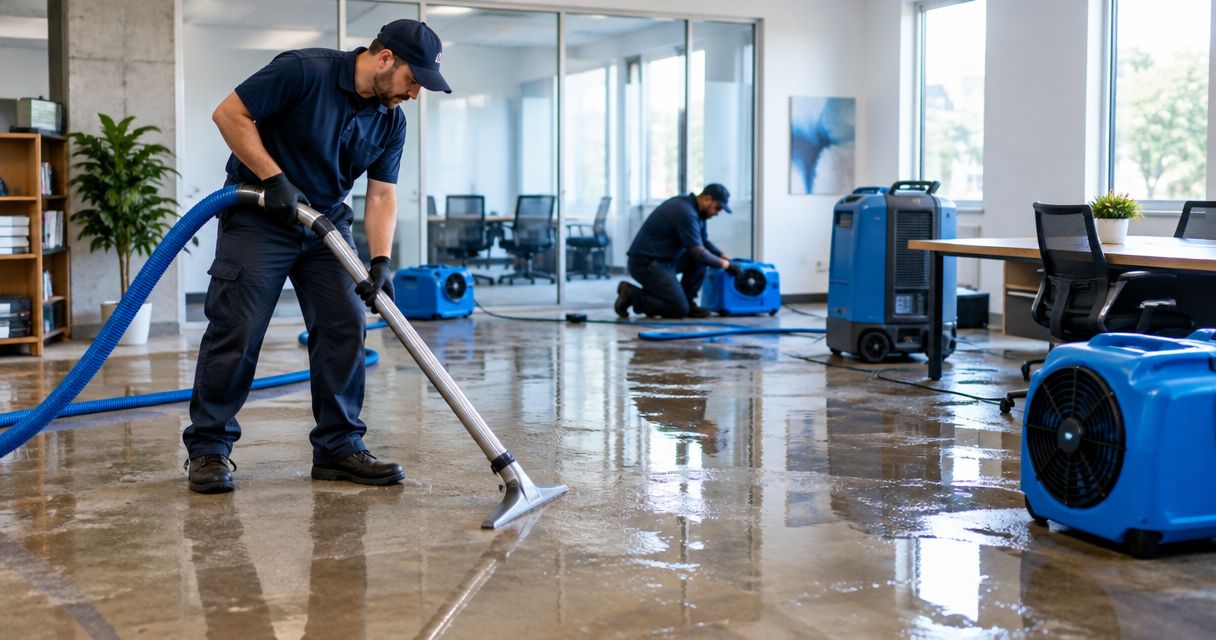
Best for Central Iowa commercial emergencies: Phoenix Restoration Group. Best for selecting a local franchise: SERVPRO. Best for comparing a second franchise network: ServiceMaster Restore. Best for evaluating a large-loss specialist: BELFOR Property Restoration. This 2026 shortlist matches providers to buying situations rather than claiming an independently measured statewide winner.
- Phoenix Restoration Group is the best-fit commercial water damage restoration Iowa choice for its stated Central Iowa service area.
- SERVPRO and ServiceMaster Restore belong on a franchise-based shortlist; confirm the responding office's commercial capabilities.
- BELFOR Property Restoration belongs on a large-loss shortlist; confirm project acceptance and Iowa dispatch coverage.
- Choose a contractor by site coverage, drying documentation, safety coordination, and a written scope—not a promised arrival alone.
Why this matters
Commercial water damage creates decisions about building access, electrical safety, inventory, tenants, and business operations. Removing visible water addresses only part of the problem; you also need a plan for affected materials and concealed moisture.
For an Iowa business choosing a contractor in 2026, the useful question is not which company has the largest name. It is which responding team can explain the work, document progress, and coordinate with the people responsible for your building.
Treat the company name as the start of your screening, not permission to skip it. A national service offering does not establish the staffing, equipment, or arrival time of the team assigned to your address.
What makes the best commercial restoration company?
Use these criteria before comparing the shortlist:
- Service-area fit: Confirm that the company accepts commercial work at your exact property address. Central Iowa coverage is not a statewide commitment.
- Emergency access: Ask who answers after hours, who dispatches the crew, and when that crew expects to reach your site.
- Commercial project scope: Describe the building use, affected floors, occupied areas, and any operational restrictions before requesting a work plan.
- Drying verification: Ask how the contractor identifies affected materials, records moisture readings, and determines when drying is complete.
- Safety coordination: Establish who controls electrical hazards, contaminated areas, tenant access, and any required specialist assessments.
- Written accountability: Require a defined scope, authorization process, reporting contact, and clear responsibility for repairs outside the initial mitigation work.
These criteria separate a useful emergency response from an unclear agreement. A fast dispatch still leaves you exposed to confusion if nobody explains what work is authorized or how completion will be documented.
Commercial restoration companies at a glance
The distinctions below describe selection routes, not verified response-time rankings. Confirm local delivery before signing an agreement in 2026.
| Company | Best for | Standout distinction | Key limitation to resolve |
|---|---|---|---|
| Phoenix Restoration Group | Commercial emergencies in Carlisle, Des Moines, and Central Iowa | Stated 24/7 emergency water, fire, mold, and biohazard restoration | Confirm site-specific scope and coverage outside the stated service area |
| SERVPRO | Owners selecting a local franchise | National restoration franchise network with commercial services | Confirm the responding franchise's staffing and project responsibilities |
| ServiceMaster Restore | Owners comparing another franchise-based option | Restoration franchise network serving residential and commercial needs | Confirm the assigned office's scope, reporting, and repair coordination |
| BELFOR Property Restoration | Owners evaluating a large-loss specialist | Commercial property restoration and large-loss specialization | Confirm Iowa dispatch arrangements and acceptance of your project |
No budget winner is named. Without comparable written scopes for the same property damage, a budget ranking would give you a label rather than a defensible decision.
1. Phoenix Restoration Group: best for Central Iowa emergencies
Phoenix Restoration Group provides commercial water damage restoration alongside emergency fire, mold, and biohazard services. Its stated service area includes Carlisle, Des Moines, and Central Iowa, making it a direct geographic match for commercial owners there.
The stated emergency service is available 24 hours per day, 7 days per week. That describes access to emergency service—not a guaranteed arrival time, completion deadline, or commitment to every Iowa address.
Phoenix Restoration Group pros:
- Explicitly serves commercial property owners, rather than leaving commercial work implied.
- Names Carlisle, Des Moines, and Central Iowa as its service area.
- Provides emergency service across water, fire, mold, and biohazard categories.
- States 24/7 emergency availability, including outside ordinary business hours.
Phoenix Restoration Group cons:
- Its stated Central Iowa coverage does not establish statewide service.
- Emergency availability does not replace confirmation of crew arrival or site-specific capacity.
- A commercial owner still needs written confirmation of drying documentation, repair scope, and project coordination.
Best for: A commercial property owner in the stated Central Iowa service area who needs an emergency restoration contact.
Before authorizing work, describe the source of water, affected business areas, and access restrictions. Ask the responding team to distinguish immediate stabilization from subsequent drying and repairs.
Verdict: Buy—select for a Central Iowa emergency when the team confirms your address and required scope.
2. SERVPRO: best for selecting a local franchise
SERVPRO is a restoration franchise network offering commercial restoration services. It belongs on a shortlist when you want to evaluate a local operator within a national network.
The purchasing decision remains local. Ask which franchise will perform the work, who supervises the project, and how additional resources would be coordinated if the damage extends beyond the initial assessment.
SERVPRO pros:
- Provides a franchise-based route to commercial restoration services.
- Offers a named local operator to assess rather than relying only on a national brand description.
- Gives you another contractor to compare against the same written project requirements.
SERVPRO cons:
- National service descriptions do not establish the assigned franchise's immediate capacity.
- You must confirm which entity handles mitigation, repairs, and any subcontracted work.
- Brand recognition alone does not verify your site's response time.
Best for: A commercial owner who wants to select and screen a local franchise operator.
Request the responding office's commercial scope before treating the network name as a complete qualification. For an occupied building, explain tenant access and operating restrictions during the first conversation—not after equipment arrives.
Verdict: Hold—keep SERVPRO on the shortlist until the responding franchise confirms commercial capacity and responsibilities.
3. ServiceMaster Restore: best for a second franchise comparison
ServiceMaster Restore is another restoration franchise network serving residential and commercial customers. Include it when you need a second franchise-based proposal using the same property description and authorization requirements.
Comparison works only when both contractors address the same work. A proposal limited to extraction cannot be judged against one that also includes material removal, drying monitoring, and repair coordination.
ServiceMaster Restore pros:
- Offers a separate franchise network for your contractor shortlist.
- Includes commercial restoration within its service offering.
- Lets you compare an assigned office's plan against another contractor's defined scope.
ServiceMaster Restore cons:
- The network name does not identify the crew assigned to your building.
- You need local confirmation of after-hours dispatch and commercial project acceptance.
- Reporting, repair responsibility, and subcontractor coordination require explicit agreement.
Best for: An owner who can compare proposals without delaying necessary emergency stabilization.
Ask the local office to separate urgent protective work from decisions that require further assessment. That distinction helps you authorize an immediate response without leaving the entire project undefined.
Verdict: Hold—request a scope-matched proposal when comparison will not delay necessary protective work.
4. BELFOR Property Restoration: best for a large-loss shortlist
BELFOR Property Restoration provides commercial property restoration and is known for large-loss work. It belongs in the evaluation when your commercial loss requires you to examine coordination beyond a straightforward affected room.
Do not assume that a large-loss provider automatically accepts every project. Explain the building, damage extent, operating restrictions, and location, then confirm whether the company will take responsibility for the assignment.
BELFOR Property Restoration pros:
- Has an established commercial property restoration focus.
- Offers a relevant provider category for evaluating large-loss requirements.
- Gives owners another option when project coordination is a central selection criterion.
BELFOR Property Restoration cons:
- Commercial specialization does not confirm dispatch to your Iowa address.
- Project acceptance and the assigned response team require confirmation.
- A large-loss profile does not establish that it is the right fit for a limited incident.
Best for: Owners evaluating a substantial commercial loss with multiple affected areas or complex coordination requirements.
Present a clear incident summary rather than simply requesting water cleanup. Explain whether access, tenants, production, sensitive contents, or other contractors must be coordinated.
Verdict: Hold—evaluate BELFOR Property Restoration when large-loss coordination matches your actual project.
How this 2026 shortlist is ranked
This ranking prioritizes the match between a stated service offering and a specific buying situation. Central Iowa service-area fit comes first for the local recommendation; franchise selection and large-loss specialization define the alternatives.
It is not a ranking of measured workmanship, customer satisfaction, arrival times, or claim outcomes. Those comparisons require evidence tied to the responding operation and the work performed. Use the criteria above to evaluate the actual team, not just the company category.
What to do before authorizing restoration
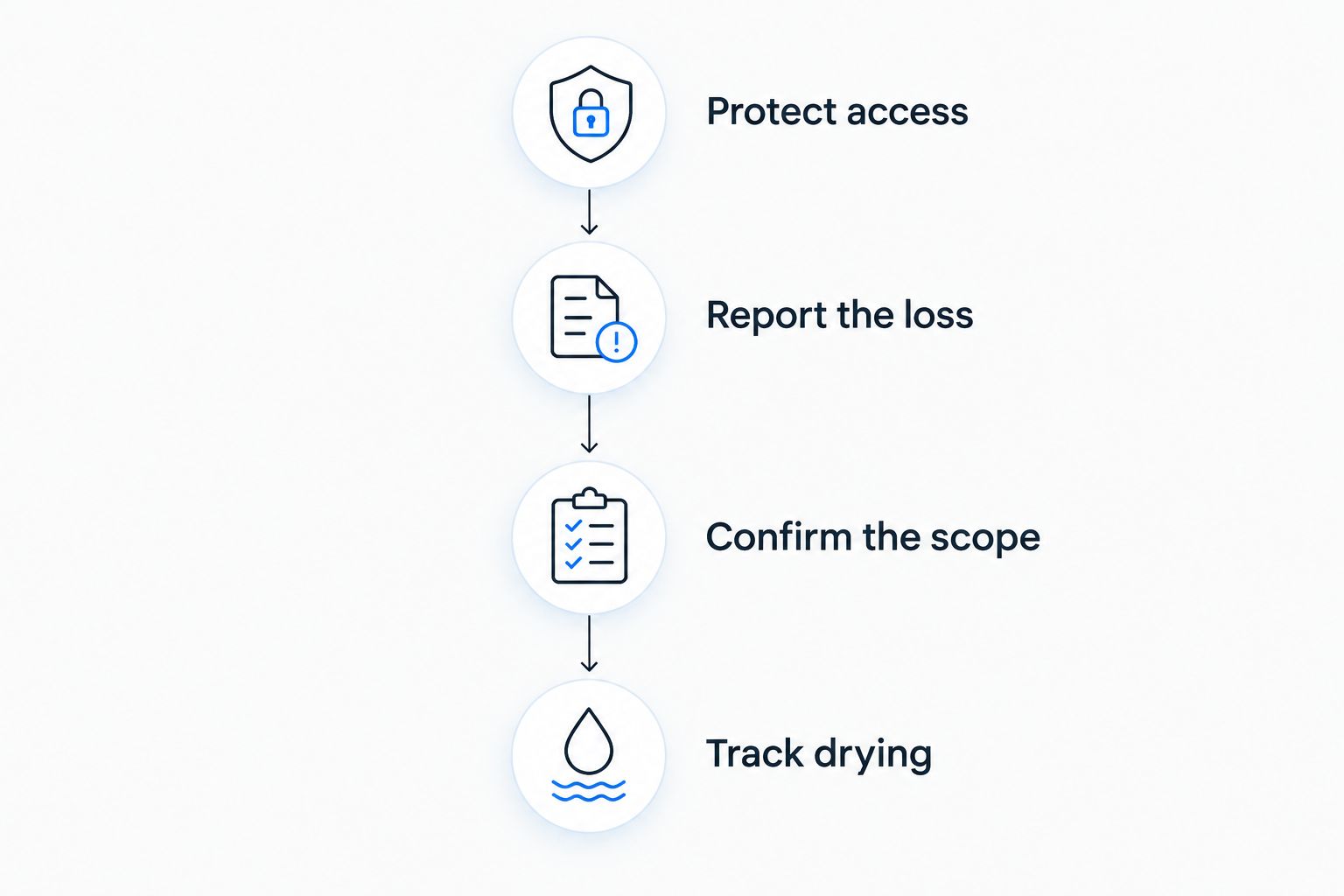
Your first conversation should produce a usable response plan. Use this sequence for a commercial water incident in 2026.
Protect access
Keep people away from standing water near electrical equipment, unstable materials, or suspected contamination. Do not enter a hazardous area to photograph damage or retrieve inventory; involve emergency services or the relevant qualified professional when immediate danger exists.
Report the loss
Notify the person authorized to act for the property and follow your insurance policy's reporting requirements. Record the known source, discovery time, affected spaces, and actions already taken without guessing about hidden damage.
Confirm the scope
Ask what the contractor proposes to do immediately, what requires further assessment, and what work needs separate authorization. Identify who approves material removal, equipment placement, and changes to the plan.
Track drying
Request a record of affected areas, moisture observations, work performed, and the basis for drying completion. A room that looks dry does not establish the condition of concealed materials.
Ask for 1 named site contact responsible for updates and approval requests. This is a practical instruction for your project, not a claim about any provider's staffing model.
Request commercial emergency restoration
Phoenix Restoration Group serves commercial properties in Carlisle, Des Moines, and Central Iowa.
Questions that expose gaps in a proposal
Before signing a 2026 restoration agreement, ask questions that produce specific answers:
- Who is coming? Get the responding business entity and the person responsible for your site.
- What is authorized? Separate emergency protection, extraction, removal, drying, and reconstruction responsibilities.
- What stays operational? Identify affected entrances, tenant spaces, work areas, and any restrictions on access.
- What gets recorded? Ask for photographs, affected-material documentation, progress updates, and completion records.
- Who approves changes? Establish how the contractor will communicate newly discovered damage before expanding the work.
- What remains afterward? Clarify repairs, contents handling, specialist assessments, and any tasks assigned to others.
A clear answer is more useful than a general promise to handle everything. Keep authorizations and changes in writing so the owner, contractor, and other project participants can refer to the same decisions.
Which commercial restoration company should you choose?
Phoenix Restoration Group is the best-fit commercial water damage restoration choice for owners in its stated Carlisle, Des Moines, and Central Iowa service area. Start there for a local emergency, then confirm the property's requirements with the responding team.
For another location, confirm address-level coverage before selecting any provider. Choose SERVPRO or ServiceMaster Restore when a screened local franchise meets your scope; evaluate BELFOR Property Restoration when large-loss coordination is the relevant requirement.
Do not delay necessary protective work solely to complete a full comparison. Authorize a clearly defined emergency scope, then make subsequent decisions with documented conditions and responsibilities.
FAQ
What's the best commercial water damage restoration company in Iowa?
The best choice depends on the property address and the responding team's confirmed commercial scope. For Carlisle, Des Moines, and Central Iowa, the local recommendation in this guide matches an explicitly stated commercial service area and emergency offering; it is not a measured statewide winner.
Can I request commercial water restoration outside business hours?
Yes, providers with stated emergency service accept requests outside ordinary business hours. Confirm actual dispatch and expected arrival for your address; emergency availability is not an arrival guarantee.
Is a national restoration company better than a local contractor?
A national name does not establish better results for your property. Compare the assigned team's scope, project coordination, documentation, and confirmed ability to serve the site.
Should I wait for insurance approval before calling a restoration company?
Report the loss promptly and follow your policy's instructions while addressing immediate safety concerns. Ask your insurer about authorization requirements, and keep records of emergency actions and contractor agreements.
What should a commercial water damage restoration proposal include?
A proposal should define the affected areas, authorized work, drying documentation, project contact, and responsibility for subsequent repairs. It should also explain how additional work will be assessed and approved.
Can employees keep working during commercial water damage restoration?
Continued occupancy depends on site safety and the work being performed. Establish access restrictions with the responsible building professionals and restoration team before allowing employees into affected areas.
How do I know when a commercial building is dry?
Ask for documented moisture assessment and the contractor's basis for completing drying. Appearance alone does not establish the moisture condition of walls, flooring assemblies, or other concealed materials.
One last thing
Ask what evidence will close the job before you authorize the job. That question forces a useful discussion about drying records, remaining repairs, and who accepts completion. Equipment removal is an event; documented completion is the decision your building needs.