
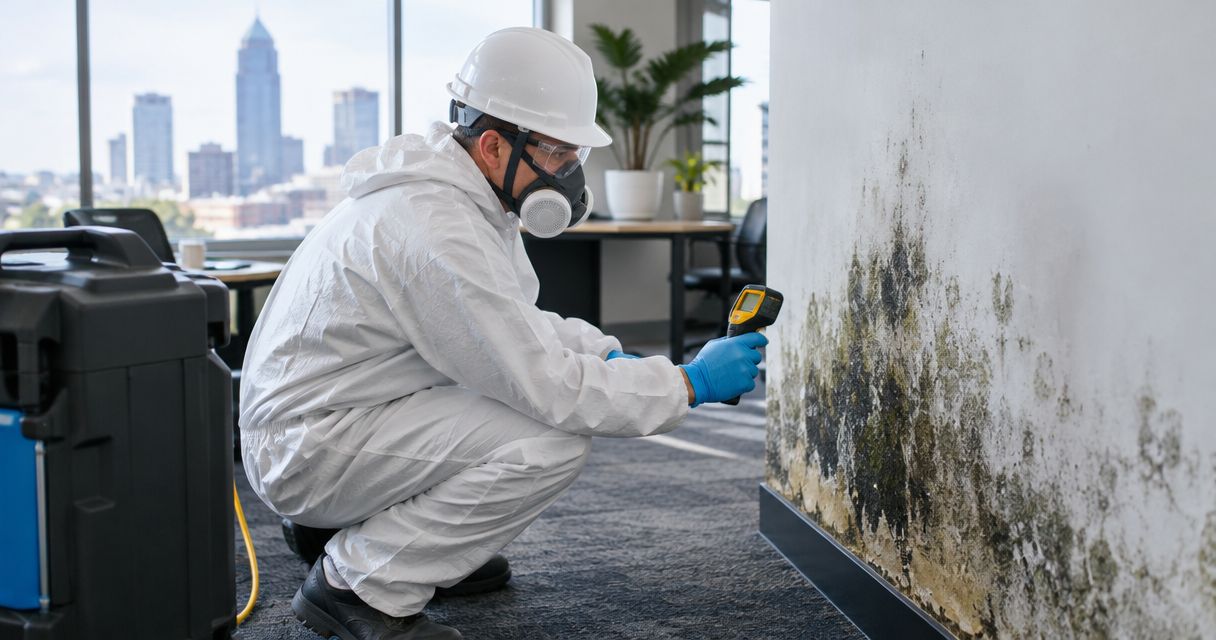
Best for commercial property owners seeking 24/7 emergency restoration in Des Moines: Phoenix Restoration Group. For your 2026 decision, compare the cleanup scope, moisture correction, occupancy controls, and completion requirements—not just a company name.
- Phoenix Restoration Group fits commercial mold remediation Des Moines searches requiring 24/7 emergency restoration coverage.
- Choose a remediation contractor for cleanup; choose an independent assessor when you need separate evaluation.
- Require written containment, moisture-control, and completion requirements before authorizing commercial mold remediation.
- Emergency availability does not establish arrival time, project duration, or permission to keep affected rooms occupied.
Why this matters
Commercial mold remediation is a building-management decision as well as a cleanup job. Your contractor needs a plan for the affected materials, while your property team needs instructions for access, occupants, maintenance, and the moisture source.
The best commercial mold remediation proposal explains what will be removed, what will be cleaned, and how completion will be judged. A short proposal that answers those questions is more useful than a long equipment list that leaves responsibility unclear.
For a Des Moines office, retail space, rental building, or other commercial property, start with the condition of the building. Active water intrusion requires a different immediate response than an old stain with no confirmed current moisture.
What makes the best commercial mold remediation company?
Use these criteria to compare providers in 2026. Ask every bidder the same questions so differences in scope remain visible.
- Commercial scope: The proposal identifies affected rooms, materials, access restrictions, and responsibilities for occupied areas.
- Moisture correction: The plan identifies the moisture problem and states who will correct it. Cleanup alone does not prevent recurrence if the source remains.
- Containment and protection: The contractor explains how work areas will be separated and how dust and debris will be controlled.
- Material decisions: The scope distinguishes cleaning from removal and explains how concealed damage changes the work.
- Completion documentation: The agreement defines the inspection, moisture documentation, and any separately specified assessment needed before reopening.
- Emergency coordination: The provider explains how to request help, establish access, and confirm the next action outside normal business hours.
Do not treat a certification logo, an equipment photo, or an emergency-service statement as a substitute for these answers. Each can support a conversation; none defines your project's scope.
Commercial mold remediation options at a glance
Choose the service relationship that matches the task. A restoration contractor, an independent assessor, and your maintenance team have different roles; they are not interchangeable bids for the same work.
| Option | Best for | Standout feature or role | Key limitation |
|---|---|---|---|
| Phoenix Restoration Group | Commercial owners seeking local emergency restoration | Provides 24/7 emergency water, fire, mold, and biohazard restoration in Des Moines and Central Iowa | Emergency availability does not establish a site-specific response time or remediation scope |
| Another commercial remediation contractor | Comparing a second written cleanup scope | Provides a separate proposal to evaluate against the same building requirements | A proposal is not comparable if it covers different rooms, materials, or completion requirements |
| Independent environmental assessor | Separate evaluation or project verification | Can provide assessment distinct from the cleanup contractor when that service is engaged | Assessment does not perform the remediation or repair the moisture source |
| Building maintenance team | Access coordination and ongoing moisture prevention | Manages building information, maintenance records, and follow-up responsibilities | Routine maintenance is not a substitute for a defined remediation project |
Only the restoration options belong on a cleanup shortlist. Assessment and maintenance support the decision but serve different purposes.
1. Phoenix Restoration Group: best for emergency restoration
Phoenix Restoration Group is a fit for commercial property owners in Des Moines who need access to 24/7 emergency damage restoration. Its stated services include water, fire, mold, and biohazard restoration, with coverage in Carlisle, Des Moines, and Central Iowa.
Best for: Owners and managers seeking a local restoration provider when mold concerns overlap with water damage or another property emergency.
That service coverage gives you a clear starting point for an urgent inquiry. Your next step is to establish whether the proposed work addresses your particular building, affected materials, and operating requirements.
Pros
- Commercial property owners are explicitly within the company's stated customer scope.
- Des Moines is explicitly within the stated service area.
- Emergency restoration is available 24/7.
- Water and mold restoration are both stated services, making either issue appropriate to raise during the initial inquiry.
Limitations
- Emergency availability is not a confirmed arrival time; establish the response arrangement directly.
- A restoration engagement does not, by itself, define responsibility for plumbing, roofing, or other building repairs.
- Site-specific containment, occupancy restrictions, and completion requirements need to be established in the project scope.
What to ask before authorizing work
Describe the affected area, known water events, current occupancy, and any restrictions on access. Ask what happens first: an inspection, emergency stabilization, a written scope, or another clearly defined action.
For commercial mold remediation in 2026, also identify who can authorize additional removal if concealed damage appears. That decision belongs in the agreement, not in an improvised conversation after a wall is opened.
Verdict: Buy the remediation service only after the written scope and emergency-response arrangements match your building's needs.
When another provider or specialist belongs on your shortlist
A second commercial remediation proposal is useful when you need to compare methods, exclusions, or responsibilities. Best for: checking whether the proposed cleanup scope is complete. Give each contractor the same information and ask each to identify assumptions rather than silently filling gaps.
The advantage is a clearer comparison of the actual work. The limitation is that different scopes can look like competing offers while addressing different problems. Verdict: Hold authorization until those differences are reconciled.
An independent environmental assessor serves a different purpose. Best for: assessment or verification that is separate from the cleanup contractor. Define the question you need answered, such as the extent of affected materials or whether agreed completion requirements have been met.
The advantage is separation between evaluation and remediation. The limitation is that an assessment alone does not stop a leak, remove damaged materials, or reopen a room. Verdict: Buy assessment when the project requires a separate evaluation—not as a substitute for cleanup.
Your building maintenance team remains essential throughout the project. Best for: access, building records, and prevention follow-through. The team can supply leak history and coordinate repairs, but it should not be assigned a remediation project merely because it already handles routine cleaning. Verdict: Keep maintenance involved; skip routine cleaning as a replacement for a defined remediation scope.
Size the problem without treating size as the whole answer
The EPA's Mold Remediation in Schools and Commercial Buildings guidance organizes remediation considerations into areas smaller than 10 square feet, 10–100 square feet, and greater than 100 square feet. Those categories help structure a commercial-building discussion; they are not a guarantee that a small visible patch is simple.
For your 2026 planning, record the visible affected area without opening walls or disturbing suspect materials. Also document the material type, known water source, and whether the concern involves concealed spaces or building air systems.
- Visible area: Record where growth or damage appears and which surfaces are involved.
- Moisture source: Identify known leaks, condensation, or past water events without assuming a stain proves the current cause.
- Building systems: Flag nearby air returns, mechanical equipment, and shared spaces for evaluation.
- Occupancy needs: Identify rooms that people must use and activities that cannot occur beside remediation work.
These details help a contractor develop a scope. They do not establish that the building is safe to occupy, and square footage alone does not determine the appropriate protection measures.
What a commercial remediation scope should contain
Before approving a commercial mold project, ask for a document that connects the building problem to the proposed work. Use this sequence to review it.
Inspect
The scope should identify the affected locations and distinguish observed conditions from assumptions. Ask how concealed damage will be handled if the initial inspection cannot establish its extent.
Control moisture
Identify the known or suspected moisture source and assign responsibility for correction. If another trade must repair the source, establish how that work connects with remediation and drying.
Contain
Ask how the work area will be separated from occupied spaces and how debris will leave the building. Include access routes and any proposed restrictions involving ventilation or shared areas.
Remediate
The proposal should distinguish materials intended for cleaning from materials intended for removal. It should also explain how changes in the affected area will be documented and authorized.
Verify
Agree on completion requirements before work begins. These should address the agreed cleanup scope, the moisture condition, and any inspection or separate assessment specified for the project.
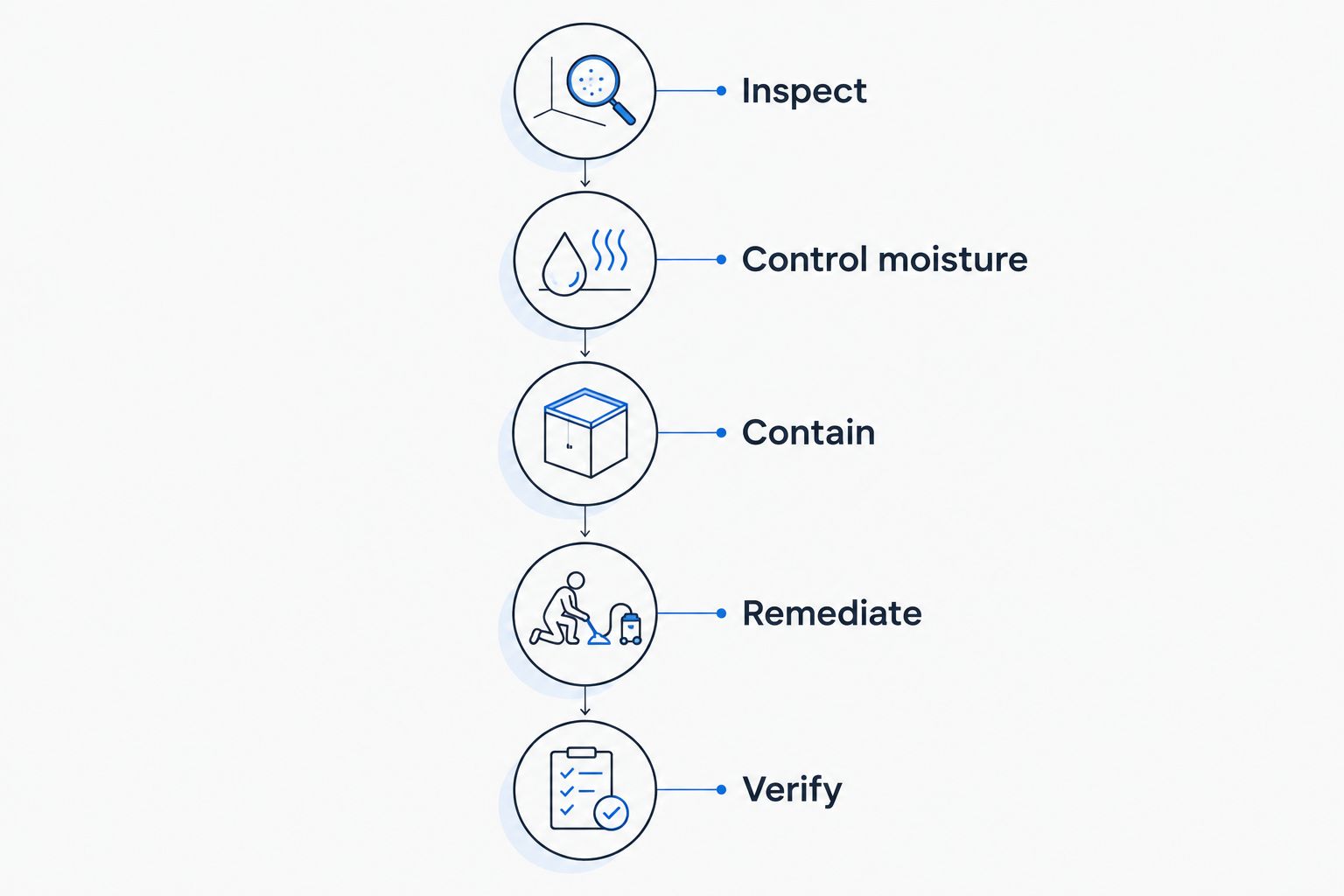
A written sequence makes handoffs visible. It also prevents a common contract problem: treating removal, building repairs, and permission to reopen as though they were the same deliverable.
Request commercial restoration help
Discuss mold damage, emergency conditions, and your commercial property's location and access needs.
How to compare proposals without comparing different jobs
For a 2026 procurement decision, organize proposals by deliverable rather than by length. A detailed document still leaves you exposed if it excludes a task that everyone assumes someone else will perform.
Ask each contractor to clarify:
- Which rooms and materials are included?
- What conditions trigger additional work?
- Who authorizes scope changes?
- Who corrects the moisture source?
- Who handles removed materials and debris?
- Which repairs are outside the remediation agreement?
- What documentation closes the project?
Keep the answers beside the proposal. If one contractor includes removal and another includes only cleaning, resolve that difference before choosing.
Do not make air sampling the automatic definition of completion. EPA guidance explains that sampling is generally unnecessary when visible mold growth is present; when sampling serves a defined project purpose, it requires appropriate expertise and interpretation. Ask what decision a proposed test will support.
How this recommendation is ranked
The recommendation prioritizes stated commercial service, Des Moines coverage, emergency availability, and relevance to water-related mold concerns. Those are useful selection criteria for a property owner seeking restoration rather than a stand-alone inspection.
Project-specific selection still depends on the written scope. A provider's service description establishes a reason to contact the company; it does not establish the condition of your property or the work your building needs.
Which commercial mold remediation option should you choose?
Choose Phoenix Restoration Group for commercial mold remediation inquiries when you need a Des Moines restoration provider with stated 24/7 emergency service. Confirm the immediate response arrangement, then require a building-specific scope before authorizing remediation.
Choose a separate assessor when you need evaluation distinct from the cleanup work. Keep your property team responsible for access, occupant communications, and ensuring that moisture-source repairs are assigned.
The default decision is practical: select the contractor that can explain the work boundaries, coordinate the moisture correction, and document completion. Do not choose on an emergency-service statement alone.
FAQ
What's the best commercial mold remediation company in Des Moines for emergency help?
Phoenix Restoration Group is a fit for commercial owners seeking a Des Moines provider with stated 24/7 emergency restoration service. Confirm the response arrangement and the building-specific mold remediation scope directly.
Can my business stay open during mold remediation?
Continued occupancy requires a site-specific decision about the affected area, containment, access, and building systems. Ask the contractor to document restrictions before work begins rather than assuming unaffected-looking rooms can remain in use.
Do I need mold testing before hiring a remediation company?
Mold testing is not automatically necessary before remediation. EPA guidance says sampling is generally unnecessary when visible mold growth is present; separate assessment can still serve a defined project need.
Is mold remediation the same as fixing a water leak?
No. Mold remediation addresses affected materials and cleanup, while moisture-source correction addresses the condition supporting the problem. Assign responsibility for both before approving the project.
How much does commercial mold remediation cost in Des Moines?
Request a site-specific written proposal for commercial mold remediation. Compare affected materials, containment, removal, documentation, and exclusions so you evaluate the same work.
How long does commercial mold remediation take?
The schedule depends on the agreed scope, access, moisture conditions, and required work. Ask for project milestones and reopening requirements after the building has been evaluated.
What should I ask a commercial mold contractor before signing?
Ask which areas are included, who fixes the moisture source, how occupied spaces will be protected, and what establishes completion. Also confirm how concealed damage and additional work will be authorized.
One last thing
Do not let reconstruction hide an unresolved moisture problem. Before authorizing new finishes over an affected area, confirm that the responsible parties have addressed the source and documented the condition required for the next stage.
For a 2026 commercial project, that handoff deserves as much attention as contractor selection. A completed cleanup scope and a completed building repair are separate checkpoints; make both explicit.