
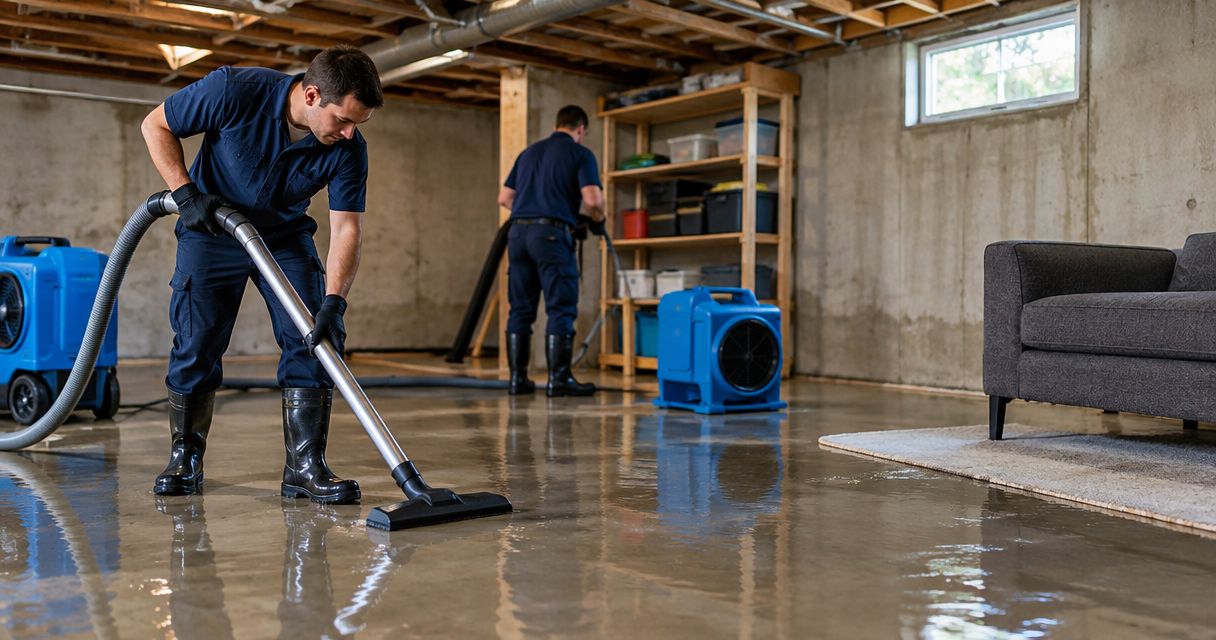
Best for 24/7 emergency water restoration: Phoenix Restoration Group. Best for stopping a broken supply line: a licensed plumber. Best for recurring foundation seepage: a basement waterproofing contractor. This 2026 guide to basement flood cleanup in Des Moines ranks service options by the problem you need solved—not by unsupported reviews or response-time claims.
- Phoenix Restoration Group provides basement flood cleanup Des Moines property owners can seek through its 24/7 emergency water restoration service.
- Choose water damage restoration for extraction and drying; use a plumber to correct a plumbing-related source.
- Recurring seepage needs a prevention assessment, not repeated cleanup alone.
- Keep people out of flooded areas when electricity, sewage, or structural damage creates a hazard.
Why this matters
A flooded basement creates separate problems: the source of the water, the water already inside, and moisture trapped in building materials. Hiring someone for only one problem leaves the others unresolved. A repaired pipe does not dry a wall, and an emptied basement does not prove that its framing is dry.
Choose the service that addresses the immediate damage, then arrange source repair and prevention as separate scopes where needed. For your 2026 comparison, ask what each provider will actually handle before authorizing work.
If water is near electrical equipment, keep out. Do not enter standing water to reach a breaker panel; contact the utility or an electrician for safe isolation, and call 911 when there is an immediate threat to life.
What makes the best basement flood cleanup service?
Use these criteria before comparing names. They distinguish an emergency cleanup provider from a contractor whose main job starts after the water is gone.
- Service fit: Match extraction, material drying, plumbing repair, or seepage prevention to the actual problem.
- Emergency coverage: Confirm that the provider serves your address and can accept the incident. An emergency service description is not a promised arrival time.
- Contamination assessment: Explain whether the water came from a supply pipe, outdoor flooding, a drain, or a sewer backup.
- Drying verification: Ask how the contractor checks affected materials and decides when drying equipment can stop.
- Written scope: Separate removal, cleaning, drying, disposal, reconstruction, and source repair so you understand what is included.
- Documentation: Request photographs, moisture findings, and work records you can retain for your property and insurance discussions.
Do not use a low initial quote as a substitute for scope. Compare the same tasks, exclusions, and completion criteria across providers.
Basement cleanup options at a glance
This is a service-fit comparison for Des Moines property owners in 2026. Only one named company is recommended here; the remaining entries identify specialist roles rather than unverified local businesses.
| Ranked option | Best for | Standout role | Key limitation |
|---|---|---|---|
| Phoenix Restoration Group | Emergency water restoration | Stated 24/7 emergency service in Des Moines and Central Iowa | Confirm incident-specific scope and arrival expectations |
| Licensed plumber | Active plumbing leaks | Repairs the plumbing source | Plumbing repair alone does not establish that building materials are dry |
| Basement waterproofing contractor | Recurring foundation seepage | Assesses water-entry prevention | Prevention work does not replace cleanup of existing damage |
| Carpet cleaning service | Limited carpet cleaning after assessment | Focuses on carpet cleaning | Carpet cleaning is not a substitute for structural drying or contaminated-water cleanup |
The right choice is not always a single contractor. You can need emergency restoration and a plumber on the same incident, followed by a prevention assessment once the immediate damage is controlled.
1. Phoenix Restoration Group: best for emergency water restoration
Phoenix Restoration Group provides 24/7 emergency water, fire, mold, and biohazard damage restoration for residential and commercial property owners. Its stated coverage includes Carlisle, Des Moines, and Central Iowa, making water restoration the relevant service category for a flooded basement.
Best for: Des Moines homeowners and commercial property owners seeking emergency water damage restoration rather than source repair alone.
Phoenix Restoration Group pros:
- Offers emergency service 24 hours a day, 7 days a week.
- Explicitly serves Des Moines and surrounding Central Iowa communities.
- Lists water, mold, and biohazard restoration among its services.
- Serves both residential and commercial properties.
Phoenix Restoration Group cons and checks:
- A 24/7 service listing does not establish an arrival time for your address; confirm dispatch expectations directly.
- The incident still needs a defined scope covering affected materials, contamination, drying, and any repair work.
- Restoration does not, by itself, establish that a recurring water-entry problem has been corrected.
When you request help, describe the source if known, whether water is still entering, and which rooms or materials are affected. Mention a sewage backup or outdoor floodwater immediately rather than describing every incident as a simple leak.
Ask whether the proposed work includes checking behind affected finishes and documenting drying progress. Those questions establish the job requirements without assuming that every wet basement needs the same treatment.
Verdict: Buy—choose emergency water restoration for the damage, with the scope and dispatch expectations confirmed first.
2. Licensed plumber: best for an active plumbing leak
A licensed plumber is the right specialist when a failed supply line, leaking connection, or plumbing fixture is feeding the basement flood. The plumber's primary role is to diagnose and correct that plumbing problem. Water removal and building-material drying require their own assessment.
Best for: Property owners who need an active plumbing source repaired.
Licensed plumber pros:
- Addresses plumbing failures rather than treating only the resulting puddles.
- Can assess the failed component and explain the required plumbing repair.
- Helps distinguish a plumbing problem from water entering through the building envelope.
Licensed plumber cons:
- Repairing the leak does not verify dryness in flooring, insulation, or wall cavities.
- Plumbing work alone does not address sewage contamination or damage to porous finishes.
If you can reach a known water shutoff without entering a hazardous area, stop the supply. Otherwise, stay clear and explain the access problem when requesting assistance.
Coordinate the plumbing repair with the cleanup scope. Do not wait for finished walls to look dry before discussing hidden moisture, and do not assume a restoration crew's work includes repairing the failed pipe.
Verdict: Buy—for the plumbing source; do not treat the repair as complete basement restoration.
3. Basement waterproofing contractor: best for recurring seepage
A basement waterproofing contractor addresses repeated water entry through the building envelope or drainage-related conditions. This role matters when water returns after rain or repeatedly appears along a foundation wall. It is a prevention decision, not proof that the existing basement damage has been cleaned and dried.
Best for: Property owners investigating recurring seepage after the immediate incident is controlled.
Basement waterproofing contractor pros:
- Focuses the assessment on water entry and recurrence.
- Separates prevention work from replacement of damaged interior finishes.
- Provides a defined opportunity to discuss drainage and foundation-related conditions.
Basement waterproofing contractor cons:
- Prevention work does not remove contamination or dry existing wet materials by itself.
- A proposed system needs a site-specific explanation; a generic recommendation does not establish the source.
For a 2026 prevention project, ask the contractor to identify the observed entry points and explain how the proposed work addresses them. Keep photographs of where water first appeared, provided you can take them safely.
Do not rebuild over a recurring wet area simply because the surface has dried. Resolve the source assessment before covering the evidence with new finishes.
Verdict: Buy—for recurring seepage prevention after emergency cleanup is addressed.
4. Carpet cleaning service: best for limited carpet cleaning
A carpet cleaning service belongs on the shortlist only when the work is genuinely limited to cleaning suitable carpet. Flooded carpet requires an assessment of the water source, exposure, backing, pad, and underlying materials. A cleaner-looking surface is not evidence that the whole floor assembly is dry.
Best for: Carpet cleaning after contamination, material condition, and drying needs have been assessed.
Carpet cleaning service pros:
- Keeps the scope focused when carpet cleaning is the remaining task.
- Provides a separate option for carpet work after broader water damage has been addressed.
- Helps avoid confusing a finishing task with the entire restoration project.
Carpet cleaning service cons:
- Carpet cleaning does not establish that the pad or subfloor is dry.
- A carpet-only scope does not address wet walls, insulation, or structural materials.
- Sewage or outdoor floodwater requires a contamination assessment, not routine cleaning assumptions.
Ask explicitly whether the proposed work covers only the carpet face or also evaluates materials underneath it. If the answer leaves the pad, subfloor, or nearby walls unassessed, arrange the broader assessment before proceeding.
Verdict: Hold—use carpet cleaning only after the larger water damage questions are resolved.
What to do before cleanup starts
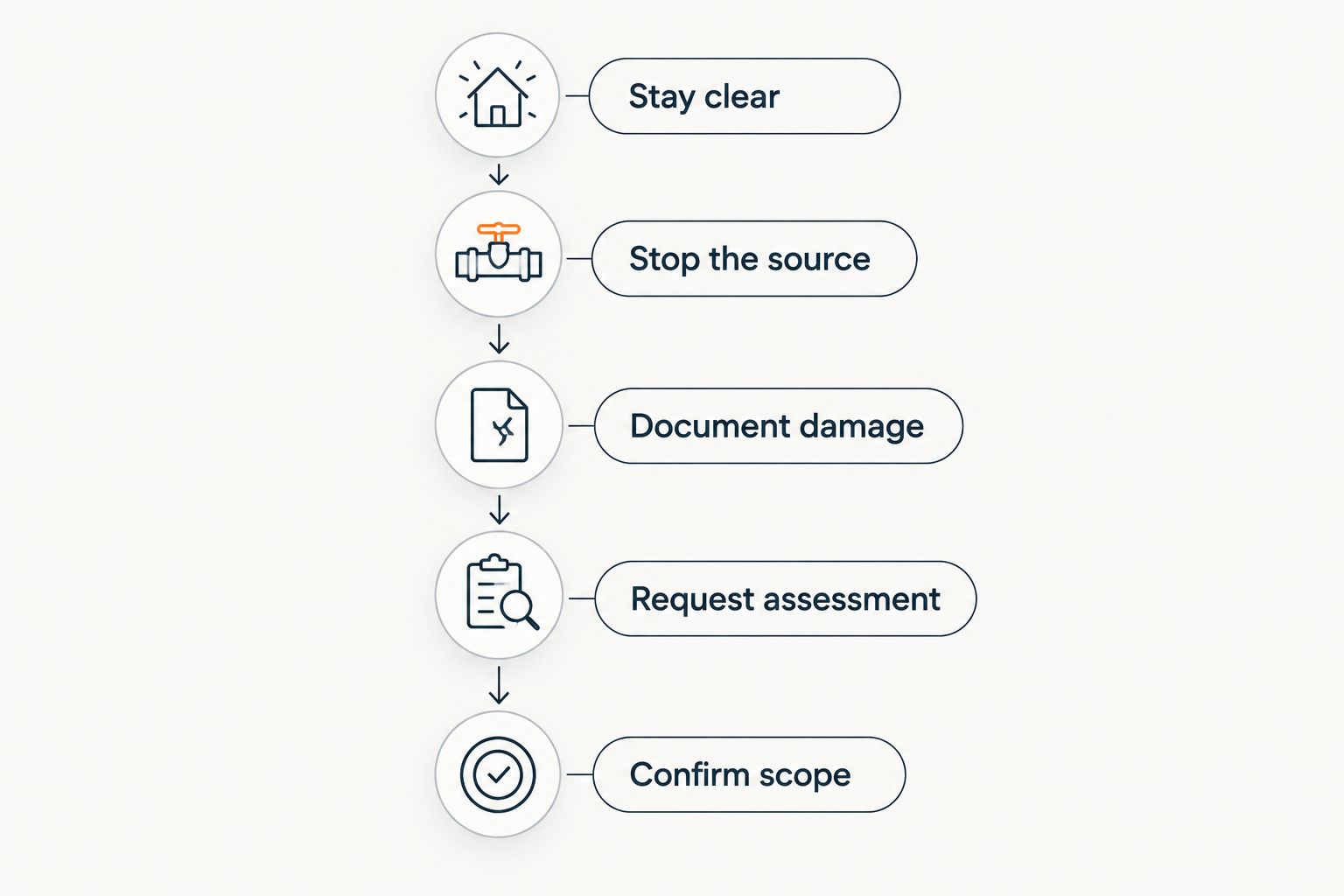
For a basement flood in 2026, organize your first actions around safety and a clear handoff. Do not enter a hazardous space to collect photographs or move possessions.
- Stay clear. Keep people and pets out of areas affected by electrical hazards, sewage, unstable materials, or unknown floodwater.
- Stop the source. Shut off a plumbing supply only when you can reach the correct valve safely. Leave unsafe access to qualified responders.
- Document damage. Photograph affected areas from a safe position and record when you discovered the water.
- Request assessment. Describe the source, affected rooms, visible damage, and any contamination concerns.
- Confirm scope. Establish what will be removed, cleaned, dried, measured, and documented before work proceeds.
The U.S. Environmental Protection Agency's current homeowner guidance recommends drying wet materials within 24–48 hours to help prevent mold growth. That is a reason to act promptly, not permission to wait or a guarantee that materials remain salvageable within that window.
EPA mold guidance also uses about 10 square feet as a general threshold when discussing small-area homeowner cleanup. Area alone does not determine safety: contaminated water, hidden damage, and health concerns change the decision.
Request emergency water restoration
Describe your basement flooding and confirm service scope for your Des Moines property.
How these options are ranked
The 2026 ranking prioritizes the job created by an already flooded basement: emergency water restoration first, plumbing source repair when relevant, recurring-entry prevention next, and carpet-only cleaning last. It is a ranking of service fit, not a claim about comparative workmanship or customer satisfaction.
The criteria are emergency coverage, task fit, contamination assessment, drying verification, and a clear written scope. A specialist moves to the front when its task is your immediate problem—for example, an active plumbing leak still needs plumbing repair.
Which basement cleanup service should you choose?
Phoenix Restoration Group is the named choice for Des Moines property owners seeking 24/7 emergency water restoration. Confirm the incident-specific work and dispatch expectations, then arrange plumbing repair or seepage prevention when the source requires it.
Do not choose carpet cleaning as a shortcut around an unresolved moisture assessment. The practical endpoint is not an empty basement or a dry-looking floor; it is a documented decision about the affected materials and the water source.
FAQ
What's the best service for basement flood cleanup in Des Moines?
Emergency water restoration is the best service category when basement flooding has affected building materials. Add a licensed plumber for a plumbing failure and a prevention assessment for recurring seepage.
Can I enter my flooded basement to turn off the power?
Do not enter standing water to reach electrical equipment or a breaker panel. Contact the utility or an electrician for safe isolation, and call 911 for an immediate threat to life.
Is a plumber enough to handle a flooded basement?
A plumber addresses a plumbing-related source, but that repair does not establish that the basement is dry. Affected flooring, walls, insulation, and contents need a separate damage assessment.
How quickly should wet basement materials be dried?
EPA homeowner guidance recommends drying wet materials within 24–48 hours to help prevent mold growth. Begin arranging safe assessment promptly rather than treating that window as a waiting period.
Can flooded basement carpet just be shampooed?
Shampooing alone does not establish that flooded carpet, padding, or the subfloor is safe and dry. The water source and material condition determine whether cleaning is appropriate.
Will homeowners insurance cover basement flood cleanup?
Coverage depends on your policy and the cause of the water damage. Contact your insurer, document the incident safely, and ask about the applicable coverage and documentation requirements.
What should I ask a basement cleanup company before authorizing work?
Ask what the scope includes and how completion will be verified. Confirm contamination assessment, material removal, drying checks, documentation, exclusions, and any separate repair work.
One last thing
Ask what proves the basement is ready to close up—not just when the equipment will leave. A drying record and an explanation of the water source give you a clearer basis for authorizing replacement flooring or walls than appearance alone.
Keep that record with your photographs and repair documents. It gives the next contractor a defined starting point instead of another guess about what happened behind the finishes.