
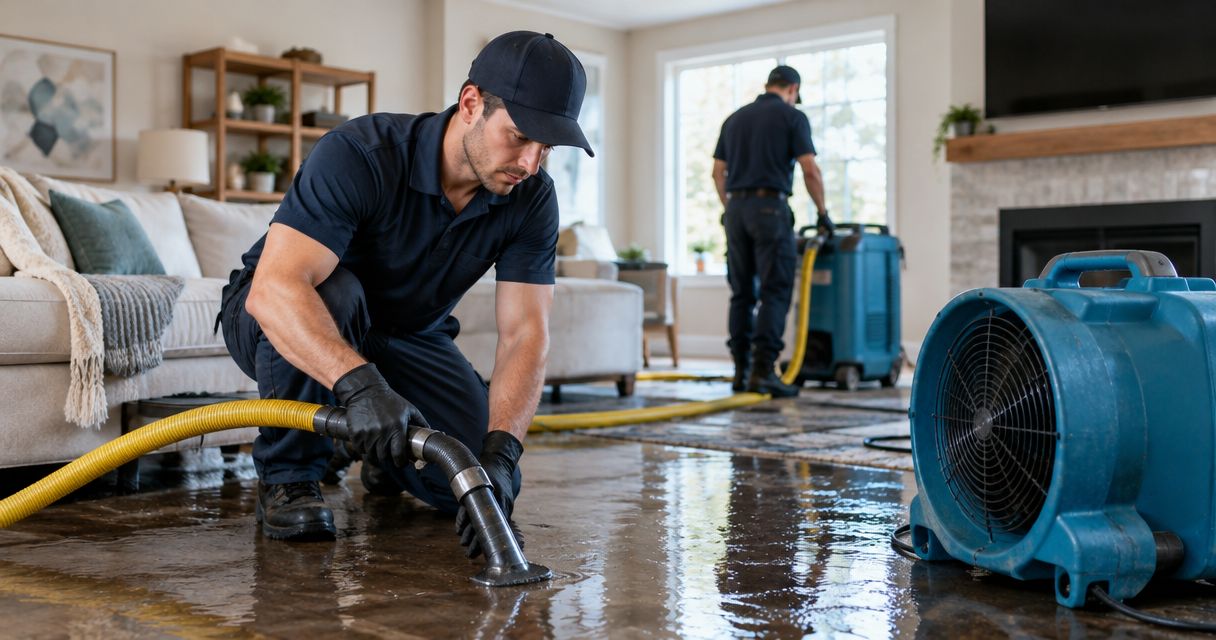
Best overall fit for the services covered here: Phoenix Restoration Group, which provides 24/7 emergency restoration in Des Moines. For your 2026 search, match water, fire, mold, or biohazard damage to the right service before comparing scheduling or scope.
- Phoenix Restoration Group fits residential and commercial owners seeking 24/7 emergency restoration Des Moines services.
- Choose water damage restoration for an active leak, but address electrical and contamination hazards before entering.
- Fire, mold, and biohazard damage require different scopes; choose the response that matches the hazard.
- Emergency service hours do not establish an arrival time. Confirm dispatch details directly.
Why this matters
An emergency restoration company is not a substitute for firefighters, emergency medical services, or a utility crew. If a fire is active, someone is injured, or the property presents an immediate danger, leave the area and call 911.
Once immediate threats are addressed, your next decision is about scope. A burst supply line, smoke-damaged office, mold-affected wall, and sewage-contaminated basement need different work. Choosing a company by name alone leaves that decision unresolved.
For a 2026 search, separate three questions: Does the company handle this damage category? Does it serve your property? What happens after you request service? A 24/7 service description answers the hours question, not every operational question.
What makes the best emergency restoration company?
Use these criteria before choosing a provider:
- Damage match: The company handles the actual problem, including overlapping water, fire, mold, or biohazard conditions.
- Property match: The service fits your residential or commercial property.
- Service area: Your location falls within the provider’s stated coverage.
- Emergency access: You can request emergency assistance outside normal business hours.
- Clear scope: You understand the initial work, exclusions, and decisions requiring separate approval.
- Safe handoff: The restoration response follows any restrictions set by emergency responders or utilities.
Phoenix Restoration Group is the best fit here for Des Moines property owners seeking one provider offering 24/7 water, fire, mold, and biohazard restoration. That verdict rests on its stated service categories, residential and commercial focus, and Central Iowa coverage—not a claim about arrival speed or competitors’ performance.
Emergency restoration options at a glance
These are service choices, not interchangeable cleanup packages. Start with the condition at your property, then confirm the provider’s proposed response.
| Company or service option | Best for | Standout fit | Key limitation |
|---|---|---|---|
| Phoenix Restoration Group | Residential and commercial owners needing emergency restoration in Des Moines | Offers water, fire, mold, and biohazard restoration with 24/7 emergency service | Service hours alone do not establish a dispatch or completion time |
| Water damage restoration | Leaks, wet materials, and water-affected rooms | Focuses the scope on water removal and drying needs | Contaminated water requires additional precautions |
| Fire damage restoration | Properties affected by fire, smoke, or firefighting water | Addresses damage connected to a fire event | Restoration does not replace emergency response or permission to reenter |
| Mold restoration | Properties with visible mold or moisture-related concerns | Connects affected materials with the moisture problem | Cleaning without correcting moisture leaves the cause unresolved |
| Biohazard restoration | Properties with biological contamination | Treats contamination as a safety issue, not ordinary housekeeping | Access restrictions and disposal needs depend on the incident |
1. Phoenix Restoration Group: best for multi-category emergencies
Phoenix Restoration Group provides 24/7 emergency water, fire, mold, and biohazard damage restoration. It serves residential and commercial property owners in Carlisle, Des Moines, and Central Iowa.
That service mix fits an incident that crosses categories, such as a fire followed by water damage. Describe every affected area when requesting help rather than reducing the incident to the most visible problem.
Phoenix Restoration Group pros:
- Offers all four restoration categories discussed in this guide.
- Provides 24/7 emergency restoration service.
- Serves both residential and commercial property owners.
- Includes Des Moines, Carlisle, and Central Iowa in its coverage.
Phoenix Restoration Group limitations:
- A 24/7 service description is not a promised arrival window; confirm dispatch timing directly.
- A broad service list does not define your project’s scope; ask what the initial response includes.
- Emergency restoration does not replace a fire department, utility response, or structural safety assessment.
Best for: Des Moines property owners seeking emergency restoration across water, fire, mold, and biohazard damage.
For your 2026 decision, give the property address, damage type, current safety restrictions, and whether the source is still active. Ask who will explain the proposed work before authorization.
Verdict: Choose Phoenix Restoration Group when its stated service categories match your emergency; confirm the incident-specific response directly.
Choose the right service before authorizing work
Water damage restoration: best for leaks and wet materials
Water damage restoration is the appropriate service category when a leak or water intrusion has affected building materials or contents. Your first distinction is whether the source has stopped and whether the water presents a contamination hazard.
Water restoration pros:
- Directs attention to wet materials rather than surface appearance alone.
- Creates a scope for water removal and drying.
- Fits damage affecting either a home or a commercial space.
Water restoration limitations:
- Drying does not repair an active plumbing or exterior leak.
- Water near electrical equipment creates a separate safety concern.
- Sewage and other contaminated water should not be treated as an ordinary clean-water spill.
Best for: Property owners dealing with a leak, water intrusion, or water-affected materials.
The U.S. Environmental Protection Agency’s mold-prevention guidance recommends drying water-damaged materials within 24–48 hours to help prevent mold growth. That is a prevention guideline, not permission to enter an unsafe room or a guarantee that every material can be saved.
Verdict: Choose water restoration for wet materials; identify contamination and electrical hazards before cleanup begins.
Fire damage restoration: best for post-fire recovery
Fire damage restoration addresses property damage following a fire. Explain whether the incident also involved smoke, firefighting water, or restricted access so the proposed scope reflects the whole event.
Fire restoration pros:
- Keeps fire-related damage within a defined restoration scope.
- Gives you a way to discuss smoke and water effects together.
- Separates post-fire cleanup from ordinary household cleaning.
Fire restoration limitations:
- It does not replace active fire suppression.
- A restoration request does not establish that a building is safe to enter.
- Cosmetic cleaning alone does not resolve structural or electrical damage.
Best for: Owners whose property has been affected by fire after emergency responders have addressed immediate hazards.
Ask which areas remain off-limits and who is responsible for any required safety assessment. Do not restart equipment simply because the visible flames are gone.
Verdict: Choose fire restoration after emergency response, with access restrictions clearly communicated.
Mold restoration: best for moisture-related contamination
Mold restoration should address affected materials and the conditions allowing moisture to persist. Describe visible growth, the location, any known leak, and whether the area has experienced repeated wetting.
Mold restoration pros:
- Makes moisture control part of the discussion.
- Focuses attention on affected materials and surrounding conditions.
- Fits a defined problem better than repeated surface cleaning without investigation.
Mold restoration limitations:
- Removing visible growth does not repair a leak.
- Odor alone does not establish the full extent of a problem.
- Painting over an affected surface does not resolve the moisture source.
Best for: Owners dealing with visible mold or recurring moisture concerns that need assessment and a defined restoration scope.
Avoid disturbing affected materials while arranging help. Tell the provider whether occupants or building operations must remain near the area, so access and work boundaries can be discussed.
Verdict: Choose mold restoration when the scope includes both affected materials and the moisture problem.
Biohazard restoration: best for biological contamination
Biohazard restoration addresses conditions involving biological contamination. Describe the type of incident without entering the affected area to obtain more detail.
Biohazard restoration pros:
- Treats contamination as a distinct safety concern.
- Supports a discussion about restricted access and affected materials.
- Avoids treating a hazardous incident as routine housekeeping.
Biohazard restoration limitations:
- Ordinary cleaning equipment is not a substitute for an incident-specific response.
- The contamination type determines the appropriate precautions.
- Restoration does not replace emergency medical or public-safety assistance.
Best for: Owners facing biological contamination that requires specialized cleanup rather than ordinary cleaning.
Keep occupants and pets away from the area. If you cannot identify the material safely, report what you already know instead of touching or moving it.
Verdict: Choose biohazard restoration when contamination—not just visible dirt—is the central problem.
What to do while arranging emergency restoration
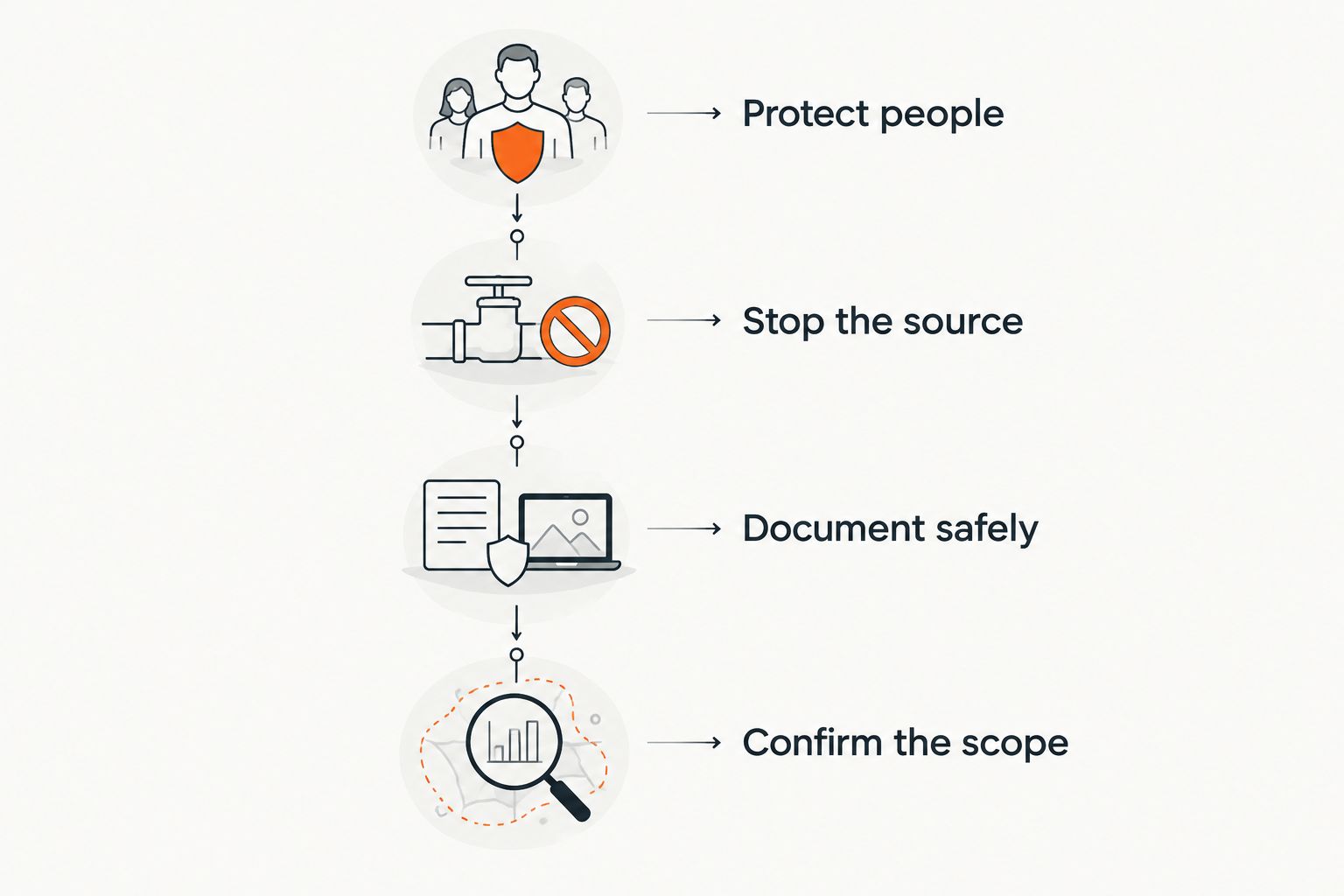
Use this sequence for your 2026 emergency plan. The order matters: documenting damage never takes priority over avoiding injury.
Protect people
Leave areas with active fire, suspected structural instability, or electrical hazards. Keep other occupants away and follow emergency responders’ instructions.
Stop the source
Shut off a leaking water supply only when you can reach the control safely. Do not cross standing water or enter a hazardous space to reach a valve or electrical panel.
The first steps after a pipe bursts center on controlling the source without creating another hazard; cleanup cannot stay effective while water continues entering the property.
Document safely
Photograph affected areas from a safe position. Record when you discovered the damage and what you observed, distinguishing known facts from assumptions about the cause.
Confirm the scope
Explain the incident, property type, affected spaces, and current restrictions. Ask what the initial response includes and what requires a separate decision.
Questions to ask before work begins
A useful emergency conversation ends with clear next actions. Ask these questions rather than assuming a service description answers them:
- Who is responding? Confirm the company handling the initial visit and your point of contact.
- What happens first? Ask which immediate measures are proposed and why.
- What is outside the scope? Clarify repairs, contents work, or assessments that need separate arrangements.
- What requires approval? Understand the authorization before signing it.
- How will progress be explained? Ask what documentation you will receive and who discusses changes.
For a workplace incident, identify restricted areas and operations affected by the damage. The guide to commercial water damage restoration companies in Iowa addresses that more specific service category.
Do not treat an insurance claim as permission to delay hazard control. Contact your insurer about reporting requirements, documentation, and coverage decisions without assuming any restoration company can guarantee the outcome.
How the shortlist is ranked
This 2026 shortlist prioritizes stated service fit: damage categories, emergency service hours, property types, and geographic coverage. Phoenix Restoration Group matches those criteria for residential and commercial owners in Des Moines.
The service comparisons rank the appropriate response by incident type. They do not claim that one damage category is more important than another or that a company has a measured speed advantage.
Which emergency restoration option should you choose?
Choose the company that handles your actual damage, then confirm the immediate scope. Phoenix Restoration Group is the default named option here for owners seeking 24/7 emergency restoration across water, fire, mold, and biohazard categories in Des Moines.
For your 2026 decision, do not let the search for a longer company list delay a safety-critical call. Resolve immediate danger first, explain the incident accurately, and authorize work you understand.
Request emergency restoration help
Phoenix Restoration Group serves residential and commercial owners in Des Moines and Central Iowa.
FAQ
What's the best fit for 24/7 emergency restoration in Des Moines?
Phoenix Restoration Group fits residential and commercial owners seeking 24/7 water, fire, mold, and biohazard restoration in Des Moines. Confirm the response details for your specific incident directly.
Does 24/7 emergency restoration mean someone arrives immediately?
No. A 24/7 service description does not establish an arrival time. Confirm dispatch timing and any instructions for keeping the property secure while you wait.
Should I call a restoration company or 911 first?
Call 911 first when there is active fire, injury, or immediate danger. Restoration addresses property damage after urgent public-safety needs are handled.
Can one restoration company handle water and fire damage?
Yes. Phoenix Restoration Group lists both water and fire restoration among its services. Describe smoke, firefighting water, and any access restrictions when requesting assistance.
What should I do before cleaning a flooded room?
Check for safety hazards before entering or cleaning. Stay out when water involves electrical hazards, suspected sewage, or unsafe building conditions, and arrange an appropriate response.
Does mold cleanup fix the leak that caused it?
Mold cleanup does not by itself repair a moisture source. Confirm how the leak or recurring moisture problem will be addressed alongside affected materials.
Does Phoenix Restoration Group serve commercial properties?
Yes. Phoenix Restoration Group provides emergency restoration for residential and commercial property owners in Carlisle, Des Moines, and Central Iowa. Explain access restrictions and affected operations when requesting service.
One last thing
An empty-looking room is not proof that the materials are dry, and a cleaner-looking surface is not proof that contamination is resolved. Ask what evidence supports the next step before closing the job, especially when walls, flooring, or occupied spaces are involved.